By Eh Saw Wah
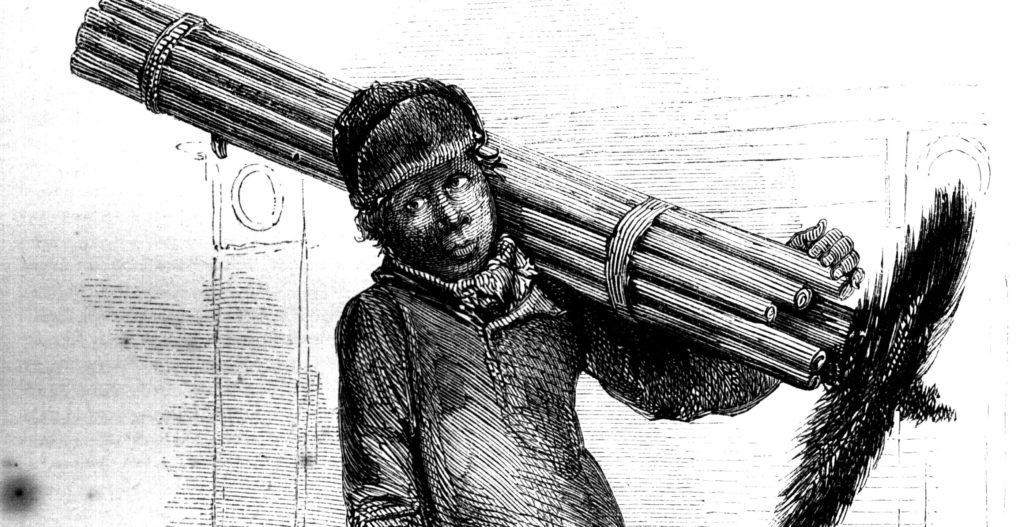
The Society for Superseding the Necessity of Climbing Boys (SSNCB) in Derby was created in May 1838 after the death of a climbing boy who suffocated in an extremely narrow chimney flue.1 Before his tragic passing, the boy experienced fear, flogging, and brutal treatment from his master. His death became a turning point for reformers and waves of activism, leading to the creation of a local society dedicated to ending the climbing boys and promoting mechanical sweeping as an alternative.
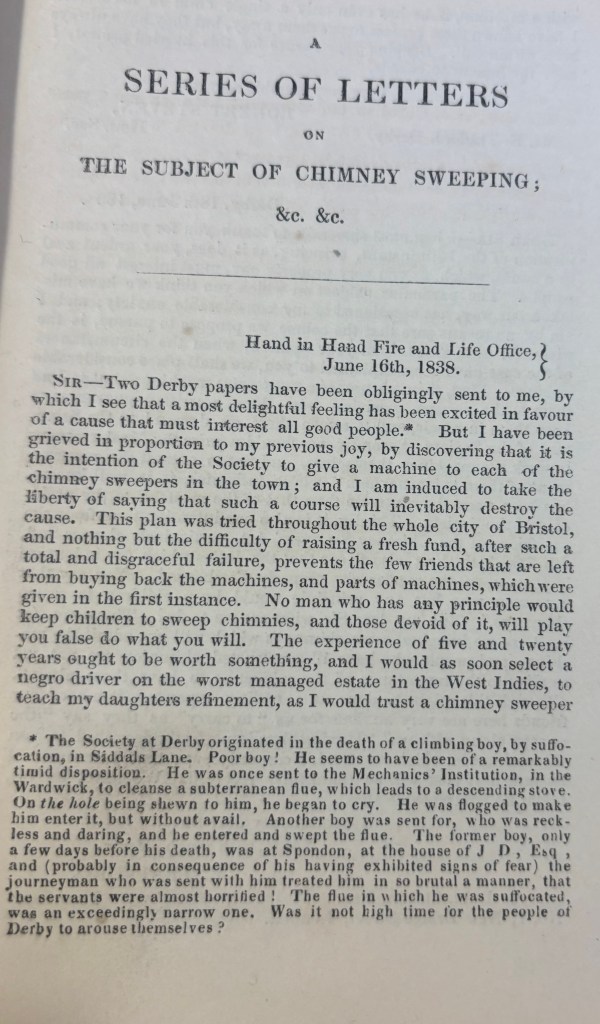
On June 16, 1838, Robert Steven, an experienced national campaigner and long time critic of the climbing boys practice, wrote to Edward Trafford, the secretary of the Derby SSNCB. In his initial letter, he warned the society against what he considered a major strategic mistake. Derby’s committee initially planned to supply sweeping machines to local chimney master sweepers in hopes of persuading them to abandon the use of children. Steven, with his 25 years of experience, argued that this approach would do more harm than good to the movement. He insisted that no master “who has any principle” would keep children if alternatives existed, and that any master willing to use children was unlikely to use a machine honestly or effectively.2 According to Steven, master sweepers occasionally sabotaged or neglected machines wherever they were introduced because they had every incentive to undermine mechanical sweeping: machines required more skill, reduced the frequency of chimney cleanings, and threatened the exclusive nature of the trade.3
Steven’s letters to Derby’s SSNCB were not just purely emotional and moral but also strategically organized. He outlined a clear strategy and approach for derby: rather than handing out mechanical machines to master sweepers, the Society should train independent agents who would rely entirely on the machines and thus have every incentive to prove their effectiveness. These agents, who were usually skilled tradesmen, like bricklayers, could offer reliable mechanical sweeping while simultaneously discrediting the old system.4 Steven also recommended canvassing households, distributing information cards, rallying public support, and preparing to defend agents against retaliation by hostile sweeps. His guidance emphasized that successful reform depended on proper coordination, planning, and the persistent shaping of public opinion.
After much thought, Derby’s SSNCB accepted Steven’s arguments. They unanimously voted to abandon their original plan and instead follow through with this recommended strategy and outline. Trafford later admitted that Steven’s warnings had prevented them from “splitting on a rock,” acknowledging the national reformer’s experience and authority.5 To justify their change of course and rally local support, the committee decided to publish Steven’s letter in the newspapers, turning private correspondence into public activism.
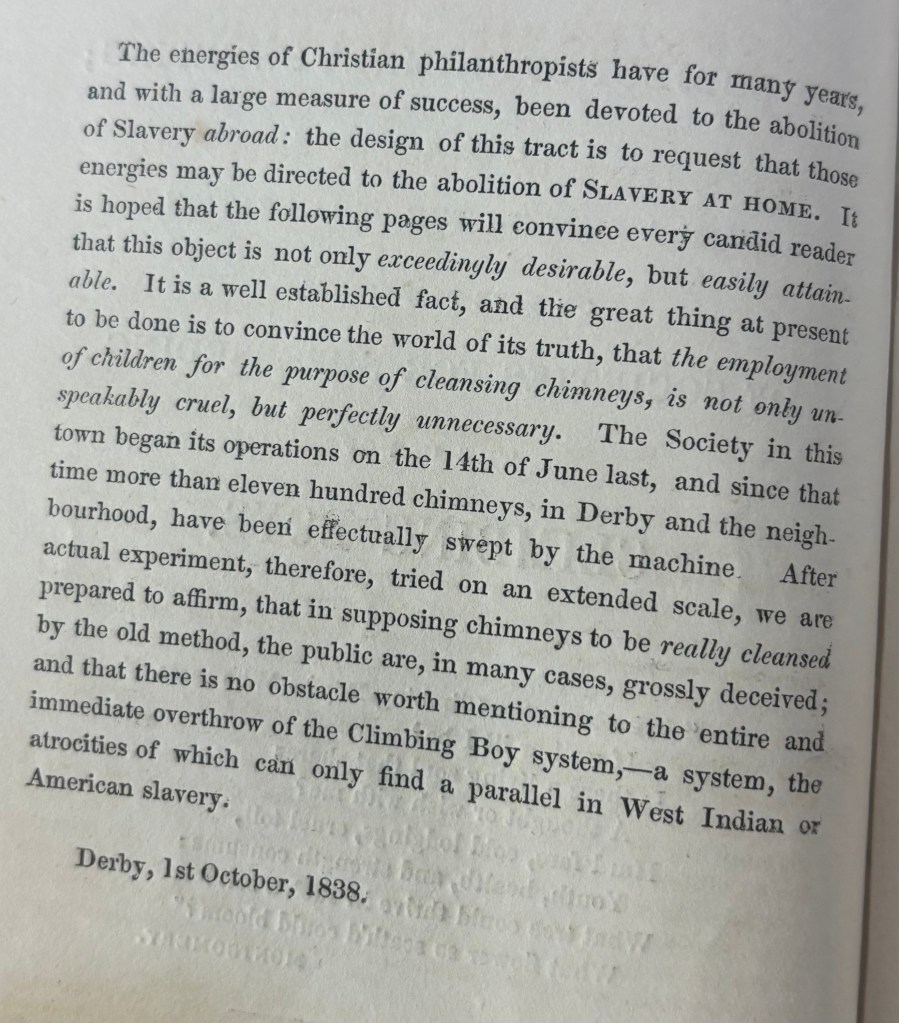
In the months following the decision made by Derby’s SSNCB, the use of emotional persuasion to appeal to the public continued. On October 1, 1838, a letter was published by W. and W. Pike discussing the abolition of the Climbing Boy system while illustrating a powerful parallel between the exploitation of the climbing boys and the slavery system in America. The letter begins by mentioning how Christian philanthropy has, for many years, “been devoted to the abolition of slavery abroad” and now the time has come to redirect this energy to the “abolition of slavery at home”. They also claimed that the “atrocities” of sending children into chimneys could “only find a parallel in West Indian or American slavery”.6 By framing the Climbing Boy system as a domestic slavery issue, the authors were hoping to continue to apply moral and emotional pressure on their audience and show that this system did not align with Christian values.
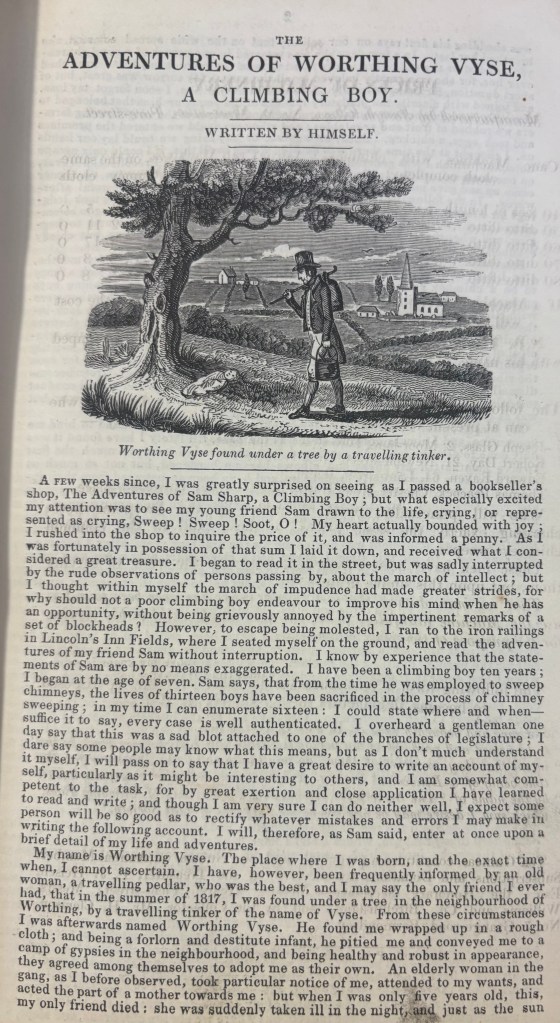
To expand on the use of emotional appeal, an “autobiography” of an individual named Worthing Vyse was written. Presented as a first-person account, the narrative contains certain contexts normal of reformist propaganda: suffering, heightened moral danger, and sentimental redemption. Vyse described himself as “a foundling…left under a tree,” framing his origins and identity around abandonment and pity from the very first line.7 He recalled how his sweeping master treated him “no better than the pigs in the sty,” and how the boys’ limbs became “raw and bleeding” from climbing hot narrow chimneys, images clearly crafted to shock readers.8 The text also warns of moral corruption, claiming the climbing boys were “ready to steal anything we could lay our hands on,” a familiar Victorian argument that physical exploitation inevitably led to crime and violence.9 Whether or not Vyse truly wrote this “autobiography”, it’s clear that the emotional tone and moral framing of this narrative is used as a persuasive tool to appeal to the emotions and morality of the audience.
The success of using emotional and moral appeal as a tactic for reform can be debated. On December 31st, 1856, the Derby Mercury reported on a new movement in the town which pushed to confront the continued employment of climbing boys in chimney sweeping, despite the prohibition from parliament. The letter had the same emotional language. The Derby Anti-Climbing Boys Association, authors of the letter, demanded an immediate response from “humane and benevolent persons” within the community and described child labor as a “system of cruel hardship towards poor friendless boys.”10 Even after nearly 2 decades, the system was still intact.
The dismantlement of the climbing boy system in Derby took well over a century, much like the rest of Britain. Despite decades of activism and push for reform from local and national organizations, legislation was slow, showing the amount of resistance there was to change this system. When the Chimney Sweepers Act of 1875 finally passed, it became illegal to employ any child as a climbing boy. The Act required all chimney sweeps to be formally registered, allowed police to prosecute those who failed to comply, and closed the loopholes that had allowed the trade to survive for so long. Only then did the lives of thousands of children were saved.
- The Derby Mercury, 23 May 1838 ↩︎
- Steven, R., & Trafford, E. (1838). “A series of letters on the subject of chimney sweeping : published with a view to the organization of safe principles, of societies for superseding the use of climbing boys.” p. 3 ↩︎
- Steven, R., & Trafford, E. (1838). “A series of letters on the subject of chimney sweeping : published with a view to the organization of safe principles, of societies for superseding the use of climbing boys.” p. 5 ↩︎
- Steven, R., & Trafford, E. (1838). “A series of letters on the subject of chimney sweeping : published with a view to the organization of safe principles, of societies for superseding the use of climbing boys.” p. 6 ↩︎
- Steven, R., & Trafford, E. (1838). “A series of letters on the subject of chimney sweeping : published with a view to the organization of safe principles, of societies for superseding the use of climbing boys.” p. 7 ↩︎
- Steven, R., & Trafford, E. (1838). “A series of letters on the subject of chimney sweeping : published with a view to the organization of safe principles, of societies for superseding the use of climbing boys.” p. 2 ↩︎
- The Adventures of Worthing Vyse, A Climbing Boy, Written by Himself, p. 1 ↩︎
- The Adventures of Worthing Vyse, A Climbing Boy, Written by Himself, p. 2 ↩︎
- The Adventures of Worthing Vyse, A Climbing Boy, Written by Himself, p. 3 ↩︎
- The Derby Mercury, 31 December 1856. ↩︎

