by Fran Comelio
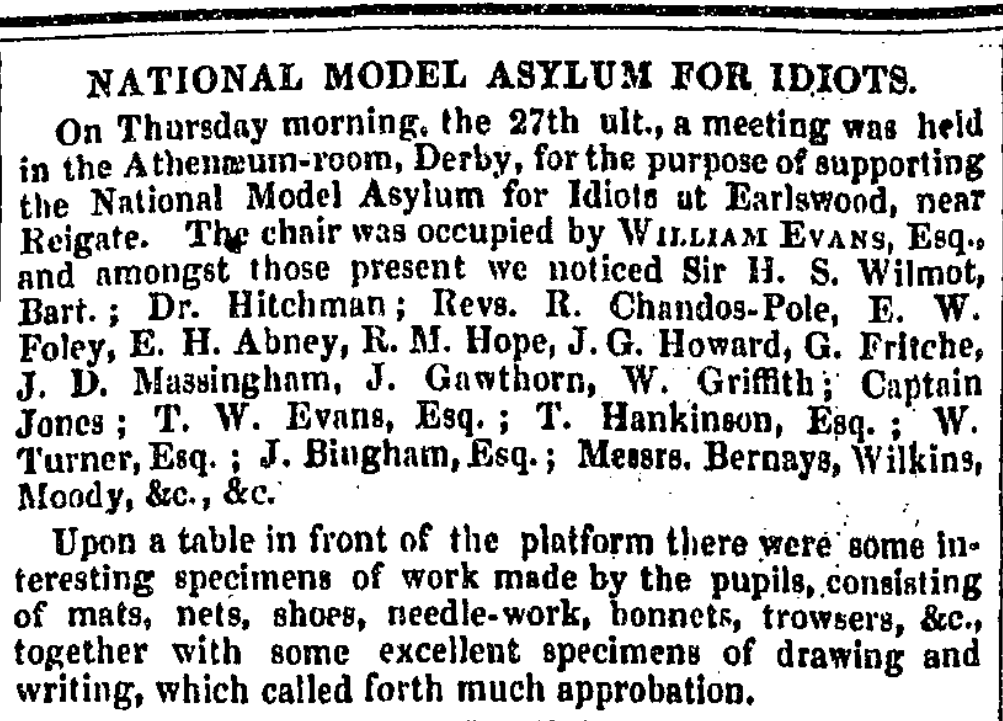
An excerpt from a column published in the Derby Mercury titled ‘The National Model Asylum for Idiots’, 1854
On 3 May 1854, the Derby Mercury published a column titled ‘The National Model Asylum for Idiots,’ reporting on a meeting held in the Athenaeum-room, Derby, that discussed and promoted the establishment of a new model asylum in Earlswood for individuals classified as ‘idiots,’ highlighting its potential for moral, domestic, and productive rehabilitation.[1]
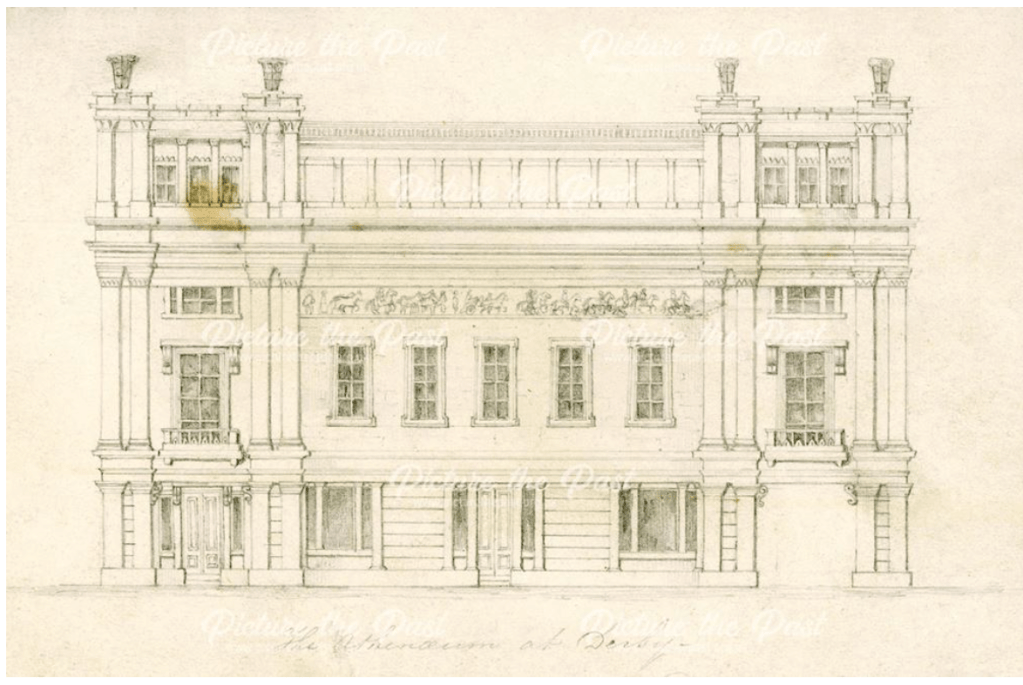
A sketch of The Athenaeum of Derby, 1838
The meeting report from the Derby Mercury Newspaper reflects the local intellectual culture of Derby as well as regional and national discussions around asylum institutions and the classification of the insane. The discussion in this specific article takes place in the Athenaeum, a building attached to the Royal Hotel in Derby, built in 1837, on the corner of Victoria Street and the Cornmarket. The Athenaeum Society, founded by Derby’s main benefactors, such as Joseph Strutt, was a space for literature, art, and scientific debate.[2][3]
This case study opens a window into mid-Victorian attitudes toward intellectual disability, philanthropy, and institutional reform. Published at a time when specialist asylums were expanding and older institutions were undergoing gradual reform across Britain, the article frames the emerging ‘model asylum for idiots’ as both a scientific achievement and a moral enterprise, celebrating it as a space where domestic routines, orderly labour, and disciplined habits could be used to reshape and regulate the intellectually disabled.[4] The establishment of the non-restraint movement within asylums across England reflected the social change in how poor and other marginalised groups could be reformed.[5] This rhetoric reflects wider Victorian narratives that linked domesticity with moral improvement, positioning the asylum as a controlled household designed to foster obedience, productivity, and respectability.[6]
For this case study, it is important to note that in Victorian medical language,‘idiots’ were regarded as having a permanent, incurable intellectual impairment from birth, whereas ‘the insane’ were seen as having lost their reason after a period of normality and were thought to have at least some possibility of recovery.[7]

Excerpt taken from The Derby Mercury, ‘The National Model Asylum for Idiots’, 1854
The article describes inmates in the model asylum as busy individuals engaged in ‘basket-making, mat-weaving, drawing, and needlework’, illustrating how domestic activities were central to this new institutional vision, which framed domestic work as a means to ‘civilise’ the intellectually disabled.[8][9] These tasks were not chosen at random; they mirrored the productive, orderly, and moralistic routines of the respectable Victorian household, where manual skill, cleanliness, patience, and regularity were seen as virtues that shaped character and functioned as markers of politeness.[10][11] Mary Poovey argues that as Victorian society began to understand poverty and incapacity in terms of the ‘social body’, where individuals were seen as interconnected parts of society, this perspective influenced asylum practices, prompting institutions to use domestic routines to regulate behaviour, instil civilisation, and enforce social control, since the failings of these individuals were now interpreted as reflecting broader societal shortcomings.[12]
The recovery of the curable, the improvement of the incurable, the comfort and happiness of all the patients, should therefore steadily be kept in view by the architect from the moment in which he commences his plan (Dr John Conolly, 1847)
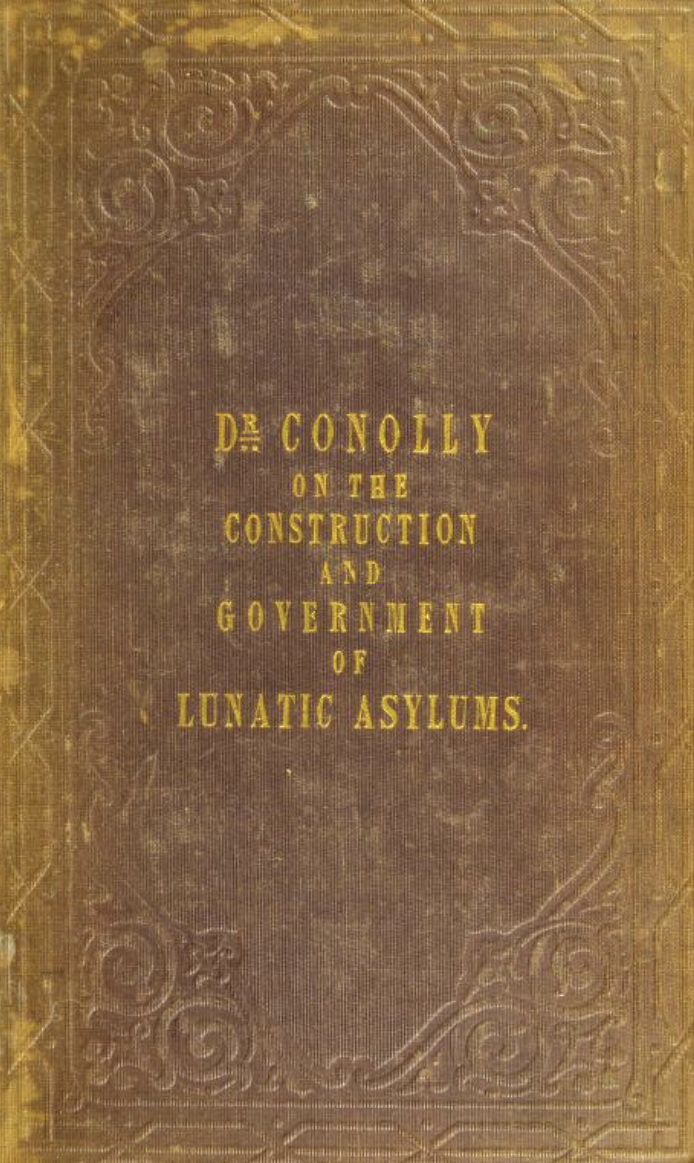
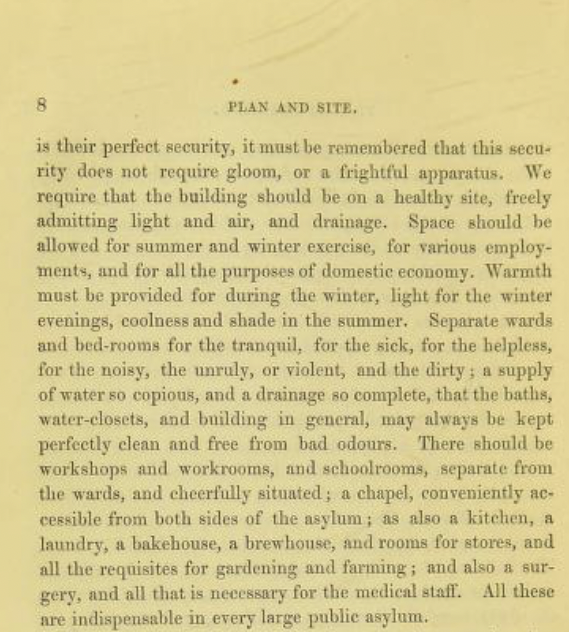
The cover (left) and a page (right) from Physician Dr Conolly’s book, ‘On The Construction And Government Of Lunatic Asylums’ (1847)
In his seminal work On The Construction And Government Of Lunatic Asylums (1847), Dr John Conolly, an advocate of a non-restraint treatment in asylums, asserted that ‘space should be allowed…for various employments and for all the purposes of domestic economy’, which presents the asylum as a benevolent, productive environment.[13] Yet beneath this rhetoric of care lie elements of surveillance and control. This mirrors the work of social commentators like Henry Mayhew, who collected detailed statistics on the lives of London’s poor, and Charles Booth, who created maps charting poverty across the city, both efforts aimed at classifying society’s ‘uncivilised’ groups.[14][15] Such initiatives reflect a broader imperial logic; the civilising mission at home and abroad, fuelled by anxieties that Englishness was eroding and that the moral heart of the empire was at risk.[16] In the asylum, the domestic routines and productive tasks that the Derby Mercury highlights were not merely therapeutic; arguably, they were a means of moral and behavioural discipline, channelling patients’ energies into orderly, socially sanctioned activity while maintaining constant observation and control.
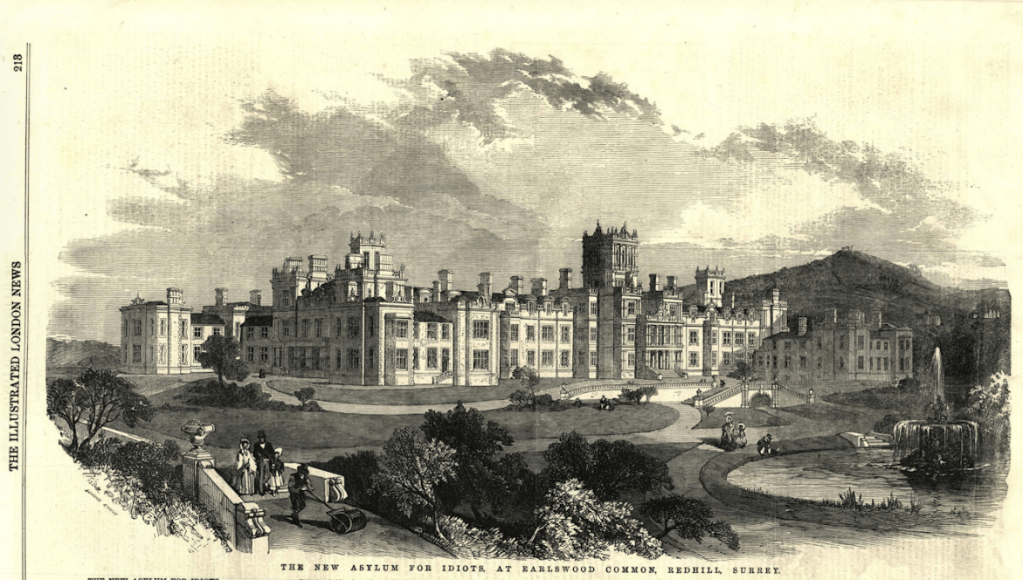
An engraving of the New Asylum for Idiots in Earlswood, Surrey from Illustrated London News (1854)
While the Derby Mercury article presents Earlswood Asylum as a model of moral and domestic rehabilitation, it is important to recognise its ideological framing. Newspapers of the period often highlighted the benevolence and achievements of institutions, potentially masking harsher realities or the lack of patient agency. Inmate perspectives are notably absent, meaning stories of recovered or improved patients may reflect middle-class domestic expectations rather than the lived experiences of the intellectually disabled. Brighton’s analysis of Victorian media in Original Spin shows that newspapers were not neutral observers but instead were often influenced by political agendas and elite interests, using moralising or sensational reporting to shape public opinion.[17] In this context, the Derby Mercury’s coverage can be seen as part of a broader media environment where portrayals of asylums served to reassure the public, justify reforms, and align social institutions with political and moral priorities, rather than provide an unmediated account of institutional life.
In conclusion, the Derby Mercury’s coverage of the New National Model Asylum for Idiots reveals Victorian attitudes toward disability, institutional reform and social order. The article presents the asylum as a moral model, using domestic labour and structured routines to care for and control inmates. The civilising narrative runs throughout the source and is not limited to this particular study, showing that Victorian asylums used domestic work to regulate behaviour, instil discipline, and render patients less ‘dangerous,’ while simultaneously framing these practices as moral and educational achievements for public approval. The absence of resident voices within the article highlights the focus on middle-class domestic ideals rather than lived experience. Together, these sources show that Victorian media portrayed asylums to instruct, reassure and control society, blending reform, morality and power in public discourse.
[1] “NATIONAL MODEL ASYLUM FOR IDIOTS.” Derby Mercury, 3 May 1854. British Library Newspapers, link-gale-com.derby.idm.oclc.org/apps/doc/BA3200012122/BNCN?u=derby&sid=bookmark-BNCN&pg=8&xid=d2abe99f. Accessed 12 November
[2] “The Athenaeum (Attached to the Royal Hotel),” Picture the Past V6 <https://picturethepast.org.uk/image-library/image-overview/poster/drby005729/posterid/drby005729.html> [accessed 4 December 2025]
[3] Elliott, Paul A, ‘The Derby Arboretum (1840): The First Specially Designed Municipal Public Park In Britain’, Midland History, 26 (2001), 144–76
[4] “NATIONAL MODEL ASYLUM FOR IDIOTS.” Derby Mercury, 3 May 1854. P8 British Library Newspapers, link-gale-com.derby.idm.oclc.org/apps/doc/BA3200012122/BNCN?u=derby&sid=bookmark-BNCN&pg=8&xid=d2abe99f. Accessed 12 November
[5] Topp, Leslie, ‘Single Rooms, Seclusion and the Non-Restraint Movement in British Asylums, 1838–1844’, Social History of Medicine : The Journal of the Society for the Social History of Medicine, 31 (2018), 754–73
[6] Hamlett, J, At Home in the Institution: Material Life in Asylums, Lodging Houses and Schools in Victorian and Edwardian England, 1st edn (London: Palgrave Macmillan, 2014)
[7] Eastoe, Stef, Idiocy, Imbecility and Insanity in Victorian Society: Caterham Asylum, 1867-1911 (Cham, Switzerland: Palgrave Macmillan, 2021)
[8] Hamlett, J, At Home in the Institution: Material Life in Asylums, Lodging Houses and Schools in Victorian and Edwardian England, 1st edn (London: Palgrave Macmillan, 2014)
[9] NATIONAL MODEL ASYLUM FOR IDIOTS.” Derby Mercury, 3 May 1854. P8 British Library Newspapers
[10] Ibid.
[11] Gilbert, William. “THE IDIOT COLONY AT CATERHAM.” Good Words, vol. 13, 1872, pp. 271-277. ProQuest, https://login.derby.idm.oclc.org/login?url=https://www.proquest.com/historical-periodicals/idiot-colony-at-caterham/docview/3304260/se-2.
[12] M. Poovey, Making a Social Body: British Cultural Formation 1830–1864 (Chicago: University of Chicago Press, 1995), pp.125–126.
[13] Dr John Conolly, The Construction and Government of Lunatic Asylums and Hospitals for the Insane (London: John Churchill, 1847), https://archive.org/details/constructionandg00conn%5Baccessed 1 December 2025]
[14] Mayhew, Henry, Victor E Neuburg, London Labour and the London Poor(Harmondsworth: Penguin, 1985)
[15] Charles Booth’s London Poverty Maps’, Geographical (London, England) (London: Savedash Enterprises, Ltd, 2020), 64
[16] Hall, Catherine, and Sonya O. Rose, eds, At Home with the Empire: Metropolitan Culture and the Imperial World, 1st edn (Cambridge: Cambridge University Press, 2006).
[17] Brighton, Paul, Original Spin : Downing Street and the Press in Victorian Britain, First edition. (London: I.B. Tauris, 2015)

