by Miles McIntosh
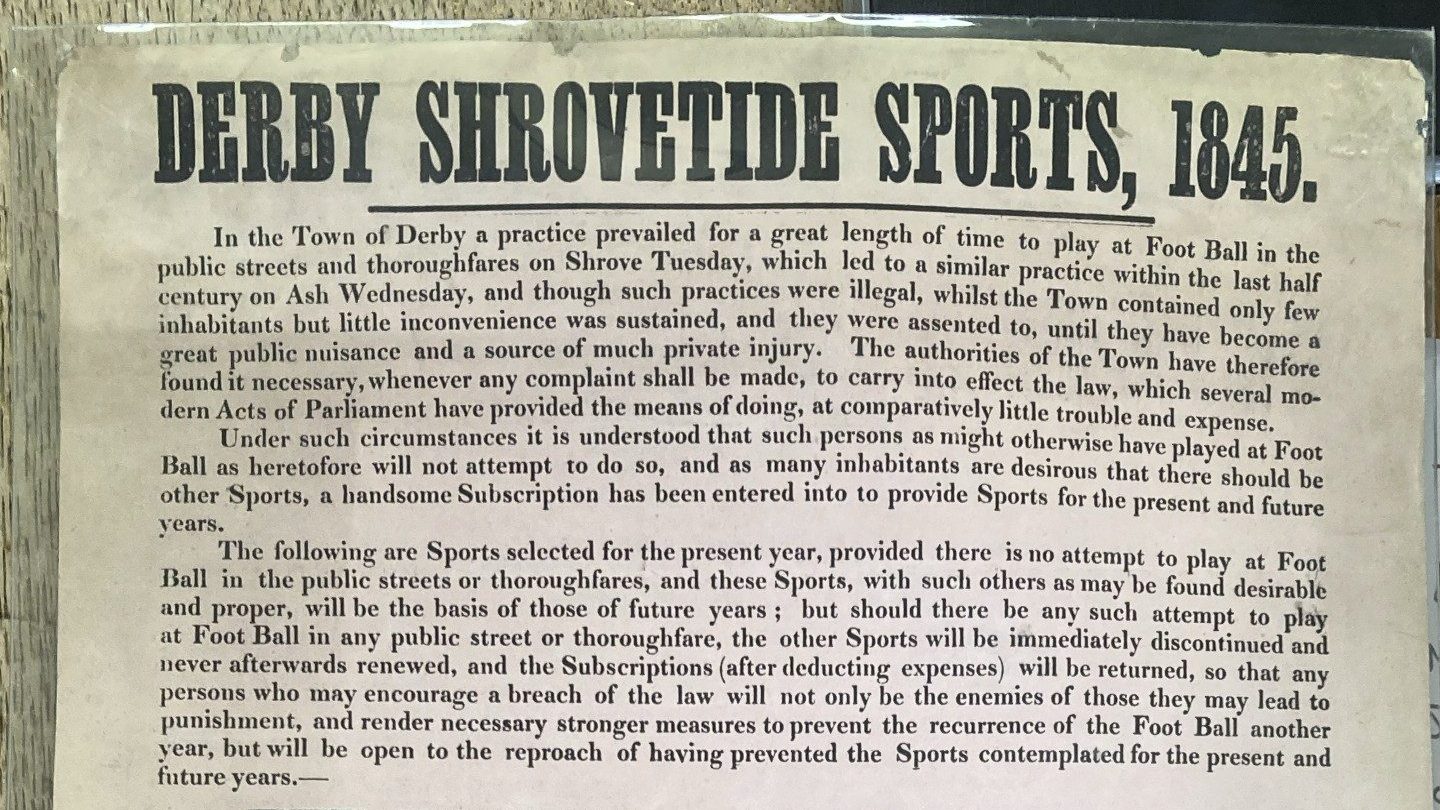
In 1845 in Derby, a poster was circulated around the town in the weeks leading up to Shrove Tuesday. The poster banned people from taking part in an activity that was the cause of “great public nuisance” and “much private injury”. The poster banned football. This short article will tell the story of the Derby government’s disastrous attempts to shut down the sport, as well as the historical and social context behind their decision.
Football has been associated with Shrove Tuesday and Ash Wednesday since the Middle Ages, football has also been banned in certain areas for the same amount of time.[1] Shrovetide football differs from modern football due to its lack of rules, and, in the case of the Derby game, its oversized ball.[2] In Derby in 1845, the evils of the Shrovetide football were equated directly with the increase in the urban population and the close proximity of bodies to one another. The Derby and Chesterfield Reporter said that “in former times, when the town contained but few inhabitants, the game was not attended with its present evils”[3]. The paper also noted the financial and social losses that the game had caused; that the “property and trade of the town had been injured in the consequence”. Visitors to the town had been confused and afraid at the sight of the game and had gone away thinking of Derby as being “one of the lowest and wickedest places in the kingdom”. Readers of the paper on that day were treated to other stories of urban degradation. The report on the “Shrovetide sports” was sandwiched between a “distressing” story about the deliberate poisoning of a “very fine and interesting” 15 year old girl, and a report on the public health of the nation:
“All attempts to save her were baffled, and she lingered in agony till Saturday night, when death put an end to her sufferings”
“In Dudley, 11 persons lost their lives from an explosion in a coal pit; at Wrexham, 5 persons were killed by an explosion of fire-damp. In the district of Oldham, 20 persons were killed by the falling of a fireproof mill.”
The central anxieties of nineteenth century urban life were represented together on this page- the destruction wrought on the bodies of industrial workers, the slow poisoning of the innocent behind closed and nameless doors by the morally degraded, and, in the case of the Shrovetide football- the mass of uncontrolled and unpredictable working class bodies that threatened the moral character of the town as well as its financial and reputational prospects. The page stressed the need for action- Shrovetide itself was subconsciously and sub textually linked with these other issues, portrayed as a symptom of the same wickedness. A more “rational recreation” was required.
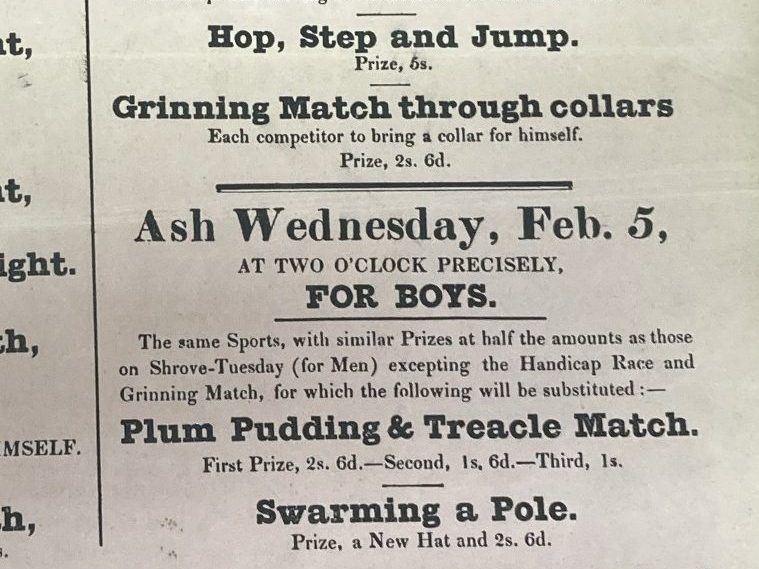
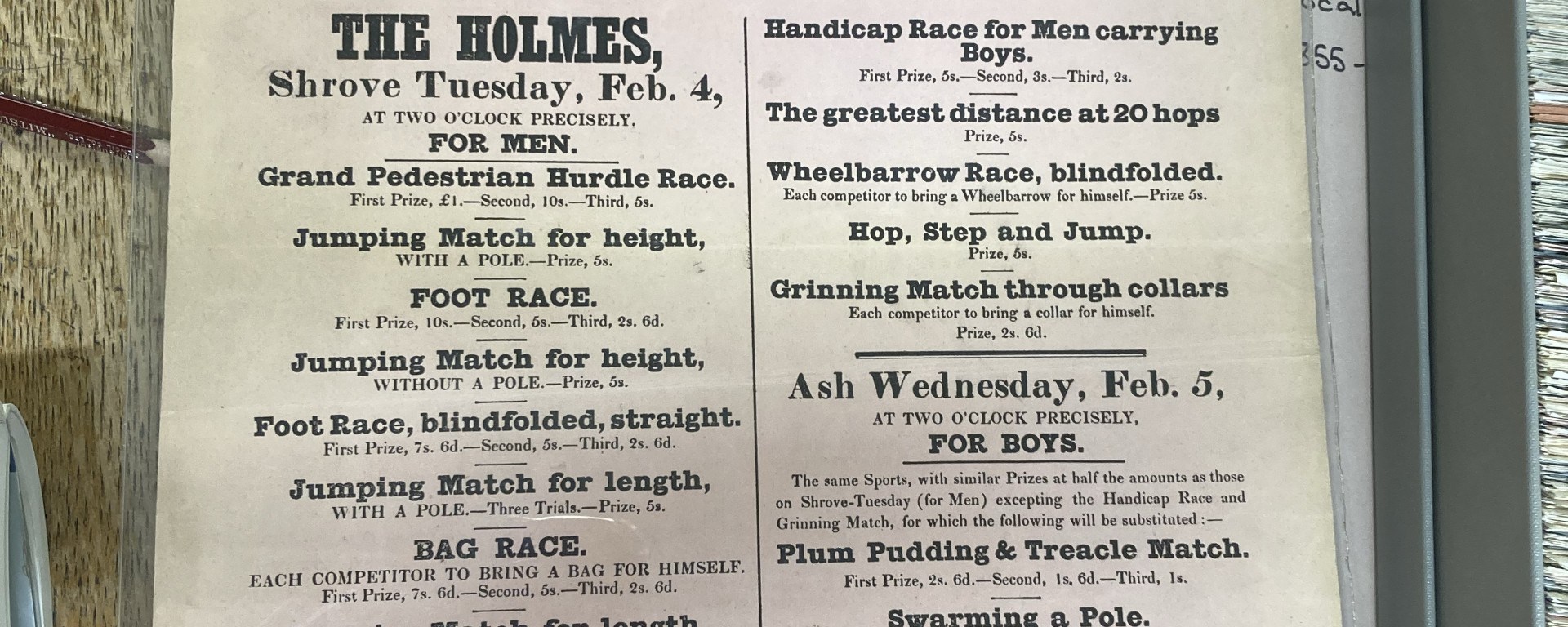
The suppression of Shrovetide football at Derby in 1845 was not the first time football had been targeted- what was new in Derby was the absolute ferocity with which the custom was supressed, the extreme lengths that both the regional and national governments went to in order to curb its popularity. At first, the mayor and his supporters made good on their promise to provide the people with more “rational recreation”. Bands were “engaged to perambulate” around the town, while banners bearing “suitable mottoes” fluttered in the wind. [4] Thousands had gathered for the new festivities, but they were not to last – the organisers found out that some people, despite the government’s efforts, were still playing football- they suddenly cancelled the event, and the assembled crowd was left to wander the streets. Thus ended the Shrovetide celebrations for 1845. They would seem a comic prelude to the events of 1846.
From the first time the “issue” of the football was raised, there were those who felt as though drastic measures should be taken to prevent it. “Had the Mayor”, began the Derby and Chesterfield Reporter “consulted the wishes of some, physical force would have been employed to supress [the game]”.[5] Before the Shrovetide celebrations of 1846, several hundred citizens were hired as special constables in order to “put down” this “irrational and disgraceful pastime”. In addition, two troops (roughly 150+ men) of dragoons were brought in to quell any social unrest that the banning of the game would incur. One ball was formally surrendered to the authorities on Monday night, one was captured during the day, it was subsequently destroyed, and one ball was in play, illegally. This game was quickly “intercepted” by the mayor and his supporters, but this imposition was soon opposed by the players: “Some ruffian threw a brick bat and bludgeon- one or both of which hit the mayor upon the shoulder”, this person was seized, and a scuffle ensued with “considerable violence”. Before long “the riot act was read and the military called out”.[6]
But why were the authorities so keen to stamp out the Shrovetide celebrations? Beyond the already stated threat to commerce and trade that the games posed, there is a subtext of bodily anxiety present in all of the anti-Shrovetide rhetoric. The suggested sports for the 1845 celebrations promised to be free from any “immorality” or “vicious excitement”- contrasted with the “manly exercise” and “social and kindly feeling” promoted by the other sports. Cricket in particular allayed these fears, the Derbyshire and Chesterfield Reporter stated that it was a sport “more conducive to health and innocent pleasure”.[7] Cricket was also seen to be more hygienic. In contrast to the rowdy game of football, which put working class bodies in close proximity to each other, while engaged in often violent lawless behaviour cricket was “a game of rules and orderly play, one in which there was no touching, and the players wore all white”[8].
There is another, more political reason for the crackdown- the sight of a great mass of working people, all cheering and shouting may have been too redolent of the social unrest of the past half century. The 1840s had been, and would be, a hotbed of working class revolution- 1842 saw a general strike across the north, the so-called “plug plot”. 1833 had also seen a lock out at Derby’s own Silk Mill.[9] Even more dramatically, the Peterloo riots, as well as the less famous, but more local, Pentrich Rising of 1817, and the public executions of its ringleaders in Derby Gaol would have been in living memory. Symbolically, socially, and hygienically, the crowd scared the middle class members of the Derby government. Even the ball itself was loaded with social symbolism- the Chartist petition of 1842 which called for increased voting rights was assembled as a large roll of paper, bearing more than three million signatures; it weighed more than three hundred kilograms[10]. All of these factors meant that the sight of a large group of working class people was a frightening thing for those that opposed the Shrovetide game, and that the image of their dispersal by armed soldiers is perhaps less comical than it first seems.
[1] Aucoin, Taylor, ‘’When the Pancake Bell Rings’ : Shrove Tuesday and the Social Efficacy of Carnival Time in Medieval and Early Modern Britain’ (ProQuest Dissertations & Theses, 2019)
[2] https://www.historic-uk.com/CultureUK/Shrovetide-Original-Derby-Game/
[3] Derby and Chesterfield Reporter, Friday, 07/02/1845
[4] Malcolmson, Robert William, ‘Popular Recreations in English Society 1700-1850’ (ProQuest Dissertations & Theses, 1970) p.255
[5] Derby and Chesterfield Reporter 07/02/1845
[6] Malcolmson, Robert William, ‘Popular Recreations in English Society’ p.255
[7] Derby and Chesterfield reporter 24/01/1845
[8] Anderson, Nancy F, The Sporting Life : Victorian Sports and Games, 1st ed. (Santa Barbara, Calif: Praeger, 2010) p.74.
[9] Kennerley, David, ‘Strikes and Singing Classes: Chartist Culture, “Rational Recreation” and the Politics of Music after 1842’, The English Historical Review, 135 (2020), 1165–94, p.1168.
[10] https://committees.parliament.uk/committee/326/petitions-committee/news/99148/the-chartist-petition-of-1842/

