by George Walker
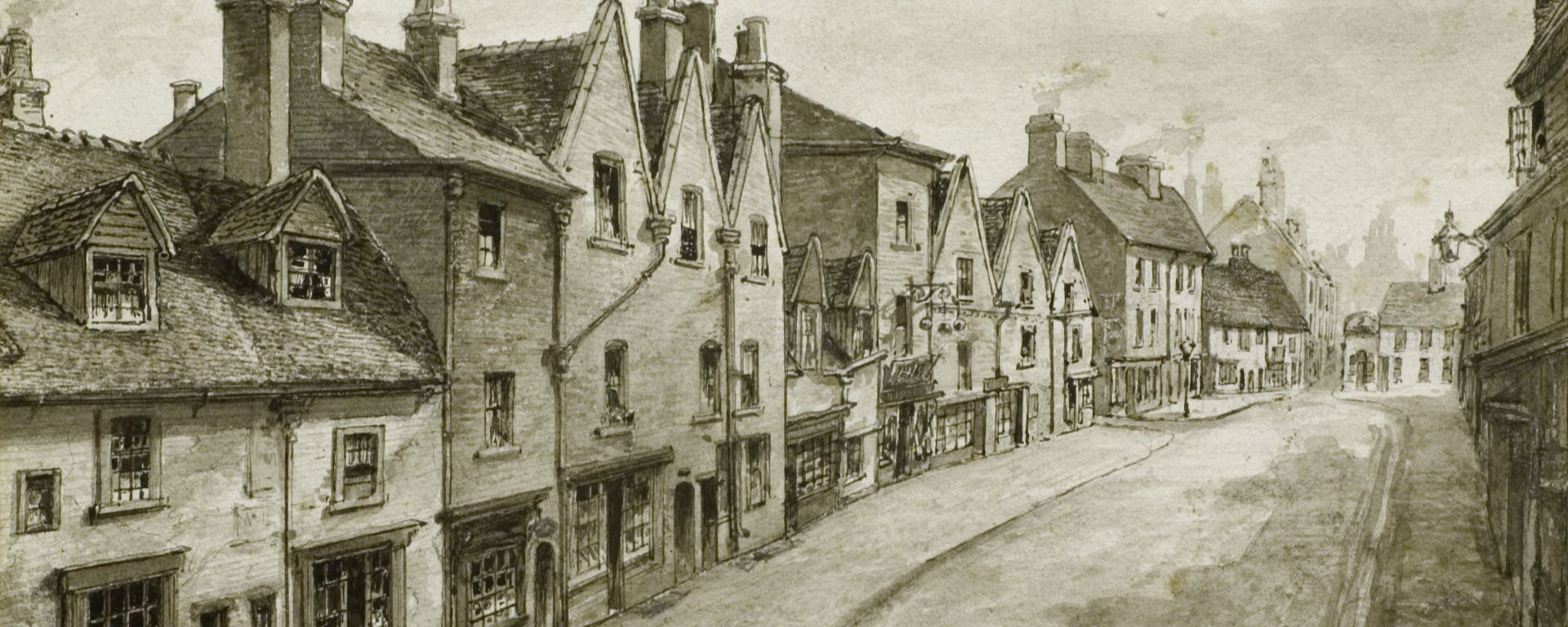
The street of Willow Row, located in the heart of Derby, looked very different during the 19th century to how it does today. The area surrounding Willow Row was a hive of activity, with street traders and, a key aspect of British culture, the public house, of which there were numerous within its vicinity. This page highlights is life and culture that surrounded the public houses located in Willow Row. These pubs were communities but also attracted crime that was part of the everyday life of Willow Row.
There were four primary public houses around Willow Row: The Old Spot, located on St Helens St, adjacent to the north of Willow Row; The Duke of Devonshire, similarly adjacent to the northeast; The Old Wheatsheaf on the corner of Willow Row and Walker Lane; and, finally, The Windmill, located on Willow Row itself (see image below). Looking at the Windmill from a micro history perspective, it would be safe to say that it had a rather turbulent and unusual existence. It is not fully known why it was in fact named the Windmill, although it would possibly be because there was one once being located nearby.[1] Despite it being nothing more than a large walkway and main entrance to student housing and Derby College now, it used to be three times its length.
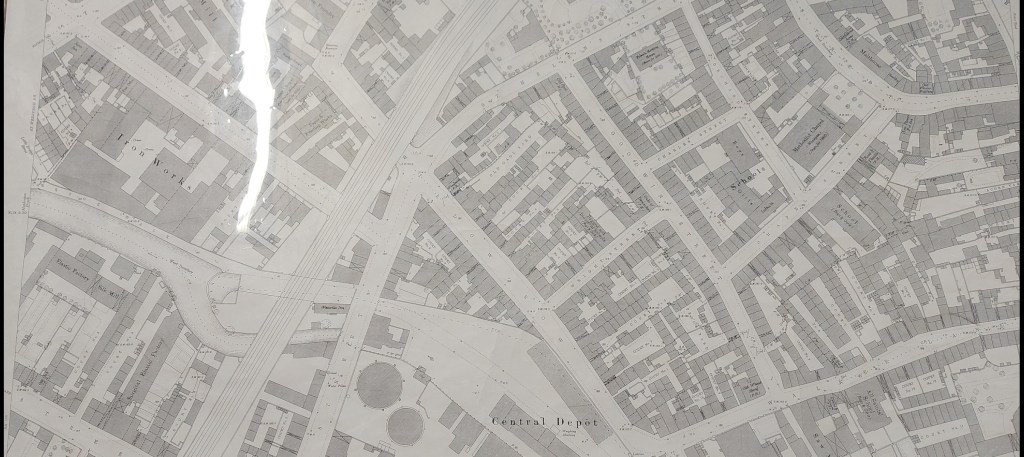
Picture of Derby map 1883, Derby Local Studies Library, Image taken by author, 2023
As for its inhabitants, the surrounding area was not exactly well known for its high society. Willow Row, as bustling as it was, did not always have the best reputation when it came to public opinion. The Derby Mercury covers this extensively, reporting on numerous different accounts of thievery and assault, a seemingly common occurrence. Willow Row, the location of the Windmill Inn public house, was conveniently or more likely inconveniently, also home to a local ‘Gaol’ (jail). For example, on the 13 July 1855, the Derby Mercury published an issue where ran with a story about a robbery in the Windmill Inn
A Thomas Percival, a labourer, was charged with stealing a shawl, a knife and a pair of scissors, the property of Eliza Yeomans, servant and the Windmill Public House.[2]
This story gives a glimpse of life in Willow Row and the problems of the so-called slums in a developing town.
Another incident surrounding the area of Willow Row highlights the shady and sometimes brutal history of the street but also its relationship with justice. Willow Row was also the location of a brutal act of murder, more specifically the murder of a woman named Eliza Morrow. Richard Thorley was found guilty of her murder and was executed. (see image below) In a confession printed by the Derby Mercury, Thorley stated that:
“I went out about 3pm and returned and put the razor in my pocket. I then went to the public house again and stopped till half past seven. I came out of the Windmill in Willow-row and saw rose Woodward across the street. I went to her and asked her to go and tell Eliza to come out”.[3]
This placed The Windmill public house at the centre of the story. However, the significance of this murder does not end there. Richard Thorley, who drank all those hours on Willow Row, became culturally significant for the people of Derby, as his execution was the last one that was available for the public to witness. From then on, they were private events.[4]
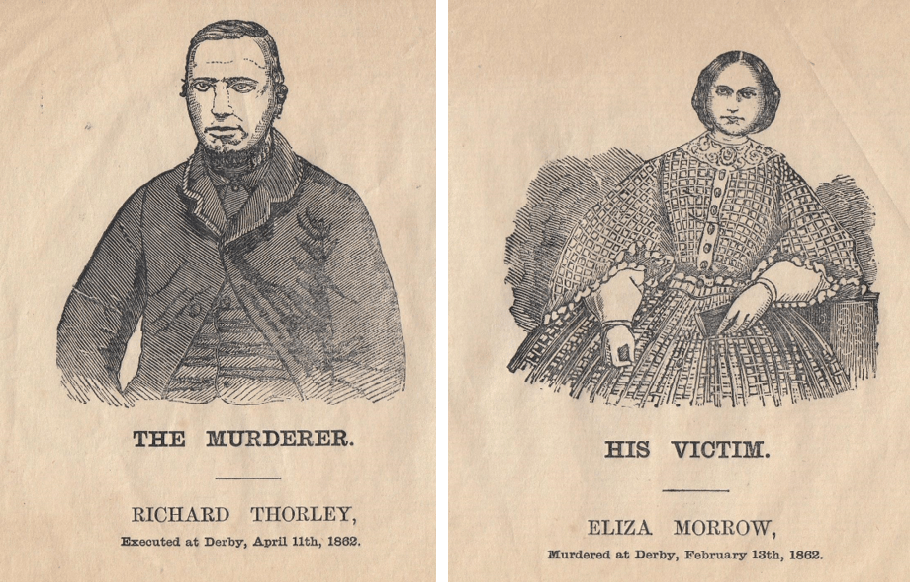
Etchings of Richard Thorley and Eliza Morrow.
However, looking at the ‘slum’ from the perspective of the public house opens up numerous ways to analyse the evolution of the society that surrounded them, and not simply as a scene of crime. For example, Nathan Booth argues in his work that the public house had a form of “hybrid status” within the community, which can be argued in the case of the Windmill Inn and Willow Row.[5] He argues that the importance of the pub and the publican and the pressure surrounding it did not go unnoticed which he highlights with a quotation from The Protector newspaper.
“He is bound to open his doors to meet certain emergencies of accident or travel”.[6]
To conclude, the relationship between Willow Row and the public house was a complex one, not only about crime but clearly at the centre of a network of criminal activity and deprivation.
[1] Craven, M, The Illustrated History of Derby’s Pubs (Breedon, 2002) pp. 60, 142, 159, 165
[2] Anon, ‘Police Office Derby’, Derby Mercury, Wednesday 18 July 1855, issue 3325, pp 5
[3] Anon, ‘The Execution of Richard Thorley’, Derby Mercury, Wednesday April 16 1862, issue 6785, p. 2
[4] Dimmer, S, ‘Every execution that’s taken place in Derbyshire since the 1800s’, 26 December 2019, available online: https://www.derbytelegraph.co.uk/news/derby-news/people-executed-derbyshire-crimes-were-2343629″>https://www.derbytelegraph.co.uk/news/derby-news/people-executed-derbyshire-crimes-were-2343629 , Date accessed 15/12/23.</p>
[5] Booth, N, ‘Drinking and Domesticity: The Materiality of the Mid-Nineteenth-Century Provincial Pub, Journal of Victorian Culture, 23: 3 (2018), p. 294,
[6] Booth, ‘Drinking and Domesticity’, p. 298
 Derby's Dark Corners