Water supply and management in the 19th century was a complex and delicate issue in which many governments and outsiders held strong opinions. The topic can be discussed widely through the lens of many different eyes. Indeed, the management of water can be investigated thoroughly through a closer inspection of the inner workings of the fire brigade and the conservation of responsibility and recognition being had there[1]. Newspaper articles recalling town council meetings are the primary sources used to facilitate these discussions, as they portray the management and opinions of the people of Derby and their fire brigade.
Firstly, it must be acknowledged that newspaper sources only show a partial picture of the reality. For example, while plenty of articles portray the conversations that took place between the council and the insurance companies, they lack any mention of the resident voice and relationship with the fire brigade. Henceforth in terms of water management there is a clear missing piece to the puzzle, the relationship between the classes and the fire brigade. Yet that does not discount the conversations that were published by the newspapers of the time are valuable to the conversations, as they are able to provide a clear narrative on water management.
Igniting the spark
Prior to 1849, fire services in the UK were spilt in authority over parish authorities, insurance companies and volunteers[2]. This meant that the supply of water and resources needed to fight these fires was the responsibility of this spilt authority, making decisions much more difficult. Moreover, there was a clear lack of rules and guidelines for the most effective ways to plan out fire service operations, which in turn meant unnecessary risks were taken by those fighting the fires[3]. For Derby in particular, in the fire service was erected in 1839 and run by the council[4]. Therefore, Derby was able to have conversations surrounding organisation in a much more adequate way than most other towns at the time.
Putting a name to the face
The men working in the fire service in Derby by 1849 were organised and paid for by the council’s insurance companies[5]. This meant that effectively their role in society was determined by the management decisions from the council. This can be seen most effectively in the application for a new fire engine in December 1939.
“The committee applied to the insurance Companies who had effected insurance policies in Derby to contribute towards the expenses”
TO THE INHABITANTS OF DERBY. Derby Mercury (1839)
The fire service then, heavily depended on both the council, to apply for these grants, and to the insurance companies to give the grants. Henceforth the roles of fire service men were reduced significantly from contemporary standards. Water supply then would surely come down to the responsibility of either key players: councils or insurance companies.
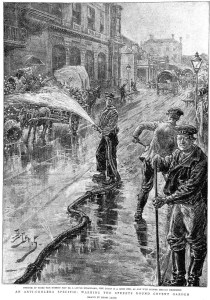
To further complicate matter, in many areas, such as Derby, fire men were put in the position of reforming the streets as well as fighting fires. As seen in the source below in London, fire plugs were used to fight of Cholera and clean the streets. Indeed, as the town council was responsible for keeping the town clean, the instillation of fire plugs and the work of fire volunteers also coincided with washing the street to prevent disease and uncleanliness in the slums[6]. This would imply that the water resources stocked up by the service had a plethora of uses. Making the management of them and their upkeep of vital importance to the community.
Supply and demand
Conversations surrounding water management in particular, were difficult due to the defining state of responsibility. That is to say that fire plugs were built into public infrastructure, making erecting, and maintaining them an infrastructural job and certainly not the job of the fire service. Yet these plugs are for the use of the fire service and there for their needs, hence it’s their responsibility to maintain them. This would be clarified in the Fire service act of 1945 but until then the argument raged[7]. The building of fire plugs was also heavily dependent on the supply and flow of water. As can be seen in many newspaper articles of the time, Derby struggled to supply a sufficient amount of water for the fire services[8]. Once again, this sparked arguments over who was responsible for this supply.
“Most desirable that the council should undertake to provide a proper quantity, which, by the extension of their water works, they were better enabled to do so, and cheaper, than could any private company”
DERBY TOWN COUNCIL. Derby Mercury (1839)
Final thoughts
As a case study, the story of the beginnings of the fire brigade can tell historians a lot regarding the state of water management in the slums. Mainly the role of the council and funding. The council were essential in the organisation of the fire bridge and the positioning of the fire plugs and resources to help enable their services. However, it is also important to note that the main benefactors behind the fire brigade and the organisational work done by the council was sue to insurance companies. In terms of water management, this is a tale of responsibility and blame.
[1] Young, C F T., Fires, Fire Engines, and Fire Brigades (London: Lockwood & Co: 1866)
[2] Ewen, S. Fighting Fires: Creating the British Fire Service, 1800–1978. (Basingstoke: Palgrave Macmillan: 2009). p. 125
[3] Ewen, S., ‘The internalization of fire protection: in pursuit of municipal network in Edwardian Birmingham’. Urban history 32.5 (2005): p288-307
[4] DERBY TOWN COUNCIL. Derby Mercury (1839)
[5] Landers, J. ‘In the Early 19th Century, Firefighters Fought Fires … and Each Other’. (2016). Available online: https://www.smithsonianmag.com/smithsonian-institution/early-19-century-firefighters-fought-fires-each-other-180960391/ Date accessed 12/01/2023
[6] Mowat, S. “Cleaning Up Victorian Dunfermline” Dunfermline Historical Society (2023) Available from: Cleaning Up Victorian Dunfermline – Dunfermline Historical Society (dunfermlinehistsoc.org.uk) . Date accessed 18/01/23
[7] Fire service Act 1947 (11 Geo 6, c41) [online] https://www.legislation.gov.uk/ukpga/Geo6/10-11/41/section/14/1991-02-01 [accessed 12/01/2023]
[8] DERBY TOWN COUNCIL. Derby Mercury (1839)
 Derby's Dark Corners