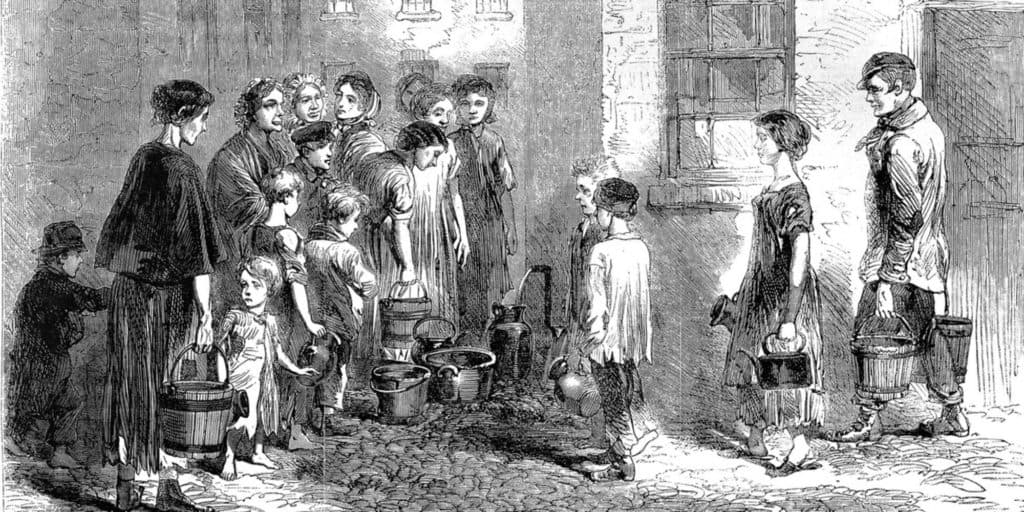
Welcome to Waste, water and water supply web page representing local history within Derby Victorian slums.
Water is one of the most essential parts of society, with regards to both consumption and cleaning. Within Victorian society, the inadequacy of the water supply ultimately had a negative impact on working-class manufacturing towns, such as Derby. This can be seen through health complications, such as cholera and dirtiness was seen as a crime.[1] This is because cleanliness is next to Godliness. [2]
Within Victorian England, local government developed through a transitional period, during which the idea of water supply should be part of the Government rather than the interest groups or company’s responsibilities. This is because the issues of the local government constituents had a negative impact due to the problems of water supply.[3] This can be seen through the cholera outbreak years, including 1848 and 1849 in Derby.
This section will analyse the issues that haunted the Derby Borough, using an enquiry from 1849 from the General Board of Health. Analysing the problematic issues that faced the working-class people of Derby. During the Nineteenth century, cholera and many other diseases impacted the lives of the nation’s people, and this was due to the issues within the water system itself. This section will demonstrate the link between water and disease in Victorian society and the lack of organisation by the local government of Derby.
Then using a written source from the architect W. Wigginton, it will be shown that the issues within Victorian Derby had solutions. As Wigginton explains, the solutions and the importance of water for working-class health. However, while there were solutions, there was no execution within the Victorian Derby, especially in the middle of the 19th century. Using the architectural source and the ideas of the local and national government, it will be explained why there were no executions within Victorian Derby.
These issues will then also be explored through documentation published by Derby’s local government to assess the change in understanding concerning waste, water and water supply in the late nineteenth-century. As well as the change surrounding the government’s role in the management of water. Through government documentation as well as city records, this section will look at: why the role of the government changed, the reality of their proposals, and why, while their solutions had both merit and scientific plausibility, they lacked a fundamental understanding of life within the slums.
The final section will use the fire brigade as a case study into local government’s management of water supply. The creation of the fire brigade and the evolution of its development is a perfect example of the points made by the previous sections surrounding responsibility and water supply. Here a string of Newspaper entries surrounding local council meetings and discussions of the fire brigades’ budget are used to facilitate this dialogue, giving both a voice to the governmental workers of derby and the reality of the slums.
Throughout the analysis of sources on this page, themes such as local government and responsibility, as well as class and water management are discussed. While each section combats these themes from different angles, there are threads of similarity present, in which the wider concept water and waste management in the slum can be defined.
[1] Freeland, N. “The Politics of Dirt in ‘Mary Barton’ and ‘Ruth.’” Studies in English literature, 1500-1900, 42: 4 (2002), pp. 804
[2] Hope, D., ‘My District and How I Visit It’, Girl’s Own Paper, 23 October 1880
[3] Wigginton, W., Sanitary reform: model town dwellings for the industrious classes, 1850, pp. 36; Hassan, J., Taylor, P., “The politics of water in early and mid-Victorian Britain: the experience of Bolton”, The Historic society of Lancashire and Cheshire, vol 148 (1998), pp. 119
 Derby's Dark Corners