Food Adulteration has been defined as the “fraudulent, intentional substitution or addition of a substance in a product” by increasing the supposed worth of the product or decreasing production costs to increase profit.[1]
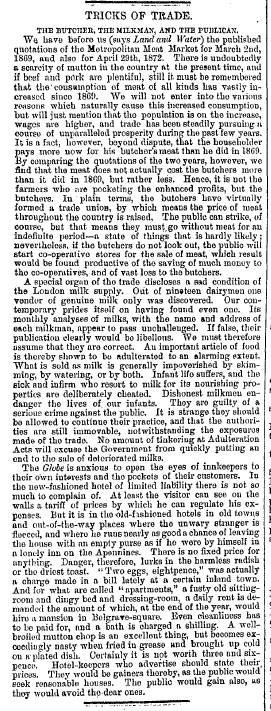
Food adulteration in nineteenth-century England was becoming more common at the expense of people’s lives. It is important to note that the food adulteration of the modern age is not generally a risk to a person’s life or physical health unlike in the nineteenth to the early twentieth century. According to ‘Tricks of the Trade’, an 1872 Derby Mercury article, meat has become more expensive, and this money is going into the butcher’s pocket. Milk was also being adulterated at an alarming rate with the Mercury article claiming to have only found one genuine milk seller out of nineteen.[2] ‘Tricks of the Trade’ is an example of the prevalence of public health concerns in the nineteenth century. In many cases, adulterous food was considered an “act of fraud” and this “network of food scares” helped to develop the food laws of Britain.[3]
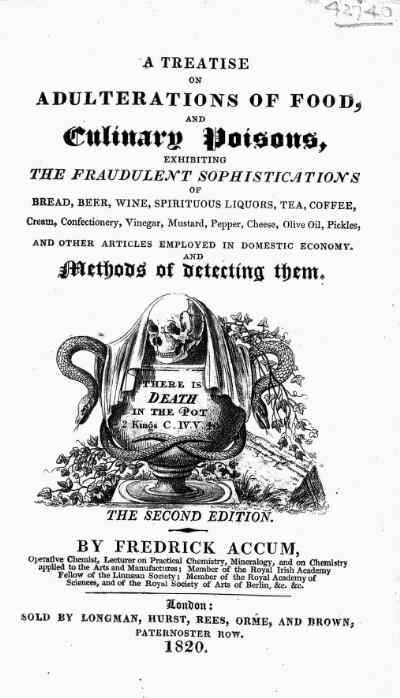
Chemist Frederick Accum in his 1820 book ‘A Treatise on Adulterations of Food and Culinary Poisons’ was one of the first to tackle the problem of food adulteration and its seriousness. He was especially concerned for the welfare of children who were much more susceptible to illness from sweet treats such as jellies. Frederick Accum publicised the names of numerous merchants that sold adulterated food and although Accum’s work did not lead to any immediate legislative changes, it has been hailed as the start of the “anti-adulteration movement”.[4]
Public health was a growing concern in the nineteenth and early twentieth century. The Derby Mercury considered it a “serious crime against the public”.[5] The fear of diseased meat in the eighteenth century had developed because of the growing number of incidents involving diseased and contagious meat and adulterated foodstuffs.[6] Of course, the urban poor would be most affected by the unsympathetic attitude displayed by the government. The quality of food eaten by the urban poor was attracting attention for its lack of nutrition and danger to health.[7] Fears of the urban poor diet were linked to fears of public health. If it affects the poor, it affects the rich.
“Producers and shopkeepers adulterate all foodstuffs in a disgraceful manner, with a disregard for the health of the consumer”.[8]
Frederick Engels
With the lack of government support and legislation, local authorities lacked the power to intervene in food safety and hygiene issues.[9] This reluctance to properly address public health fears was due to the idea of the “free trade mentality”.[10] James Kay’s liberal suggestion of removing any hindrance to the freedom of trade also didn’t help. However, notions of respectability began to affect this especially as consumers demanded “pure food”.[11] A previous Adulteration of Coffee Act in 1718 placed the loss of revenue before the health of the consumer and the impact on “honest” traders which only magnifies the lack of government intervention in public health risks due to economic gain.[12]
The incorporation of meat into the classic British diet had become more prevalent as meat developed a cultural significance as part of the national diet and was linked to class and gender distinctions. Harris noted a ‘Breadwinner effect’, in which the male members of the household “traditionally” received more meat.[13] Being able to afford meat or rather more meat showed the level of income a family lived by. However, diseased meat dismantled this, and public health risks showed a lack of class distinction. This means that with such a strong emphasis on its inclusion, the lack of food safety legislation on the importance of foodstuffs and contaminated food became more prevalent especially due to the 1858 Bradford Sweets Poisoning which led to the development of the 1860 Adulteration of Food and Drink Act. Before this Adulteration Act passed, at least nine other Bills were introduced but ultimately failed.[14]
“The man who robs a fellow subject of a few shillings on the highway is sentenced to death but he who distributes a slow poison to the whole community escapes unpunished”.[15]
Frederick Accum
Diseased meat had become almost “synonymous” with tuberculosis meat in the late 1880s and Robert Koch’s claim that the disease could be spread from animal to human only heightened the growing fears. Government attempts at solving this crisis led to the 1875 Public Health Act although implementation was rather patchy.[16] This may have been in part due to a shift in focus towards adulterated milk. Public fears about the lack of regulated milk led to the Derby Mercury claiming, “dishonest milkmen endanger the lives of our infants” and according to Keir Waddington, “dirty and infected milk was blamed for corrupting the health of British children”.[17] Eventual amendments to the Sale of Food and Drugs Act in 1879 and 1899 gave legislative reach to most consumable products and clarified much of the confusion of the local government’s ability to intervene.[18]
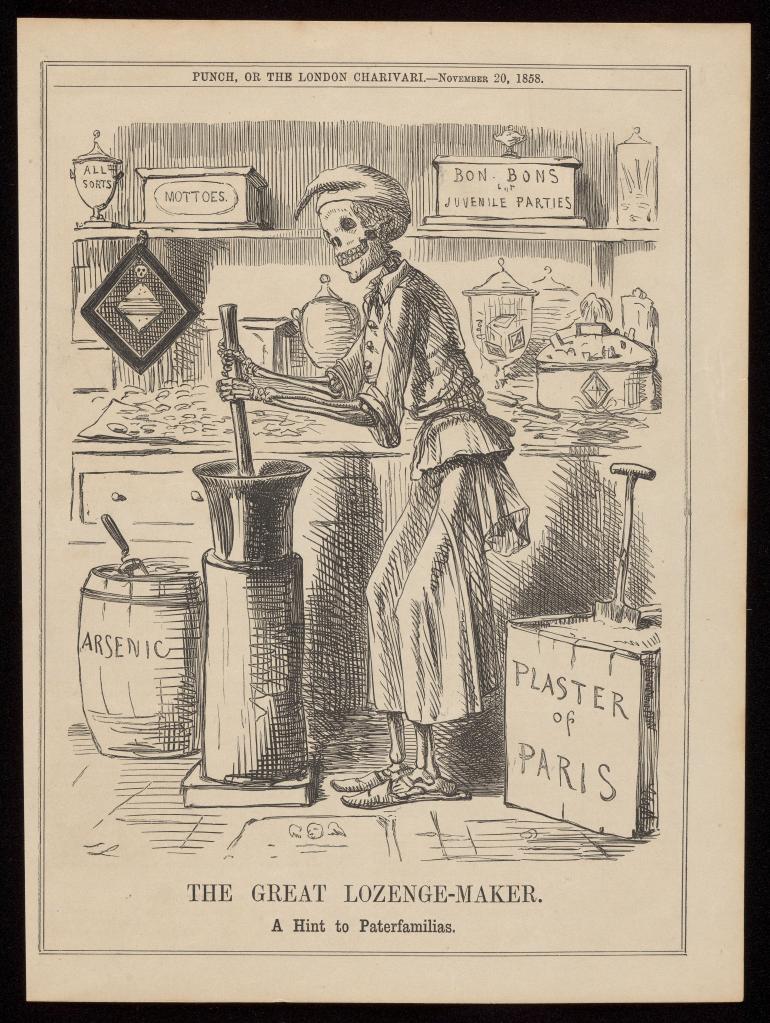
‘Death as a Lethal Confectioner’ illustrates the 1858 Bradford Sweets Poisoning and links it directly to the introduction of the “privately sponsored” 1860 Adulteration of Food and Drink Act which the Derby Mercury argued was not enough to solve the growing concerns surrounding public health and safety.[19] It later developed into the more standardised food safety legislation we have today and is helpful in showing the influence of major food adulteration scandals on societal views of food regulation and its eventual impact on the legally permitted use of food substitutes. This ‘Lethal Confectioner Making up Sweets’ paints a picture of the view of loss in relation to food regulation and further supports the notions put forward in ‘Tricks of the Trade’ as it represents the public opinion on the impact of adulterated, unwholesome food on public health.
[1] Rioux, Sebastien, ‘Capitalist food production and the rise of legal adulteration: Regulating food standards in 19th-century Britain’, Journal of Agrarian Change 19 (2019), p. 64-65
[2] “TRICKS OF THE TRADE.” Derby Mercury. 15 May 1875. British Library, Tricks of the Trade Accessed 21 Dec. 2022
[3] Richards, Edgar, ‘Legislation on Food Adulteration’, Science 16.394 (1890), p. 102; Waddington, Keir, ‘”Dead Meat” Dramas: Diseased Meat and the Public Health’, History Compass 1.44 (2003), p. 1
[4] London, Jillian, ‘Tragedy, Transformation, and Triumph: Comparing the Factors and Forces that Led to the Adoption of the 1860 Adulteration Act in England and the 1906 Pure Food and Drug Act in the United States’, Food and Drug Law Journal 69.2 (2014), p. 318; Hart, F. Leslie, ‘A History of the Adulteration of Food Before 1906’, Food, Drug, Cosmetic Law Journal 7.1 (1952), p. 14
[5] “TRICKS OF THE TRADE.” Derby Mercury. 15 May 1875. British Library, Tricks of the Trade Accessed 21 Dec. 2022
[6] Waddington, Keir, ‘”Dead Meat” Dramas: Diseased Meat and the Public Health’, History Compass 1.44 (2003), p. 2
[7] Otter, Chris, ‘The vital city: public analysis, dairies and slaughterhouses in nineteenth-century Britain’, Cultural Geographies 13.4 (2006), p. 518
[8] Collins, EJ. T., ‘Food adulteration and food safety in Britain in the 19th and early 20th centuries’, Food Policy 18.2 (1993), p. 95
[9] Collins, ‘Food adulteration and food safety’, p. 96
[10] Atkins, P. J., ‘Sophistication Detected: Or, the Adulteration of the Milk Supply, 1850-1914’, Social History 16.3 (1991), p. 318
[11] Atkins, ‘Sophistication Detected’, p. 319
[12] Gallagher, Maree And Ian Thomas, ‘Food Fraud: The deliberate Adulteration and Misdescription of Foodstuffs’, European Food and Feed Law Review 5.6 (2010), p. 348
[13] Waddington, ‘”Dead Meat” Dramas’, p. 2
[14] London, ‘Tragedy, Transformation, and Triumph’, p. 321
[15] Gallagher, ‘Food Fraud’, p. 348
[16] Waddington, ‘”Dead Meat” Dramas’, p. 3-4
[17] “TRICKS OF THE TRADE.” Derby Mercury. 15 May 1875. British Library, Tricks of the Trade Accessed 21 Dec. 2022; Waddington, ‘”Dead Meat” Dramas’, p. 4
[18] Otter, ‘The vital city’, p. 522
[19] Atkins, ‘Sophistication Detected’, p. 319
 Derby's Dark Corners