Evie Smith.
The years roughly between 1880 and 1910 marked a seminal period in the history of undertaking, a period when undertakers rose to economic prominence and began a beleaguered grasp for social power
Scandura, Jani. 1996. “Deadly Professions: ‘Dracula,’ Undertakers, and the Embalmed Corpse,” Victorian Studies, 40.1: pp 2
The source portrays the Wathall family funeral business which occurred in 1858, before this the Wathall family were cabinet makers and furniture broking.[1] They expanded into funeral care with the increase of commercialisation of death and opportunity for profit. As seen in the source, undertakers were responsible for the creation of coffins amongst other tasks they took on to conduct a burial for a person. Their existing skills were transferable in the occupation of death and burials. With the increasing financial value of death during this time, they began to ‘undertake’ more roles of the process such as corpse preparation and transportation services hence the profession title Undertakers
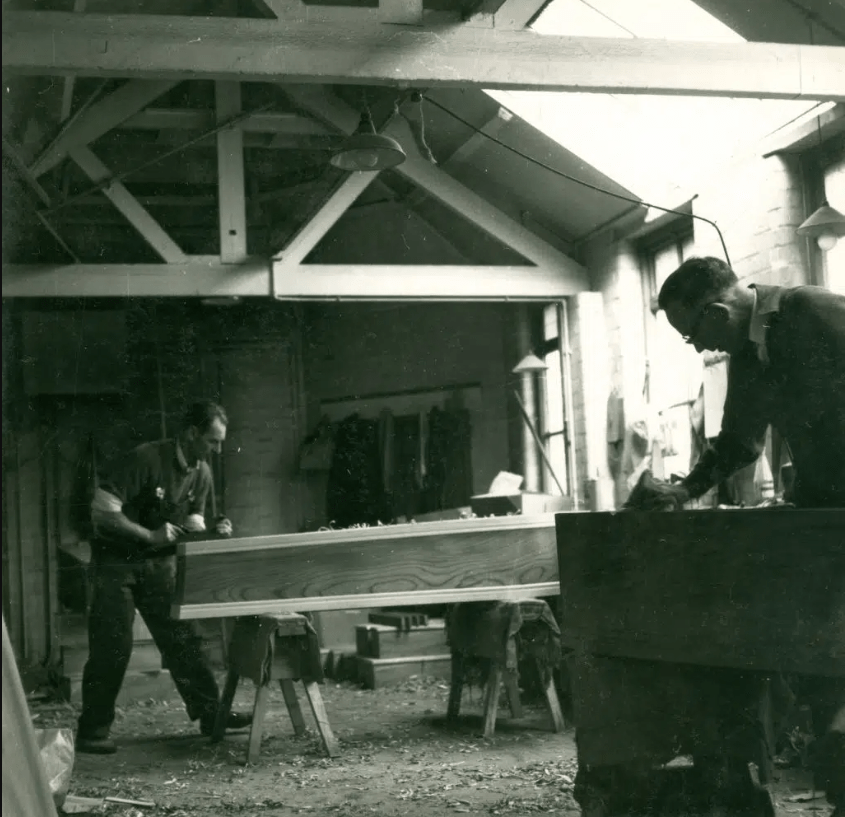
“Wathall’s Family History.” 2021. Wathalls (Wathall’s) <https://www.wathalls.co.uk/about-us/our-family-history/>
Early Development.
Through-out the nineteenth and early twentieth century the trade emerged as a modern profession, it was influenced by wider factors that were continuously changing within society such as: fashion, religious and political views, trade, profit and geography.[2] It was in the mid nineteenth century that individuals began to focus their occupational abilities towards death and promote undertaking as an independent trade. As seen in the source above, the Wathall family used their existing skills of carpentry and business of furniture brokers to diverse into coffin building which expanded their company and, with the demand for occupations surrounding death, concentrated their focus to undertaking. Another key factor for the emergence of undertaking was transportation. In 1852, the appearance of public and municipal ceremonies due to poor sanitary conditions altered the process of burials.[3] Businesses advertised their accessibility to transport bodies to graveyards and cemeteries highlighting that existing skills were being used to constitute a contemporary and evolving trade.[4]
Economic Profit.
During the early development of this field of work, undertaking was viewed as a controversial occupation. Like body-snatchers at the time, undertakers began to associate in the trade of corpses. However, the professional title allowed profit to be made from both bereaved families and professionals in search of cadavers.[5] Undertakers increased the prices of burials for the additional benefit of ‘security from anatomists’; but also continued to trade corpses with medical professionals. Both allowed undertakers to make a financial gain.[6] It was not until the 1832 Anatomy act in Britain, which allowed medical school to legally permit corpses of unclaimed bodies[7], that undertakers began to detached form the trade of body-snatching and began to find new means of economic consumption.[8]
Aesthetics.
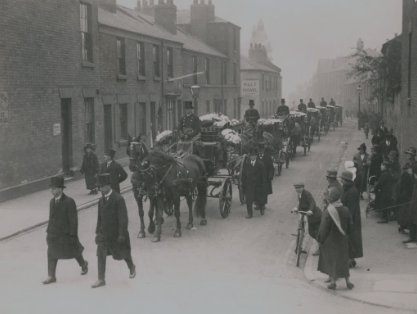
As funeral and burial ceremonies evolved during the nineteenth century so did the role of an undertaker. The responsibilities undertakers took on were not just practical jobs but also the aesthetics touches. The role of undertakers portrayed two sides. The practical side was required to maintain the sanitary requirements: such as removing the body from the home, preparation of the body, transportation, burial and perhaps adding a marker for the deceased. This was a role the undertaker upheld no matter the deceased social class, whether that be a pauper’s funeral or a lavish funeral. However, with the influence and importance of social class to a person meant undertakers also portrayed an aesthetic side to their profession. During the nineteenth century, death and burial ceremonies became theatrical performances.[9] Death became an opportunity for a family to exert their wealth and Undertakers allowed this willingly knowing they would be able to profit. For the wealthy, they built extravagant coffins[10] lined with expensive materials, dawned hearses with exotic feathers and even instructed other employees dressed as ‘mutes’ to stand outside mourner’s houses to exaggerate the melancholy atmosphere of the funeral.[11] The importance of solidifying a person and their families social status and the obsession with the theatrics that people had which allowed undertakers to profit so highly from their occupation.[12]
Professionalisation.
With the decline of religious input in society and many more understandings of a person’s body were accepted.[13] The process of death and burial became a detached process, families were no longer taking the responsibilities of the death and burial of loved ones.[14] It was the role of the undertaker to perform all tasks for the deceased. Whilst one reason for this was to allow the family to mourn the loss of their family member in private. Death was still a taboo subject within society this allowed for the professionalisation of trade. The industrialisation of death was influenced by wealth and the ostentation required by the bereaved. Families who had the wealth to transfer the responsibility of organising a burial increased the demand for specialist agencies and individuals. Consistent responsibility of corpses and burials influenced by societal values established qualities and skills that were autonomous to any other trade and promoted a specialised and respectable occupation. Formulating Undertaking as an independent trade.
Industrialisation.
The role of an undertaker and the practice as a whole was described as ‘solely a profit-driven enterprise’. In this 1895 study, life and labour of the people of London, Charles Booth[15] argues that undertaking was a seasonal trade profiting more during the months of November to April due to unsatisfactory health conditions and higher death rates. Success in this line of work directly correlated with epidemics or poor social conditions, therefore it was suggested that undertakers had financial interest in the continuation of insufficient sanitary conditions. The key feature that industrialised undertaking was embalming.[16] Professionalisation adjusted the occupational focus of economical profit to knowledge and expertise in a particular field. Embalming enabled undertakers to highlight an anatomy service to their existing traditional trade of burial. The similar properties embalming had to surgery enhanced professional status for undertakers and shifted the idea that undertaking was a solely profitable trade but also that the industry of death was a respected profession.
Conclusion.
Everything discussed above contributed to the emergence of undertaking and the developments that occurred, and whilst it was the main focus during the early development, how undertaking was able to shift the perspective of exclusively being a profitable gain to a respectable profession. The analysis of undertaking highlights the evolution, the changes and the impact social factors and status to the trade and overall portrays a microcosm for the view of death and burials in the nineteenth century.
Images:
“Wathall’s Family History.” 2021. Wathalls (Wathall’s) <https://www.wathalls.co.uk/about-us/our-family-history/>
[1] “Wathall’s Family History.” 2021. Wathalls (Wathall’s) <https://www.wathalls.co.uk/about-us/our-family-history/>
[2] Griffith, Lisa Marie, and Ciarán Wallace. 2018. “Buried in the Archives: A History of Dublin Undertakers and Their Records from the Late Eighteenth Century to the Present,” Dublin Historical Record, 71.1: 32–46 <http://www.jstor.org/stable/44984621>
[3] Kyung-Hee, Kim. 2003. “A Study On the Patterns of the Late 19h Century Funerals,” Journal of Fashion Business, 7.3: 1–13 <https://koreascience.kr/article/JAKO200331559975197.pdf>
[4] Griffith, Lisa Marie, and Ciarán Wallace. 2018. “Buried in the Archives: A History of Dublin Undertakers and Their Records from the Late Eighteenth Century to the Present,” Dublin Historical Record, 71.1: 32–46 <http://www.jstor.org/stable/44984621>
[5] Scandura, Jani. 1996. “Deadly Professions: ‘Dracula,’ Undertakers, and the Embalmed Corpse,” Victorian Studies, 40.1: 1–30 <http://www.jstor.org/stable/3828796>
[6] Scandura, Jani. 1996. “Deadly Professions: ‘Dracula,’ Undertakers, and the Embalmed Corpse,” Victorian Studies, 40.1: 1–30 <http://www.jstor.org/stable/3828796>
[7] Knott, John. 1985. “Popular Attitudes to Death and Dissection in Early Nineteenth Century Britain: The Anatomy Act and the Poor,” Labour History: 1 <https://doi.org/10.2307/27508747>
[8] Scandura, Jani. 1996. “Deadly Professions: ‘Dracula,’ Undertakers, and the Embalmed Corpse,” Victorian Studies, 40.1: 1–30 <http://www.jstor.org/stable/3828796>
[9] Scandura, Jani. 1996. “Deadly Professions: ‘Dracula,’ Undertakers, and the Embalmed Corpse,” Victorian Studies, 40.1: 1–30 <http://www.jstor.org/stable/3828796>
[10] Hoile, Sarah Ann Essex. 2020. “Death, Time and Commerce: Innovation and Conservatism in Styles of Funerary Material Culture in 18th-19th Century London,” Ucl.ac.uk <https://discovery.ucl.ac.uk/id/eprint/10095497/7/Hoile_10095497_Thesis.pdf>
[11] Scandura, Jani. 1996. “Deadly Professions: ‘Dracula,’ Undertakers, and the Embalmed Corpse,” Victorian Studies, 40.1: 1–30 <http://www.jstor.org/stable/3828796>
[12] Kyung-Hee, Kim. 2003. “A Study On the Patterns of the Late 19h Century Funerals,” Journal of Fashion Business, 7.3: 1–13 <https://koreascience.kr/article/JAKO200331559975197.pdf>
[13] Masur, Margo. 2015. “‘Inhumanly Beautiful’: The Aesthetics of the Nineteenth-Century Deathbed Scene” <https://www.academia.edu/24295997/_Inhumanly_Beautiful_The_Aesthetics_of_the_Nineteenth_Century_Deathbed_Scene>
[14] Kearl, Michael C. 1997. American Journal of Sociology, 102.4: 1210–12 <http://www.jstor.org/stable/2782054>
[15] Scandura, Jani. 1996. “Deadly Professions: ‘Dracula,’ Undertakers, and the Embalmed Corpse,” Victorian Studies, 40.1: 1–30 <http://www.jstor.org/stable/3828796>
[16] Scandura, Jani. 1996. “Deadly Professions: ‘Dracula,’ Undertakers, and the Embalmed Corpse,” Victorian Studies, 40.1: 1–30 <http://www.jstor.org/stable/3828796>
 Derby's Dark Corners