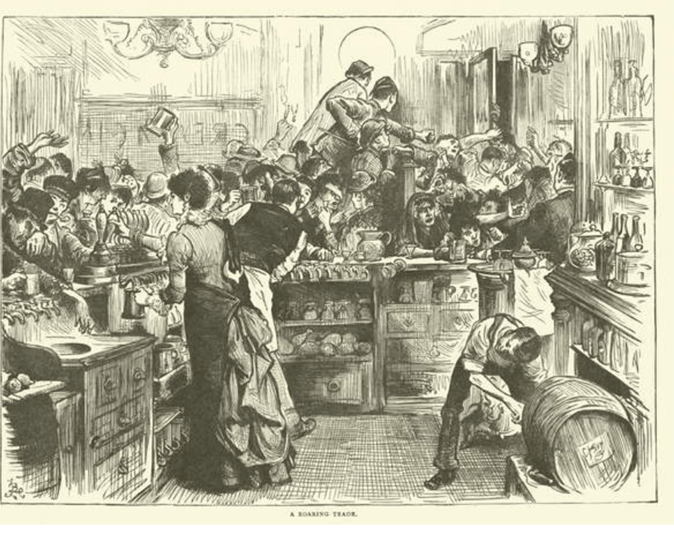
England like most of the world has a long history of alcohol consumption which can still be seen today in many of Britain’s oldest pubs some being hundreds of years old. While alcohol itself is not unique to this period there were many developments in the production of alcohol, distribution of alcohol and consumption of alcohol. All of this together with an increasingly global capitalist economy made drinking in this period unique to other periods in the reasons why people drank, where people drank and what people drank. Below is an engraving of a very busy Victorian public house which is made for George R Sims’ work on how the poor lived.[1] The engraving is titled “a roaring trade” which is certainly suitable for the alcohol trade and specifically the beer trade where in this engraving we can see this is the drink being served and what most of the patrons are drinking.[2]
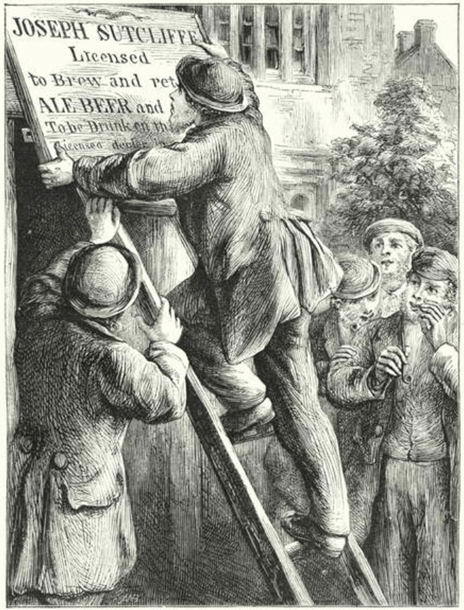
Before 1830, the main concern of drinking was the gin craze with huge volumes being consumed in all aspects of society which resulted in a series of laws attempting to control this craze.[3] The 1830 Beer Act changed the game in terms of drinking, making scenes like that in the engraving possible as it placed Beer retail under magisterial control taking power away from local economic and political elites and was a victory of capitalism showing a break with the gin craze era of legislation.[4] The Act liberalised the beer trade, allowing anyone who wanted to sell beer to do so as long as they brought a license for two pounds and two shillings, there was no application to the magistrates, no certificate of character and no alehouse license needed, a radical change.[5] The act allowed the poor to open their house as a beer shop but they were only allowed to sell beer and cider hence the boom in beer consumption.[6] The Act showed the importance of alcohol and how it has great political weight as this very popular Act was passed by Wellington and the Tories in the run-up to a general election and it was used to split the opposition.[7] With the new law making it easier to sell beer it resulted in an explosion in the number of premises selling beer with 24,000 opening within a year of the Act and 40,000 by 1835.[8] Clearly this was a “roaring trade” as explained by the engraving. Because of this, there were mass complaints of increased drunkenness and beer was starting to be seen as the same as gin in terms of the problems it created.[9] After a select committee looked at these issues in 1833 the following year saw most of the provisions of the Beer Act reversed.[10] But the prominence of beer in society could not be reversed and beer and other alcohol producers like today became even more of a major industry and employer and producing large sums of tax revenue which cements their importance in society and political power.[11]
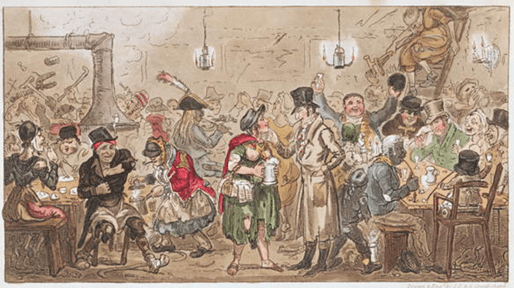
The Victorians loved to drink and they lived in a society that was geared towards alcohol consumption especially for the urban poor because, in the industrial cities, there was no escaping drinking establishments such as beer houses, gin palaces, refreshment rooms, restaurants, theatres, music halls, dram shops (bars), oyster bars, private clubs and public houses.[12] The scene engraved was typical for industrial cities as these establishments littered the streets and there was no escape. At the core, the reason for drinking is the same today because it was and is a legal intoxicant and with the hard long hours of work that the urban poor did in the nineteenth and early twentieth century, it’s easy to see why this would be so popular.[13] Alcohol was an ordinary part of everyday life in working-class culture.[14] The historian Paul Thompson found that excessive drinking was widely reported in the press but private drinking habits in moderation existed without this public scrutiny.[15] As alcohol was less acceptable in the workplace, alcohol became a symbol of leisure time for the urban poor.[16] For many families free time was spent at home and alcohol was a central part of home life with alcohol consumption at home being as popular as visiting local pubs.[17] At home alcohol consumption was normal for men and women, especially with the evening meal where beer was most often drunk.[18] However, despite this mass drinking at home, pubs were often where the alcohol would be brought from, adding to why pubs would be so busy like in the engraving as they also operated commonly as takeaways.[19] A key element in the engraving is that of the customers in there the vast majority of them are men and this was typical of most places around the country, in a lot of these places women would not enter pubs at all.[20] In a study of pubs in York in 1900 Seebohm Rowntree found that in the slums women were more visible in pubs while in more affluent working-class areas women only went to pubs to get dinner beer for home consumption.[21] Using Rowntree’s logic it can be assumed that the engraving is depicting a lower class or slum setting for this pub as while men are the majority there are some women in this pub. As well as the regional differences in the status of women in pubs, regional tastes in beer were common as one professional described that in Birmingham “a full-bodied” beer is preferred while half an hour away in Worcestershire the people prefer “a pale, dry, thin” beer.[22] The pub was so much more than just a drinking establishment for the working class, it could be a place of business, a place to smoke, play cards, dominoes, darts, sing and listen to the piano, gamble and just have conversations.[23] It could also be a place for fighting for example advertised in a sporting chronicle Derby man John Castletledine could be found in the George and Dragon on Walker Lane (a Derby slum) and was happy to fight anyone from Derby.[24] In the engraving there seems to be some fighting, showing that the environment was certainly a very masculine environment. Overall, the engraving is very useful to a historian studying Victorian-age drinking as it shows accurately what a pub would look like at that time as backed up by the scholarly literature. The pub was so much more than just a drinking venue it was the centre and the heart of working-class culture and activity the only public space where patrons could enjoy their free time and as the engraving describes it was certainly a roaring trade.
[1] Bernard, Frederick L, A roaring trade, engraving,1846-1896, Private Collection Available online: Bridgeman Images Bridgeman Education (derby.ac.uk) Accessed on: 18/01/23
[2] Bernard, Frederick L, A roaring trade, engraving,1846-1896, Private Collection Available online: Bridgeman Images Bridgeman Education (derby.ac.uk) Accessed on: 18/01/23
[3] Rogers, Nicholas. Mayhem : Post-War Crime and Violence in Britain, 1748-53, (Yale: University Press, 2013) p. 131-157
[4] Nicholls, James. The Politics of Alcohol a History of the Drink Question in England. (Manchester: University Press, 2009) p. 80
[5] Nicholls, The Politics of Alcohol a History of the Drink Question in England, p. 90
[6] Burnett, John, Liquid Pleasures: A Social History of Drinks in Modern Britain (London: Taylor & Francis Group 1999) p. 120
[7] Nicholls, The Politics of Alcohol a History of the Drink Question in England, p. 91
[8] Nicholls, The Politics of Alcohol a History of the Drink Question in England, p. 92
[9] Nicholls, The Politics of Alcohol a History of the Drink Question in England, p. 93
[10] Nicholls, The Politics of Alcohol a History of the Drink Question in England, p. 93
[11] Jackson, William J; Paterson, Audrey S; Christopher K.M. Pong; Scarparo, Simona, ‘How easily can the barley brie’, Accounting, Auditing & Accountability Journal, vol. 25, Issue 4. (2012) p.637
[12] Hands, Thora. Drinking in Victorian and Edwardian Britain Beyond the Spectre of the Drunkard. 1st ed. 2018., (Springer International Publishing, 2018) p. 1
[13] Hands, Drinking in Victorian and Edwardian Britain, p. 2
[14] Hands, Drinking in Victorian and Edwardian Britain, p. 129
[15] Hands, Drinking in Victorian and Edwardian Britain, p. 129
[16] Hands, Drinking in Victorian and Edwardian Britain, p. 130
[17] Hands, Drinking in Victorian and Edwardian Britain, p. 132
[18] Hands, Drinking in Victorian and Edwardian Britain, p. 132
[19] Hands, Drinking in Victorian and Edwardian Britain, p. 132
[20] Hands, Drinking in Victorian and Edwardian Britain, p. 132
[21] Hands, Drinking in Victorian and Edwardian Britain, p. 132
[22] Pilcher, Jeffrey. “National beer in a global age: technology, taste, and mobility, 1880-1914.” Quaderni Storici, vol. 51, no. 151 (1), (2016) p. 55
[23] Hands, Drinking in Victorian and Edwardian Britain, p. 133
[24] “THE RING.” Bell’s Life in London and Sporting Chronicle, 23 Dec. 1838. Nineteenth Century UK Periodicals, link. gale.com/apps/doc/DX1900154211/NCUK?u=derby&sid=bookmark-NCUK&xid=b4da4705. Accessed 18 Jan. 2023
Images
Bernard, Frederick L, A roaring trade, engraving,1846-1896, Private Collection, Available online: Bridgeman Images Bridgeman Education (derby.ac.uk)
Egan Pierce, Tom and Jerry ‘Masquerading It’ Among the Cadgers in the ‘Back Slums’ in the Holy Land, colour etching, from ‘Life in London’, published by Sherwood, Neely & Jones, 1821, Private Collection, Available online: Bridgeman Images Bridgeman Education (derby.ac.uk)
English School, Taking down the Beer-House Sign, engraving, 1869, Private Collection, Available online: Bridgeman Images Bridgeman Education (derby.ac.uk)
 Derby's Dark Corners