Throughout the Victorian period, butchers were growing in popularity, with people from all classes visiting to purchase different quality meats. This enabled them to gain a reputation as respected suppliers of animal products. However, the harmful presentation of meat within their shops posed a threat to this respectability.
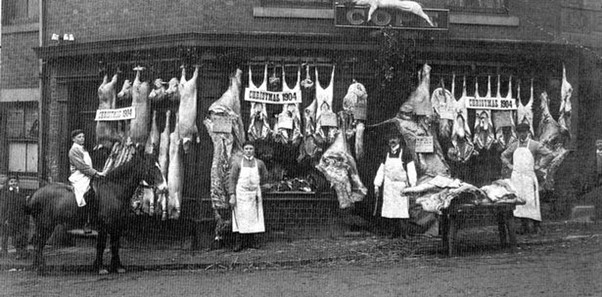
Goddard, J., ‘When Derby butchers showcased a festive feast of fowls and choicest cuts’, Derbyshire Live, 2018.
As depicted by this image, Cope’s Butchers in Derby had a vast amount of meat for sale, with this particular photograph portraying the building during a Christmas market. Not unlike many other butchers from the Victorian period, the products were displayed in risky, unhygienic ways. Once the dangers of this became public knowledge, the respectability of their reputation was put on the line. Because of this, the photograph provides an insight into how meat was presented and the potential hazards caused by its dangerous display.
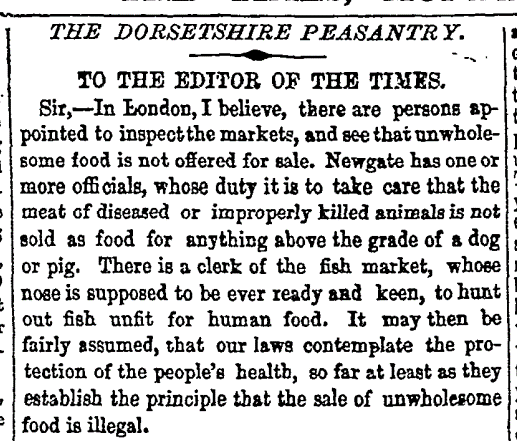
The image of Mr. Cope’s butchers provides an insight into why the presentation of meat by Victorian butchers caused concern for sanitation committees. By the mid-nineteenth century, the importance of sanitation was gaining recognition, which led to more concern over potential hazards on the streets. An example can be seen through the newspaper article on the left published in 1846 which calls for a more thorough inspection of the meat trade. This then threatened to ruin a butchers’ respectable reputation for supplying good meat.
To the left: Excerpt from Osborne, S. G., ‘The Dorsetshire Peasantry’, The Times, Issue 19323, 24 August 1846, p. 5.
In line with this, customers began wanting to thoroughly ‘inspect’ the meat before they purchased it, making its display crucially important.[1] Most notably, ‘miasma’ was a huge issue, as it was believed that ‘offensive smells’ caused by animal products in the streets were a ‘direct cause of disease’.[2] Not only would this pose a threat to the contamination of adjacent meat, but it was also a worry for the health of the public walking by the shop. For this reason, butchers would often attempt to mask the smell of diseased meat by using products such as wood vinegar. Consequently, this led to numerous deaths which further illustrates the dangerous ways meat was presented.[3] The image of Mr. Cope’s property further illustrates why this would be an issue within Victorian butchers, as the animals are displayed very openly and close to the public sidewalk. This then presents another issue, which is that of obstructing the public walkway, both with meat and live animals. This ‘pedestrian hazard’ can be seen within the photograph through the presence of a horse to the left, which is also dangerously close to the meat for sale.[4] Because of this, the photograph reflects negative attitudes towards how butchers displayed their meat.
Despite such profound efforts to disguise any disease-ridden meat, the photograph depicts the butchers wearing white aprons, which scholars such as Kelley Graham argue illustrates their ‘disconnect’ from the actual slaughtering of the animals.[5] Whilst some butchers (‘carcase’) did kill their animals prior to selling them, other types of butchers such as ‘cutting’ purchased the meat already slaughtered, meaning that not all butchers had direct input into the harvesting of their animals. ‘Carcase’ butchers were viewed as the biggest public nuisance because they dumped the most waste from slaughtered animals in the streets.[6] Because of this, butchers would not always know the origins of their products, such as whether they came from diseased animals. For this reason, the production and selling of diseased meat was a substantial issue within Victorian Britain, with butchers’ shops being one of the most notable places of concern. Cattle plague was the root cause of the increase in contaminated meat, and despite some of it being seized by sanitation inspectors, not all of it was which meant that butchers had to ‘trick people’ into purchasing it.[7]
It was common for the public to mistrust butchers due to their attempts to conceal diseased meat, but also because of their ability to sell meat disguised as a more expensive animal. For example, cats or dogs would often be sold as rabbits because it was difficult to tell them apart once they were in the shop. One of the methods used to hide this was displaying the animals with their ribs facing inwards, as the ribs could be used to easily identify the animal.[8] Consequently, the fact that most of the carcasses in the photograph of Mr. Cope’s butchers are hung without showing their ribs suggests that perhaps he was trying to conceal the quality of his meat. As well as this, they would often leave blood in carcasses to give them extra weight or blow air into them to make them appear bigger.[9] These methods thus suggest that butchers had little concern for the quality of the meat they were selling. Alongside wanting to disguise contaminated meat, butchers would often display their products on marble slabs to ‘slow the spoilage’ and make it last as long as possible.[10]
The photograph is also indicative of the role class played in the purchasing of meat from butchers. For example, the expense of quality meat meant that thirty percent of poor families in the 1860s never purchased it.[11] Because of this, the meat displayed in the photograph of Mr. Cope’s butchers would most likely be consumed by the top percentage of working-class people who could afford it, alongside the middle classes.
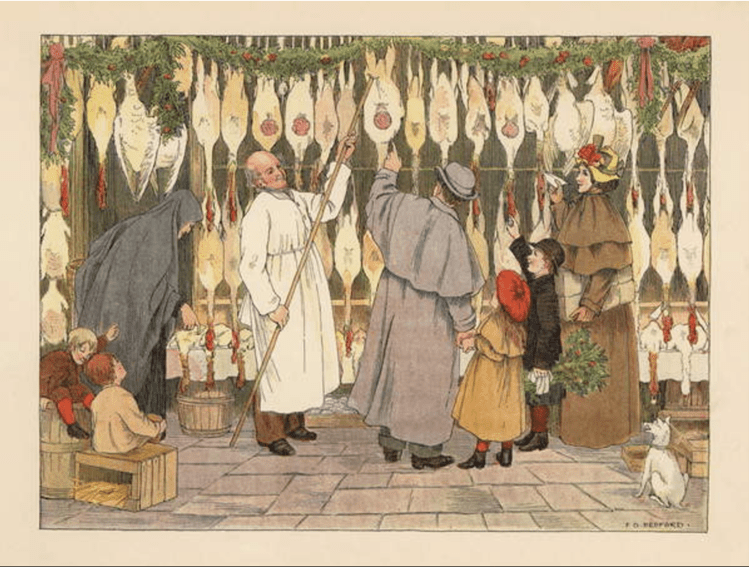
Such high prices of meat also meant that the working classes willingly purchased diseased meat because it was more affordable, despite the health risks that came with it.[12] The fact that some establishments advertised some of their meat as contaminated to be purchased by the poor would undoubtedly ruin their respectability. The image on the right depicts a well-off family having the luxury of inspecting and choosing their Christmas turkey, showing how the purchasing of good-quality butchers’ meat was reserved for those who could afford it.
To the right: Bedford, F. D., Victorian family choosing a turkey for Christmas at the poulterers, Chromolithograph, 1899.
Despite the growing concern about public health in mid-nineteenth century Britain, the photograph of Mr. Cope’s establishment suggests that the presentation of meat within butchers remained unsanitary and a breeding ground for contaminated meat. Whether it was the poor deliberately choosing to purchase diseased meat, or the well-off being unknowingly conned into buying it, the result was a rise in deaths from dangerous consumption. Ultimately, this served to damage their respectability as places for those who could afford it to purchase good-quality meat.
[1] Graham, K., Gone to the Shops: Shopping in Victorian England (Westport: Praeger Publishers, 2008), p. 66.
[2] Maclachlan, I., ‘A bloody offal nuisance: the persistence of private slaughter-houses in nineteenth-century London’, Urban History 34:2 (2007), p. 240.
[3] Rioux, S., ‘Capitalist food production and the rise of legal adulteration: Regulating food standards in 19th-century Britain’, Journal of agrarian change 19:1 (2019), p. 70.
[4] Maclachlan, ‘A bloody offal nuisance’, p. 240.
[5] Graham, Gone to the Shops, p.66.
[6] Maclachlan, ‘A bloody offal nuisance’, p. 236.
[7] Rioux, ‘Capitalist food production and the rise of legal adulteration’, p. 70.
[8] Graham, Gone to the Shops, p. 66.
[9] Graham, Gone to the Shops, p. 66.
[10] Graham, Gone to the Shops, p. 66.
[11] Waddington, K., ‘The Dangerous Sausage: Diet, Meat and Disease in Victorian and Edwardian Britain’, Cultural and Social History: The Journal of the Social History Society 8:1 (2011), p. 54.
[12] Waddington, ‘The Dangerous Sausage’, p. 60.
 Derby's Dark Corners