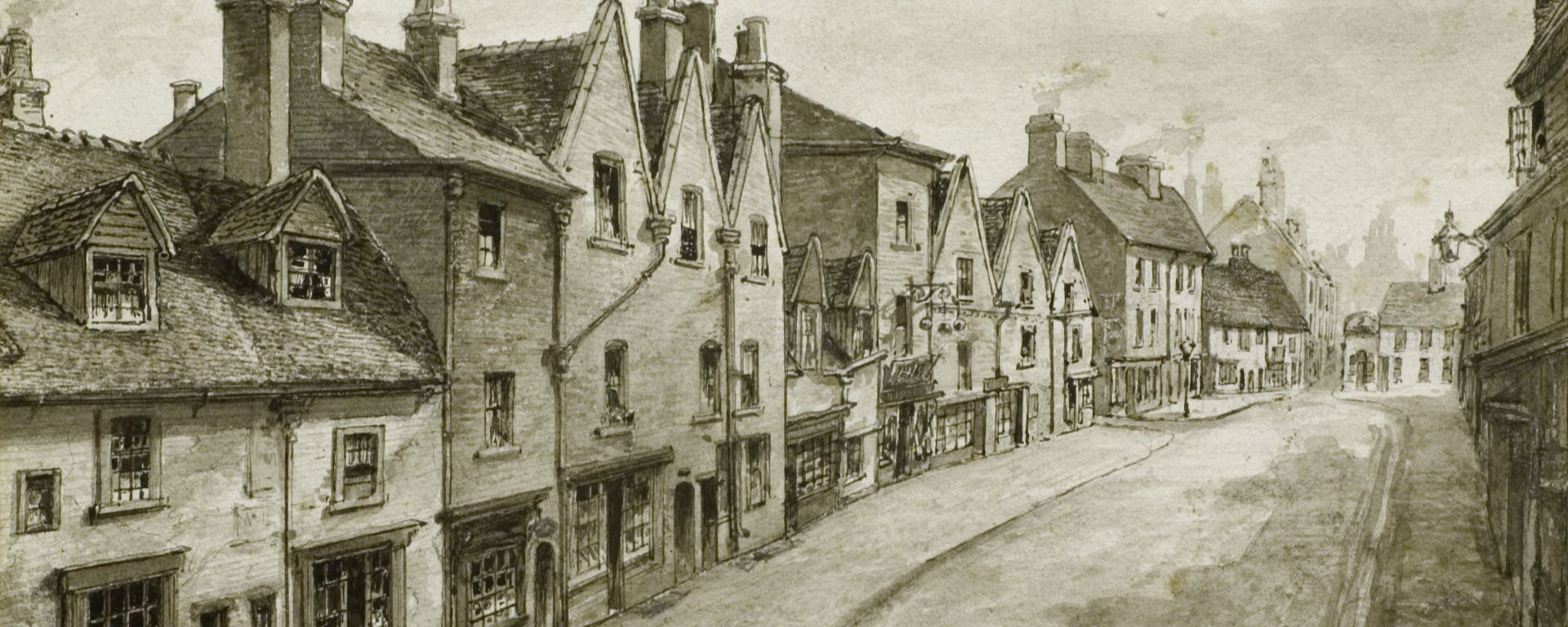
by Amelia Brain
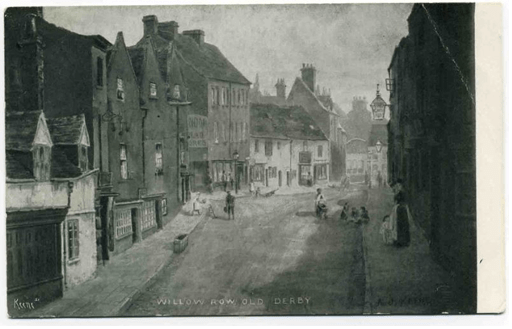
Although there is not an exact date attached to this postcard of Willow Row, similar picture postcards became popular during the latter part of the nineteenth century. From research on other postcards produced during the nineteenth century, the intended audience for this postcard is more than likely the upper and middle classes targeting those interested in tourism.
Picture Postcards
One of the aspects that you can take from looking at this postcard as the main primary source is exploring when the picture postcard was developed and popularised in such a way that this postcard has survived. The picture postcard was developed in the nineteenth century, and it aligned with the development of the Universal Post Union in 1874.[1] The scholar Monica Cure has written extensively on the development of postcards and the different narratives associated with the different forms of postcards. She highlights the main narrative of picture postcard as being ‘a new medium that developed in the late nineteenth century which often set the postcard, first and foremost, against the medium of the letter in an antagonistic fashion.’[2] One reason for this narrative of postcards against letter’s was that postcards were a cheaper form of post which did not discriminate between classes which in a society that was all about what class you belonged to was a deciding factor in live is telling. Cure supports this when she wrote, ‘The postcard’s cheaper postal rate indeed accounted for much of its immediate appeal. It made regular postal communication available to a previously unrepresented group, and in doing so, it laid claim to being a democratic medium.’[3] The possible reason for the survival of this postcard can be theoretically linked to the inclusive nature of postcards as a form of communication between the different classes and the less expensive nature of postcards, during a time when philanthropists were trying to tackle the problem of poverty
Middle-Class Ideals
Another aspect that you can take from looking at this postcard as a primary source is exploring the middle-class ideals that the postcard displays. One element of this is the middle-class idea of Victorian childhood, the postcard shows three children playing a game in the middle of the street. This is a blend of ideas as middle-class children would not be playing in the street they would have a room in the house to play or they would play in the garden,[4] however most working-class children lived in crowded and cramped houses that did not have room for playing would have to play in the streets.[5] In addition, while middle-class children would have had the time to play, working-class children were unlikely to. Scholar Janet Sack has stated that ‘wealthy and middle-class children were not required to work… by the beginning of the nineteenth-century working-class children were in full-time work in the mills, many of them as young as seven years old.’[6] The other element of middle-class ideals that you can look at is the buildings displayed in the postcard, termed ‘Victorian tall houses’, which were a form for the middle-class to display their wealth similar to the way that the upper class used country houses. The slum could hide in plain sight behind these beautiful and picturesque buildings. As the scholar Alan Mayne has observed, this could lead to poverty and wealth being cheek and jowl: ‘the hidden slum just behind a prestigious social club; a seedy alleyway at the rear of handsome banking and insurance buildings’.[7] Finally, the picturesque element of this can be linked to the ideas around leisure and tourism, as the use of these beautiful buildings with children playing in the street made it a place that people would want to visit.
Hidden Aspects
The postcard is picturesque and hides not portray what town planning maps of Willow Row show, or the conditions described in Edward Cresy’s Report to the General Board of Health on a Preliminary inquiry into the sewerage, drainage and supply of water, and the Sanitary Conditions of the Inhabitants of the Borough of Derby[8] There is one element that both the report and the maps show: overcrowding. One map shows the layout of the court housing, with houses almost on top of each other, where the architect and builder of the house had tried to make the most of the space available to them. The Cresy report puts words to what the map is shows when he describes two of the courts of Willow Row :
‘Court 1 holds 25 houses with inhabitants of between 102 and 103 living in them.’[9]
Furthermore the Cresy report highlighted the dirt, describing ‘two privies that are used by all ages and sexes, they are in such a state of filth that women state that many of the men prefer one at the adjoining public house.’[10] These sanitary conditions are then connected with health problems as in Court 1 ‘the water pump cannot be used when it is mixed with milk as it turns it into curd and the cows have refused it when it is offered’.[11] Court 9 had ‘two large dustbins and privies in bad states, and the water pump is unusable.’[12]
Overall, this postcard shows a middle-class idea of Willow Row in terms of the buildings portrayed and the children having the time and ability to play. However, this representation was completely at odds with that portrayed by maps of Willow Row and the description in Edward Cresy’s report
[1] Cure, Monica, Picturing the Postcard: A New Media Crisis at the Turn of the Century (Minneapolis: University of Minnesota Press, 2018), p 10
[2] Cure, Picturing the Postcard, p 4
[3] Cure, Picturing the Postcard, p 8
[4] Frost, Ginger S., Victorian Childhoods (Westport Connecticut: Praeger, 2008), p. 79
[5] Frost, Victorian Childhoods, p 81
[6] Sacks, Janet, Victorian Childhood (Oxford: Shire Publications, 2010), p 23.
[7] Mayne, Alan, ‘Representing the Slum,’ Urban History,17 (1990), p 71
[8] Edward Cresy, Report to the General Board of Health on a preliminary inquiry into the sewerage, drainage and supply of water, and the sanitary conditions of the inhabitants of the Borough of Derby
[9] Cresy, Report to the General Board of Health, p 15
[10] Cresy, Report to the General Board of Health, p 15
[11] Cresy, Report to the General Board of Health, p 15
[12] Cresy, Report to the General Board of Health, p 15
 Derby's Dark Corners