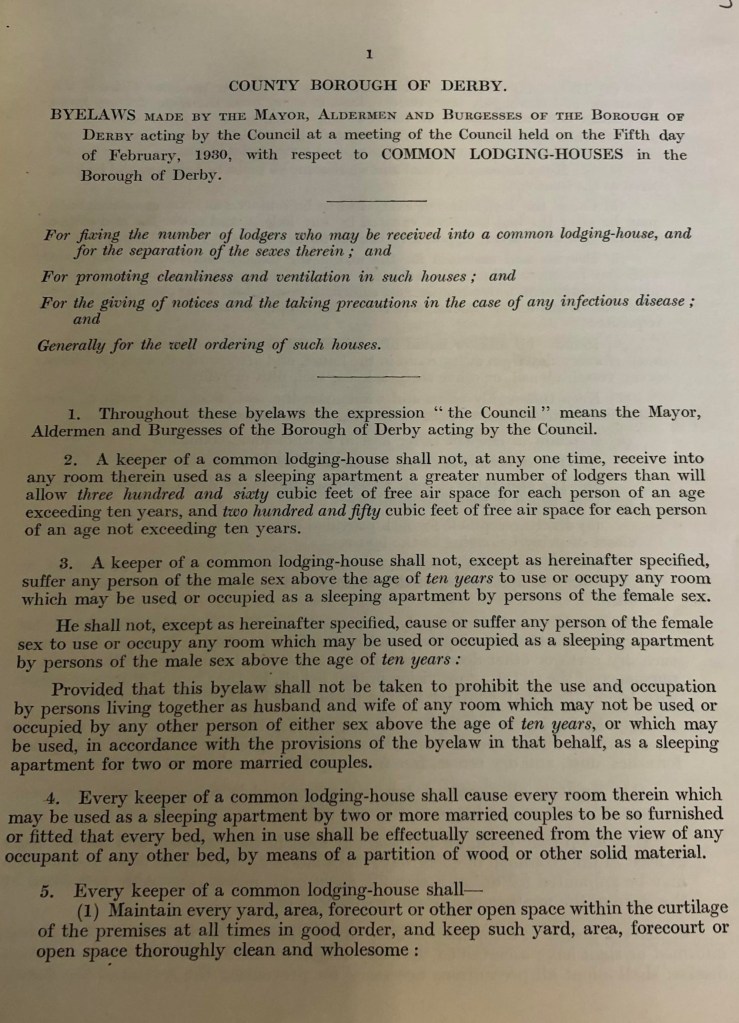
In 1930, Derby Council implemented byelaws to improve the condition of the common lodging house.[1] Aimed at both the public and lodging house owners themselves, these byelaws promoted ventilation and cleanliness, only receiving lodgers within a set number of cubic feet of air, and the separation of males over the age of 10 from people of the opposite sex.[2] Without directly mentioning it, this source gives an insight into what lodging houses could be like prior to the creation of these byelaws, suggesting that lodging houses were cramped, overcrowded, unhygienic, disease-ridden spaces.
This source reveals a great deal about previous attitudes towards the spread of both disease and immorality during the nineteenth and early twentieth centuries. It was believed that cleanliness equalled morality – an unachievable goal for those who lived in the lodging house.[3] As a result, the lodging house’s image was one of deviance and impropriety in the eyes of the upper classes.[4] Lodging houses were observed, by one evangelical social reformer, to be:
‘the deepest dens of vice, filth, and misery’.[5]
– Lord Shaftesbury, 1847
To fully understand this source, it is important to consider the context of lodging houses leading up to the creation of the 1930 byelaws.
On the surface, this source implies that Derby council were ultimately improving the lodging house. While the Council were indeed showing interest in developing and updating the lodging house for the twentieth-century tenant, it is interesting to note that these byelaws appear to echo legislation introduced in the mid-nineteenth century.[6] When considering the byelaws of 1930, it shows that the regulations created in the Victorian era were subsequently not followed – or as actively enforced as they should have been – allowing the lodging house to gain its reputation as a centre of disease and moral corruption.
Many pieces of legislation were introduced in the nineteenth century in order to combat the growing number of issues that arose in the lodging house.[7] For example, the Public Health Act of 1848 stated that it was a requirement that lodging houses were to be registered and inspected regularly.[8] While some local governments actively enforced these rules, others chose to ignore the problems of overcrowding and the spread of disease. Liz Woolley has argued that the apparent leniency towards enforcement displayed by local governments was caused by an inability to define what a lodging house was, and so their ability to control them was limited.[9] It could be suggested that this was a result of prejudice and discrimination against the ‘undeserving poor’, and the fear that they could corrupt morally respectable people.[10]
Furthermore, lodging house owners failed to comply with these regulations.[11] For example, in 1879, a Derby lodging house keeper was summoned to court as he had failed to notify the sanitary inspector of an outbreak of scarlet fever within his property in Walker Lane.[12] His lack of action resulted in the death of a small child who had mixed with around fifteen to twenty other occupants of the lodging house.[13] These failures in legislation therefore enabled lodging houses to become squalid and disease-ridden.
By the early twentieth century, public health in Britain was increasingly focussed on and improved, as shown with the establishment of the Ministry of Health in 1919.[14] However, the success of public health initiatives could only be enabled by complicity to the regulations. This may explain why the byelaws stress the importance of cleanliness and ventilation, and the endorsement of heavier penalties, as to halt the spread of disease and promote a better quality of life for lodgers.[15]
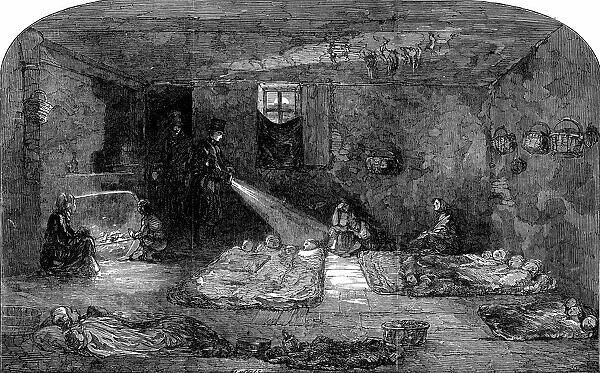
A major source of concern for society was the spread of moral disease. The idea of people of all ages and sexes mixing within the lodging house challenged middle-class norms of family and domesticity, and in turn, ideas around morality.[16] An article called The Needs of Derbyshire captures views towards these practises:
‘The dense crowding of a number of persons in a room, and often with the mixture of sexes of all ages, are evils which cannot be over-estimated’.[17]
Historians have argued that nakedness, in varying degrees, was a major cause of the panic associated with this mixing.[18] The perceived immorality of nakedness is summed up by Hector Gavin, a nineteenth-century social explorer:
‘There is no form or show of propriety, decency or morality; but, at times, a vitiating and disgusting bestiality unknown to savages’.[19]
This quote quite clearly displays imperial rhetoric, a theme that can be found throughout many pieces written about the slums, such as Henry Mayhew’s London Labour and the London Poor, and George Sims’ How the Poor Live.[20] Historians have suggested that writers drew comparisons between the poor and tribal populations in order to highlight the unseen primitiveness of the poor in England.[21] However, associating nakedness with savagery also constructed a sensationalised narrative about the poor which further created barriers between classes. Furthermore, the idea of ‘character’ became incredibly important to the middle class.[22] To label the lower class as more savage than ‘savages’ severely damaged their reputation, so much so that in some instances, Christian missionaries would often attempt to save the ‘savages’ of the lodging house by visiting them as to ‘shape atmosphere and character’.[23] Consequently, this seemingly confirmed assumptions that the lodging house was a space of indecency and depravity.
The fear of moral degeneration continued into the twentieth century. Many people still feared that knowledge of sexual matters caused ‘moral deterioration’, and so sexual ignorance was highly favoured during the 1920s.[24] As the source mentions segregating males from the opposite sex, it firmly establishes that there was still a fear of sexual impropriety. The implication that men and women could not be trusted in one another’s company in the lodging house certainly shows that Victorian and Edwardian moral values still found themselves situated within the 1930s.
The byelaws of 1930 illuminate attitudes towards the poor of the Derby lodging house. This source gives insights into the conditions of the lodging house and allows historians to learn more about disease and perceptions of morality. This piece has shown why the conditions of the lodging house went unchanged until 1930, which ultimately stemmed from the failures of local government and lodging house owners. This source is useful in providing understandings of slum living, and how lodgers earned poor reputations merely by being associated with the lodging house.
[1] Derby Council, ‘BYELAWS MADE BY THE MAYOR, ALDERMEN AND BURGESSES OF THE BOROUGH OF DERBY acting by the Council at a meeting of the Council held on the Fifth day of February, 1930, with respect to COMMON LODGING-HOUSES in the Borough of Derby’, 05 February 1930, Derby Local Studies Library.
[2] Derby Council, ‘BYELAWS’.
[3] Mort, F., Dangerous Sexualities: Medico-Moral Politics in England Since 1830 (Milton Park: Taylor & Francis Group, 2000), p.92
[4] Mort, Dangerous Sexualities, p.92.
[5] Lord Shaftesbury quote found in Koven, S., Slumming: Sexual and Social Politics in Victorian London (Princeton: Princeton University Press, 2004), p.55.
[6] Hamlett, J., At Home in the Institution: Material Life in Asylums, Lodging Houses and Schools in Victorian and Edwardian England (Basingstoke: Palgrave Macmillan, 2015), p.116.
[7] Crook, T., ‘Norms, Forms and Beds: Spatializing Sleep in Victorian Britain’, Body & Society 14.4 (2008), p.24; Hamlett, At Home in the Institution, p.112.
[8] UK Parliament, ‘Lodging Houses’, (n.d.). Available online: https://www.parliament.uk/about/living-heritage/transformingsociety/towncountry/towns/tyne-and-wear-case-study/about-the-group/housing/lodging-houses/#:~:text=This%20included%20fixing%20a%20maximum,Lodging%20Houses%20Act%20of%201851. Date accessed: 10 Jan. 2023.
[9] Woolley, L., ‘“Disreputable Housing in a Disreputable Parish”? Common Lodging-Houses in St Thomas, Oxford, 1841-1901’, Midland History 35.2, p.224.
[10] Woolley, ‘Disreputable Housing’, p.216.
[11] Crook, T., ‘Norms, Forms and Beds’, p.24.
[12] Anon., ‘Scarlet Fever at Common Lodging-Houses’, Derby Mercury, 24 December 1879, p.2.
[13] Anon., ‘Scarlet Fever at Common Lodging-Houses’, p.2.
[14] Cherry, S., ‘Medicine and Public Health, 1900-1939’ in Wrigley, C. (ed.), A Companion to Early Twentieth-Century Britain (Hoboken: John Wiley & Sons, 2003), p.414.
[15] Derby Council, ‘BYELAWS’, p.4.
[16] Crook, ‘Norms, Forms and Beds’, p.20; Hamlett, At Home in the Institution, p.120.
[17] J.P. Bemrose, ‘The Needs of Derbyshire’, Derby Mercury, 19 December 1883, p.8.
[18] Kirby, D., Angel Meadow: Victorian Britain’s Most Savage Slum. (Barnsley: Pen & Sword History, 2016), p.151; Barret-Ducrocq, Love in the Time of Victoria (Paris: Plon, 1989), p.21.
[19] Excerpt of a speech given by Hector Gavin at Crosby Hall in 1850, found in Barret-Ducrocq, Love in the Time of Victoria, p.21.
[20] Mayhew, H., London Labour and the London Poor (New York: Dover Publications, 1968); Sims, G., How the Poor Live (London: Chatto & Windus, 1883).
[21] Herbert, C., ‘Rat Worship and Taboo in Mayhew’s London’, Representations 23 (1988), pp.12-13; Donovan, S., and Matthew Rubery (eds.), Secret Commissions: An Anthology of Victorian Investigate Journalism (Peterborough: Broadview Press, 2012), p.21.
[22] Collini, S., ‘The Idea of “Character” in Victorian Political Thought’, Transactions of the Royal Historical Society 35 (1985), p.30.
[23] Hamlett, At Home in the Institution, p.112.
[24] Cook, H., ‘Emotion, Bodies, Sexuality, and Sex Education in Edwardian England’, The Historical Journal 55.2 (2012), pp.475-476; Szreter, S., and Kate Fisher, Sex Before the Sexual Revolution: Intimate Life in England 1918-1963 (Cambridge: Cambridge University Press, 2010), pp.63-64.
 Derby's Dark Corners