Written by Galin Nenov
On May 31, 1882, the Derby Mercury published a brief article on the “singular death” of a woman named Catherine Rice.[1] The announcement states that Mr Close, coroner for Derby, “formally opened an inquest” into the death of the woman who died at Derby Infirmary. The reason for this investigation was the suspicious circumstances in which Catherine Rice suffered injuries to her left shoulder that eventually led to her death. The inquest was adjourned for further analyses due to the absence of one of the main witnesses, Martin Quinn, who carried the woman to the front door of her lodgings in Walker-lane Derby. From the short publication, we understand that the woman was in a helpless state due to intoxication caused by the use of alcohol. The story also included a hawker John Rice, who cohabited with her but remembered almost nothing because he was drunk.
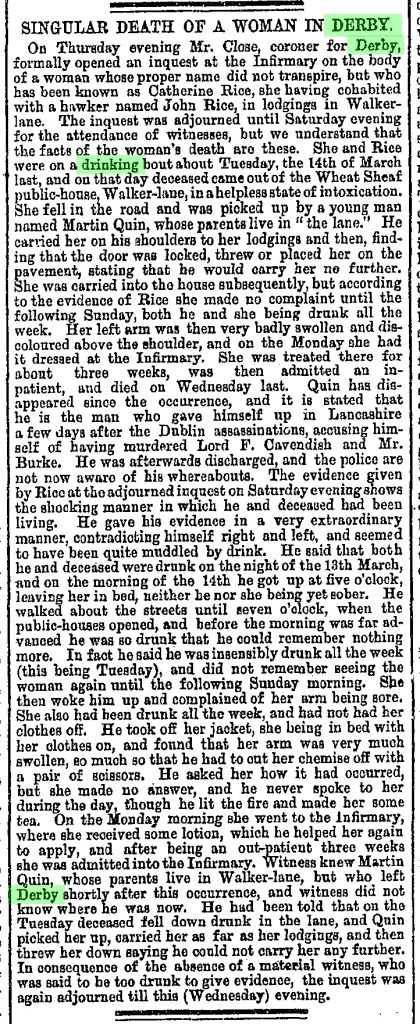
“Singular Death of a Woman in Derby”
Derby Mercury,31 May 1882
The newspaper focus has been laid on the mysterious personality of Mr Quinn, an Irishman who surrendered in Lancashire a few days after the political murders in Dublin of Lord Cavendish and Mr Burke, taking the blame for those murders. The article only states that Mr Quinn was released by the police and then disappeared. The confusion becomes greater because we understand that the incident between Catherine Rice and Martin Quinn happened in the month of March, and the death of Catherine Rice was at the end of May. It all seems like a classic crime novel scenario involving a woman’s corpse, the conflicting testimony of Catherin’s partner, a mysterious and missing Irishman, a political assassination, a lack of witnesses and alcohol consumption. The mise-en-scene also seems appropriate – the dark and unpleasant slum of Walker Lane in the provincial town of Derby. Perhaps the writer of the article in the Derby Mercury detected something unusual in the whole story and hoped that something would probably come out of the case of Catherine Rice. But to the disappointment of the journalists and the readers, Sherlock Holmes had not yet appeared from the pen of Arthur Conan Doyle, and Hercules Poirot had not even been born.[2] A week later, the court’s final verdict was that Catherine Rice’s case was “accidental death”.[3]The case of Catherine Rice was closed, and her death was a banal story.
Who was the real Catherine Rice? Perhaps we will never be able to answer this question. Probably nothing remarkable happened in her life, and even her death was an unpleasant confluence of circumstances and was “simply accidental”. However, the story of Catherine Rice is compelling because her death is a snapshot of society and the court decision for “accidental death” is a verdict on that society. Rice was a victim of circumstances but also a collective image of all those women who had the misfortune to be born, live and die in the slum. We do not know why she drank and why her degradation came about. Perhaps its cause was trivial or dictated by deep emotional or physical trauma. Maybe she was one of those women for whom English parliamentarians concluded that alcohol consumption leads to women’s “evil course” and women had “often more shameless” behaviour than men.[4] Maybe she was a prostitute, and the public house was her hunting area.[5] Whatever she was, she was part of a society where being a woman was a harsh destiny. Women in late nineteenth-century Britain lived in a male-dominated society, and many were denied political representation or career opportunities. Whether you were born into an aristocratic family or in a deprived slum, being a woman puts you at a disadvantage in a man’s world. The women were burdened with expectations, duties and responsibilities set and created by a male-dominated society. However, the ironic contradiction was that Britain was a world empire whose head of state was a woman – Empress Victoria. In reality, Britain was a masculine republic. In this masculine republic, parliament was the public house where men drank, gambled, and discussed everyday problems and politics. This homosocial society was built by its own unwritten laws and rules.[6]
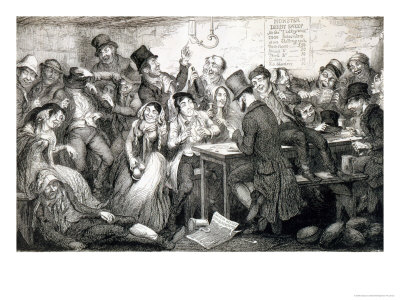
“Masculine Republic”
The Boy Gambles His Money – Plate 2 of Cruikshank’s The Drunkard’s Children [10]
Catherine Rice invaded this male world and faced gender stigma and public disapproval. She probably had nothing to lose or nothing to prove to society. From a publication in the Nottinghamshire Record, we understand that she was a woman of about 50.[7] However, we are not sure of the age because the hard life, combined with regular drinking of alcohol, prematurely ages a woman. Perhaps this aged woman did not find the meaning of the good life, and alcohol was her salvation and scourge. She did not leave written records of her thoughts, feelings, and emotions; therefore, we can only assume the reasons for her behaviour. Her case is part of the overall picture of Victorian drinking women. Some of them, representatives of the higher class, manage to drink secretly.[8] Perhaps these upper-class women envied the freedom of these poor and downtrodden women who did not conform to the hypocritical practices of society. They were aware of their place in society, and alcohol was an escape route and a protest against norms, hypocrisy, and rules.
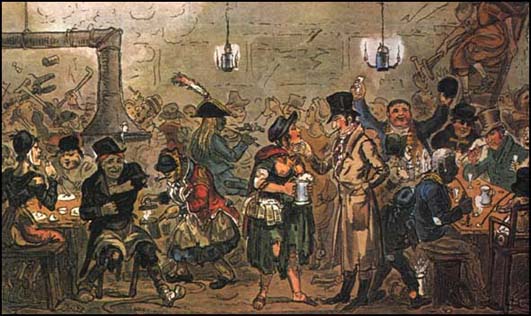
“The House of Pleasure” [11]
Perhaps Catherine Rice was freer because, in all her wretchedness, she still died in a way she chose. Maybe long before her physical death occurred, her soul’s more terrible metaphysical death happened because she refused to fight for her life. The tragedy of Catherine Rice is comparable to that of Virginia Woolf’s fictional Shakespearean sister Judith.[9] Although not gifted like Judith, Catherine Rice was a similar tragic figure. Her death is not only a personal tragedy but a tragedy for a society that does not notice, or refuses to see, that inequality and meaninglessness which lead to the spiritual and physical death of thousands of women who had the misfortune of being born in a slum. Did Catherine Rice have a choice? Whatever the answer, she chose alcohol, and it was the agent that brought about her tragic end.
Galin Nenov
[1] SINGULAR DEATH OF A WOMAN IN DERBY.” Derby Mercury, 31 May 1882. Available on: British Library Newspapers, link-gale-com.ezproxy.derby.ac.uk/apps/doc/BA3202783948/BNCN?u=derby&sid=bookmark-BNCN&xid=e4a83718. < Accessed 17 Jan. 2023.>
[2] For the creation of the fictional character of Sherlock Holmes, see Pascal, Janet B. Arthur Conan Doyle: Beyond Baker Street. (Cary: Oxford University Press, Incorporated, 2000) pp.69-79; For the first introduction to the fictional character of Hercules Poirot, see: “The case of the 100-year-old detective; Hercules Poirot.” The Economist, 26 Sept. 2020, p. 78(US). Available online: https://go-gale-com.ezproxy.derby.ac.uk/ps/i.do?p=AONE&u=derby&id=GALE|A636363484&v=2.1&it=r <Accessed 17 January 2023>
[3] “Local News.” Derby Mercury, 7 June 1882. Available on: British Library Newspapers, link-gale-com.ezproxy.derby.ac.uk/apps/doc/BA3202784001/BNCN?u=derby&sid=bookmark-BNCN&xid=1ecc3e71. <Accessed 17 Jan. 2023.>
[4] Hands, Thora. Drinking in Victorian and Edwardian Britain Beyond the Spectre of the Drunkard. 1st ed. 2018. (Cham: Springer International Publishing, 2018) p.41
[5] Beckingham, David. The Licensed City : Regulating Drink in Liverpool, 1830-1920. (Liverpool, England: Liverpool University Press, 2017) pp.133-136
[6] Hands, Drinking in Victorian, p.135,p.141
[7] “Multiple News Items.” Nottinghamshire Guardian, 9 June 1882, p. 5. Available on: British Library Newspapers, link-gale-com.ezproxy.derby.ac.uk/apps/doc/R3213360026/BNCN?u=derby&sid=bookmark-BNCN&xid=8c350733. <Accessed 17 Jan. 2023.>
[8] Beckingham, David. “Private Spirits, Public Lives: Sober Citizenship, Shame and Secret Drinking in Victorian Britain.” Journal of Victorian Culture : JVC 26.3 (2021) pp. 419–434
[9] Woolf, Virginia. A Room of One’s Own. (Surrey: Alma Classics, 2019) pp.56-58
[10] ‘The Boy Gambles His Money – Plate 2 of Cruikshank’s The Drunkard’s Children’, The Virtual Victorian , Available on: https://virtualvictorian.blogspot.com/2010/06/tee-totallers-and-temperance-society.html <Accessed 19 January 2023>
[11] Unknown image, The Virtual Victorian , Available on: https://virtualvictorian.blogspot.com/2010/06/tee-totallers-and-temperance-society.html <Accessed 19 January 2023>
 Derby's Dark Corners