
by Milly Walker
In nineteenth-century England, including in Derby, the spread of typhoid fever was a big worry for public health officials and normal everyday people going about their lives. Many had lots of questions about how this disease had been allowed to get so out of control. Who was spreading this? How was typhoid being spread? How could they stop people from being infected with typhoid? Many did not expect that the way to do this was to regulate milk production and consumption. This regulation and outbreak of typhoid had an impact on many parts of Derby life, even on Bridge Street. For a dairyman named Joseph Gibson, these regulations would have an impact on his business and the supply of milk.
‘Report on an Outbreak of Typhoid Fever in the Borough of Derby’
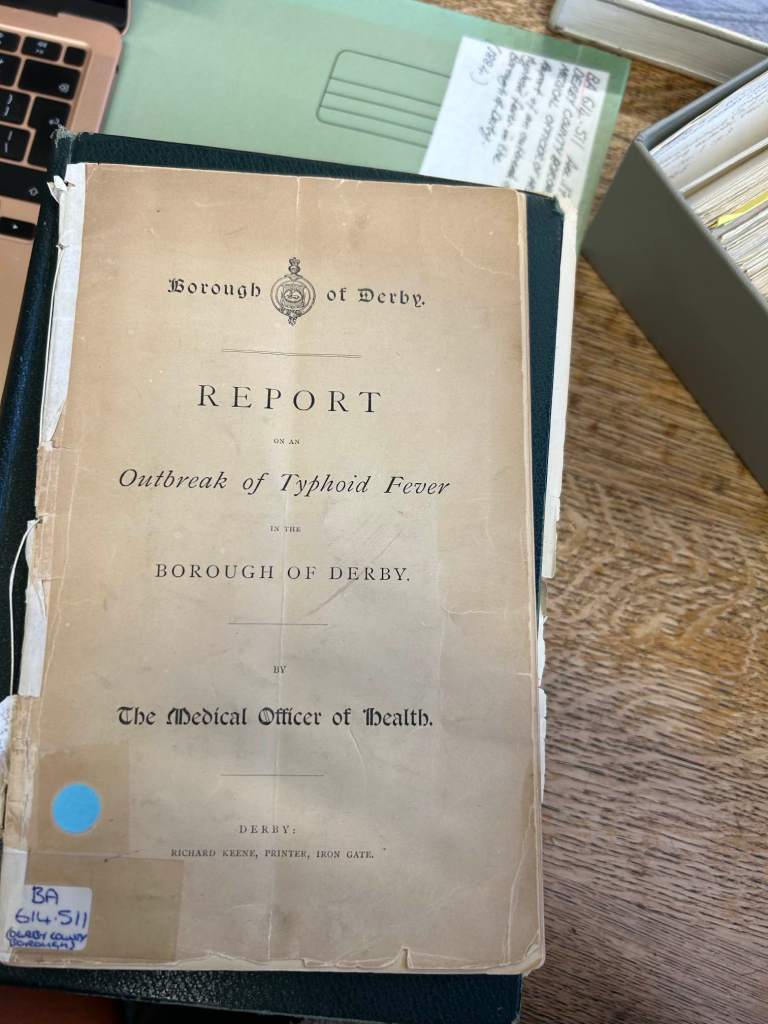
In 1884, a report was published by the Medical Officer of Health regarding a recent outbreak of typhoid fever that had attacked the borough of Derby. The cause of this outbreak was found to be a milk supply that had been contaminated with typhoid fever. This was not uncommon across the country but was very worrying for a small town like Derby. Local outbreaks were one-half of all investigations of typhoid fever between 1870 to 1890.[1] As you can imagine, the rules and regulations we have now were not in place. Many reforms were welcomed by the public and this was due to the poor sanitary conditions that many lived in, people in Derby included and even on Bridge Street.[2] Typhoid fever was a disease that was unforgiving and a serious bout of illness could affect a person in many ways.[3] Typhoid struck many towns and villages, especially during periods of war and famine.[4] Typhoid hitting Derby in 1884, was unusual as most places had a typhoid epidemic before 1884. A more insidious outbreak of typhoid would strike if it had people consumed contaminated food products, including milk, and Derby is a prime example of this.[5] Once the connection was made between milk and typhoid fever, investigations were made into typhoid fever like the one published by the medical officer of health, and other investigations were made into other contagious diseases such as scarlet fever, diphtheria, and tuberculosis.[6]
The prime focus of the investigation was milk and how it had been allowed to spread disease so ferociously. The link between typhoid and milk had only been established about 10 years prior. In 1873, there was a growing concern that under the right conditions, milk could spread epidemics.[7] However, from the 1870s, the source and spread of diseases were more important than the nature of the germ.[8] This is not surprising for the nineteenth century, as germ theory was just being established and miasmic theory was still very popular. Due to typhoid being the first disease linked to milk, these outbreaks received considerable attention.[9] It has been argued that it was the most important disease to British epidemiologists in the second half of the nineteenth century.[10] This can be seen from the report and the reaction to typhoid in the Derby Mercury at this time. Milk had also been constructed as a nutritious food but when it was linked to typhoid it became tainted with filth and disease.[11] This was mainly due to the adulteration that the milk went through. Milk was often tainted and things such as food, hair, skin, and cobwebs could get into the milk supply.[12] Sounds very appealing, indeed! However, to combat this, pasteurization and sterilization were developed as the most efficient techniques to stop bacteria.[13]
In the report published by the Board of Health, it states, ‘Shall it become necessary for every part of the country to have its typhoid epidemic before steps are taken to prevent what is eminently preventable, via, the suffering, anguish, and loss of life that inevitably follow in the wake of every such epidemic?’[14] Health reform was a long process in the nineteenth century, and as the report states a lot of what could be solved was ‘preventable.’[15] This was the case with milk as many steps could have been taken such as sterilization and keeping areas where milk was produced clean. The report then states that milk had an ‘immense power for evil’ and that this was based on ‘knowledge… so expansively gained and so conclusively proved.’[16] This links back to the research that had been done to conclude that milk had the power to spread disease if it was contaminated with dirty water or people who had been infected with typhoid. Even though the report was mainly an investigation into the spread of typhoid, the author asked the people reading this how they ‘allow such a state of things to continue as exposes people to these dangers?’[17] In all kinds of reform in the nineteenth century, trying to change people’s minds about health, especially relating to poverty, was a hard process. Reform around milk was still new and people were still sloppy with food regulation. They still mixed dirty water with milk to adulterate it but some may have had no choice as it would have been their normal water supply. This may have also been the case for the dairyman on Bridge Street Joseph Gibson. They also warn of the dangers of what may happen if people are not protected. It states ‘for if milk… cannot be protected from contamination there is no telling who may not suffer,’ this shows that typhoid could affect anyone and was not necessarily a poor person’s disease.[18] The outbreak in Derby was caused by the owners of Littleover Farm being infected by typhoid and therefore infecting the milk supply and this would have affected business for Bridge Street. This was the main supply in Derby and therefore the dangers of this would have affected business. However, some would have been unaware of the link between typhoid and milk.
‘Milk as a Source Of Disease’
There was also a reaction from the public around this outbreak. In an article published by the Derby Mercury, ‘Milk as a Source of Disease,’ on the 18th of June 1884, they blame the owners of the farm for the outbreak. They state ‘the cow is not susceptible of acquiring typhoid’ and it cannot ‘transmit the poison’ through anything it is fed.[19] This shows the anger towards dairymen who would have been altering the milk and therefore infecting it with typhoid. This would not have been good for the dairymen of Derby and their reputations would have been damaged by this outbreak and this article in the Mercury. They also highlight how dairymen could combat this but choose not to. They write about washing utensils with steam and that if this was done they would not have as much chance to spread disease. They also implore the dairymen of Derby to look after their stock, use clean water, and not sell the milk of diseased animals. This article would have been very damaging to the reputations of dairymen and potentially damaging to the dairyman on Bridge Street, Joseph Gibson. This article could also link to the idea of a moral panic. Moral panics when the media turns something into a threat and implores others to fix it. Some notable examples of this in the past have been the mod and rocker clashes in the 1960s, or even hoodie-wearing in the last 20 years. Making milk out to be a threat is an example of a local moral panic .
Looking at the outbreak of typhoid fever and the Bridge Street dairyman Joseph Gibson, we can see the impact that the 1884 outbreak of typhoid fever had on the city of Derby and Bridge Street. We can also see wider links to public health reform not just in Derby but also around the country and how this was not a new problem, but the disease of typhoid did allow for improvements to be made in health reform and food regulation.
[1] Jacob Steere-Williams, ‘Performing State Medicine During its ‘Frustrating’ Years: Epidemiology and Bacteriology at the Local Government Board, 1870-1900,’ Social History of Medicine, 28.1, (2015), p. 95
[2] Michael Sigsworth & Michael Worboys, ‘The Public’s View of Public Health in Mid-Victorian Britain,’ Urban History, 21.2, (1994), p. 240
[3] Bill Luckin, Death and Survival in Urban Britain: Disease, Pollution and Environment, 1800-1950 (London: Bloomsbury Academic, 2020), p. 26
[4] Luckin, Death and Survival in Urban Britain, p. 35
[5] Luckin, Death and Survival in Urban Britain, p. 35
[6] Jacob Steere-Williams, ‘The Perfect Food and the Filth Disease: Milk-Borne Typhoid and Epidemiological Practice in Late Victorian Britain,’ Journal of the History of Medicine and Allied Sciences, 65.4, (2010), p. 514
[7] Steere-Williams, ‘The Perfect Food and the Filth Disease,’ p. 531
[8] Steere-Williams, ‘The Perfect Food and the Filth Disease’, p. 541
[9] Jacob Steere-Williams, ‘The Perfect Food and the Filth Disease: Milk, Typhoid Fever, and the Science of State Medicine in Victorian Britain, 1850-1900,’ (doctoral thesis, University of Minnesota, 2011), p. 13
[10] Jacob Steere-Williams, ‘The Perfect Food and the Filth Disease: Milk, Typhoid Fever, and the Science of State Medicine in Victorian Britain, 1850-1900,’ (doctoral thesis, University of Minnesota, 2011), p. 103
[11] Jacob Steere-Williams, ‘The Perfect Food and the Filth Disease: Milk, Typhoid Fever, and the Science of State Medicine in Victorian Britain, 1850-1900,’ (doctoral thesis, University of Minnesota, 2011), p. 16
[12] Chris Otter, ‘The Vital City: Public Analysis, Dairies, and Slaughterhouses in Nineteenth-Century Britain,’ Cultural Geographies, 13.4, (2006), p. 524
[13] Otter, ‘The Vital City’, p. 524
[14] “THE RECENT TYPHOID FEVER OUTBREAK IN DERBY.” Derby Mercury, 17 Dec. 1884. British Library Newspapers
[15] “THE RECENT TYPHOID FEVER OUTBREAK IN DERBY.” Derby Mercury, 17 Dec. 1884. British Library Newspapers
[16] “THE RECENT TYPHOID FEVER OUTBREAK IN DERBY.” Derby Mercury, 17 Dec. 1884. British Library Newspapers
[17] “THE RECENT TYPHOID FEVER OUTBREAK IN DERBY.” Derby Mercury, 17 Dec. 1884. British Library Newspapers
[18] “THE RECENT TYPHOID FEVER OUTBREAK IN DERBY.” Derby Mercury, 17 Dec. 1884. British Library Newspapers
[19] “MILK AS A SOURCE OF DISEASE.” Derby Mercury, 18 June 1884. British Library Newspapers
 Derby's Dark Corners