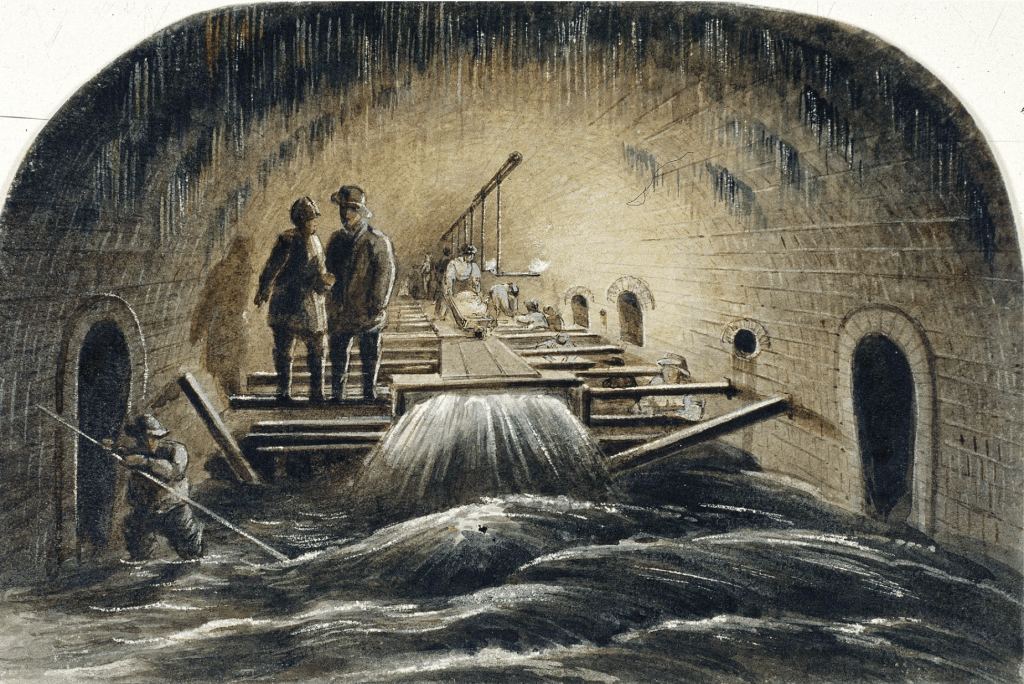
The Victorian water system was an inadequate issue that many groups in society cared for, including the upper class. Whether it was for their own personal gain within an interest group or it was to help the industrial working class, these groups wanted to change the water system in Victorian society. The industrial working class of Derby was no exception to the issues at the hand of water and water supply faced by manufacturing towns. W. Wigginton was an individual who cared for the poor and this is seen across his work as he writes about solving the issues that face Derby but despite these solutions there was no executions.
Who was W. Wigginton?
W. Wigginton was an intellectual, who was not only an architect, but he was also a freemason.[1] He wrote the book Sanitary Reform: Model Town Dwellings for the Industrious Classes in 1850. W. Wigginton was someone who cared for the poor as seen within the book itself using his architectural knowledge, he expresses the change that needed to happen within Derby for the water supply to be an acceptable standard and for the “blessings of health” to be among the poor.[2]
W. Wigginton’s solutions to the problems of Derby
Amongst historians it can be agreed that Victorian society had many problems, unsanitary water being one of them.[3] As water was not as clean as it is today, with many working-class Victorians relied on wells that contained sewage to be used for their day to day lives.[4] The issue within Victorian society is that the industrial working class were looked down upon for their dirtiness as there was a common misconception that the poor chose to be dirty.[5] The issue for the working class was that the upper class Victorians made dirtiness itself a crime.[6]
W. Wigginton wrote within his book the section, “Supply of water’ where he talks of the importance of water and how development could be achieved. Firstly, he expresses the importance of pure water for the poor, because nothing can be done without it.[7] This relates to the importance of health and the criminality of dirt, as W. Wigginton expressed having a constant supply of water was vital for each family.[8]
These issues were not only found in the Midlands but Nation-wide as well. However, water supply was dealt by local government, which meant there were variations between how water supply was organised in each borough.[9] Even then there were different interest groups that argued over the politicisation of the water supply and Derby was no exception.[10] As W. Wigginton expressed how water should be in the hands of the public, rather than interest groups as their constant disputes hindered development.[11] W. Wigginton believed the public could handle water supply more efficiently.
W. Wigginton’s architectural knowledge is shown with the solution of pipe work, as he pointed out the solution for deteriorating pipes. As the lead pipes deteriorates over time as the water passes through them, however he recommends “gutta percha” (a natural resources that is like rubber but is resilient).[12] W. Wigginton demonstrates in less than a page the issues within the manufacturing town of Victorian Derby and which as he noted could save many valuable lives.[13]
Lack of development
Wigginton’s work as an architect shows an inside knowledge to helping society and his work had solutions to the issues, however, there was no executions of development for Derby at this time. It can be noted that despite the works like W. Wigginton’s, there was still a lack of development in Victorian water supply, not only within Derby but on a nation-wide scale. This was because of the lack of local government organisation. As well as the argument between interest groups on how the water supply should be treated, the clash of interest groups on water supply was a limited factor of the time for developments.[14]
Who this written to and the bigger picture?
Sanitary Reform: Model Town Dwellings for the Industrious Classes was written in hope of change from an intellectual standpoint. However, sadly this was not the case, but Derby was not the only location that struggled with working class and insanitary water.
This is shown as the book was written to firstly, Lord Ashly M.P, also known as Lord Shaftsbury. As well as it was written to the Chairmen of General Board of Health.[15] This was to gain the local problems of Derby as well as national problems by allowing this book to have the attention of the General Board of Health. While W. Wigginton wrote on the local issues of water and water supply of Derby, the solutions can be used on a national level regarding water, to help all working-class people regarding health.
Lord Ashly M.P. was someone who cared for the industrial class, as he was the chairmen of the society for improving the conditions of the labouring classes.[16] By writing to Lord Ashly M.P., an influential figure, shows that he could have the momentum to help the working class, yet sadly this did not occur. Not only was Sanitary Reform: Model Town Dwellings for the Industrious Classes written to Lord Ashley but so was other work such as The Habitations of the Industrial Class which also talks of the concerns of the working class and their health, which does include water supply as well[17]. Nevertheless, while solutions were found there were no executions.

Pinwell, G., ‘’Death’s Dispensary,’, Fun Magazine, London 1866
This is because of the problems of not only local government and clashing interest groups but also the General Board of Health.[18] This is seen in 1850 as a report of the 1848 and 1849 cholera outbreak included knowledge of how to stop it, and with solutions given by W. Wigginton, there was still no development.[19] This frustration can also be seen through the General Board of Health on the 14th of July 1854 parliamentary debate. Where it could be agreed that the lack of progress on the physical conditions of people, disgusted the whole country and the Board of Health was not executing the solutions of issues that would help the people.[20]
W. Wigginton’s source is one of many of across the country that showed the potential for development. While showing the issues of water within Derby, it showed the solutions to benefit the manufacturing town that sadly never truly devolved, causing a continuation of negative health aspects of the poor and for them to be deemed lesser for their dirtiness.[21]
Joe Coucher
[1] Anon, ‘Advertisements & Notices’, Derby Mercury, Sept. 5, 1849, pg 2: Anon, ‘The Freemason: weekly journal of Freemasonary, literature , science and art, Freemason, July 19 1890, pp. 6
[2] Wigginton, W., Sanitary reform: model town dwellings for the industrious classes, 1850, pp. 36
[3] Craven, M. An Illustrated History of Derby. (Derby: Breedon, 2007), pp. 198; Symonds, J., “Dirty Old Town? Industrial Archaeology and the Urban Historic Environment.” Industrial archaeology review 27:1 (2005), pp. 64; Costantini, M. ‘Mapping Gothic London: Urban waste, Class rage and Mixophobia in Dan Simmons’s Drood’, in Kohlke, M.L. & Gutleben, C. (Eds.), Neo-Victorian Cities : Reassessing Urban Politics and Poetics (Boston: Brill, 2015), pp. 179; Butterton, H., Victorian Derby : a Portrait of Life in a 19th-Century Manufacturing Town. (Derby: Breedon, 2006.), pp. 67-8
[4] Craven, M. An Illustrated History of Derby. (Derby: Breedon, 2007), pp. 198
[5] Freeland, N. “The Politics of Dirt in ‘Mary Barton’ and ‘Ruth.’” Studies in English literature, 1500-1900, 42: 4 (2002), pp. 802
[6] Freeland, N. “The Politics of Dirt in ‘Mary Barton’ and ‘Ruth.’” Studies in English literature, 1500-1900, 42: 4 (2002), pp. 804
[7] Wigginton, W., Sanitary reform: model town dwellings for the industrious classes, 1850, pp. 36
[8] Wigginton, W., Sanitary reform: model town dwellings for the industrious classes, 1850, pp. 36
[9] Symonds, J., “Dirty Old Town? Industrial Archaeology and the Urban Historic Environment.” Industrial archaeology review 27:1 (2005), pp. 64
[10] Hassan, J., Taylor, P., “The politics of water in early and mid-Victorian Britain: the experience of Bolton”, The Historic society of Lancashire and Cheshire, vol 148 (1998), pp. 119
[11] Wigginton, W., Sanitary reform: model town dwellings for the industrious classes, 1850, pp. 36
[12] Wigginton, W., Sanitary reform: model town dwellings for the industrious classes, 1850, pp. 36
[13] Wigginton, W., Sanitary reform: model town dwellings for the industrious classes, 1850, pp. 36
[14] Symonds, J., “Dirty Old Town? Industrial Archaeology and the Urban Historic Environment.” Industrial archaeology review 27:1 (2005), pp. 64; Hassan, J., Taylor, P., “The politics of water in early and mid-Victorian Britain: the experience of Bolton”, The Historic society of Lancashire and Cheshire, vol 148 (1998), pp. 119
[15] Wigginton, W., Sanitary reform: model town dwellings for the industrious classes, 1850, pp. 1
[16] Gavin, H., The Habitations of the Industrial classes: The Influence on the physical and on the social and moral conditions of these classes: showing the necessity for legislative enactments: being in address, delivered at Crosby Hall, November 27th, 1850, 1851, pp. 1
[17] Gavin, H., The Habitations of the Industrial classes: The Influence on the physical and on the social and moral conditions of these classes: showing the necessity for legislative enactments: being in address, delivered at Crosby Hall, November 27th, 1850, 1851, pp. 9, 16, 17, 21
[18] Symonds, J., “Dirty Old Town? Industrial Archaeology and the Urban Historic Environment.” Industrial archaeology review 27:1 (2005), pp. 64
[19] Welcome collection, Report of the General Board of health on the Epidemic of Cholera, 1948-149, London, Presented to both houses of Parliament, 1850
[20] UK Parliament, ‘The General Board of Health (HL Deb 14 July 1854 vol 135 cc234-43), Hansard, Available online: https://api.parliament.uk/historic-hansard/lords/1854/jul/14/the-general-board-of-health [Accessed: 3 January 2023]
[21] Freeland, N. “The Politics of Dirt in ‘Mary Barton’ and ‘Ruth.’” Studies in English literature, 1500-1900, 42: 4 (2002), pp. 804
Illustrations
Pinwell, G., ‘’Death’s Dispensary,’, Fun Magazine, London 1866
Unknown artist, ‘Living in fear: the dangers of Victorian London’, history extra, available online: https://www.historyextra.com/period/victorian/victorian-london-dangers-what-was-life-like/ [accessed 3 January 2023]
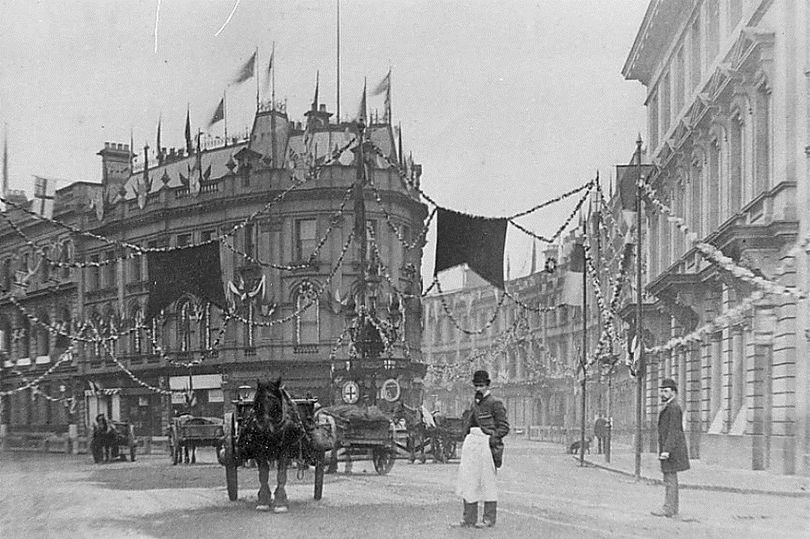
Unknown photographer, ‘Floral decorations adorn the junction of the Strand, the Wardwick and St James’s Street for Queen Victoria’s visit to Derby in 1891’, Derby Telegraph, Avaiable online: https://www.derbytelegraph.co.uk/news/nostalgia/fabulous-old-photos-showcase-one-2512981 [accessed 21 December 2023
 Derby's Dark Corners