Alcoholism and substances abuse: social investigators in the victorian slums
The rise of alcoholism and substance abuse throughout the long nineteenth century has most commonly been associated with the working class slums as With the creation of the phase the deserving poor emerged. As the Victorian’s sensationalised alcohol consumption and drug use, many were attracted to become social investigators such as Charles Booth which will be discussed in more detail later.
Alcoholism and substance abuse from the early nineteenth century to mid twentieth century was one area that caused social scrutiny. This type of alcoholism and drug use was perceived as a moral deviant that was commonly associated with the deprived urban communities[1] otherwise known as the slums.
Throughout the industrialisation process of the nineteenth century drug use became rampant due to increased opium trade, strongly associated with the East India Trading Company. This was particularly rife within the working classes. [2] Initially the use of substances such as opiates were not seen as an addiction but rather a habit [3]. From the early nineteenth century proceeding into the early twentieth century, many forms of popular culture noted the impact of alcohol and drugs use. The popularisation of alcoholism and drug use can be seen in works such as Alice in Wonderland as noted by Kristina Aikens.
Lewis Carroll, Alice In Wonderland (1865) noted by Kristina Aikens
“the substances Alice consumes in Wonderland are never called drugs specifically, but her encounters with mysterious bottles filled with strange substances, cakes imprinted with injunctions to consume them, hookah-smoking caterpillars, and magical mushrooms — all of which appear to Alice in a dreamspace, and which distort her sense of her body, space, time and logic — have become associated in the popular imagination (today’s at least) with drug consumption.”[4][5]
Therefore it is likely that the Victorian sensationalism culture fueled the use of drugs and alcoholism and it was the very same sensationalism culture that drove social investigators to tackle the problem. Sensationalism pushed many social investigators such as Charles Booth to study and observe police proceedings. Police notebooks prove to be a very insightful and interesting source to examine the practises of the slum as well as social investigators views of these activities.
Charles Booth used police notebooks in particular in order to quantify the severity of drunkenness and drug use. The extract from one police notebook shown below is just a small insight into the documentation that was available to Charles Booth.
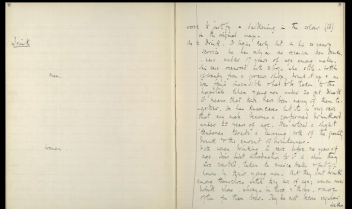
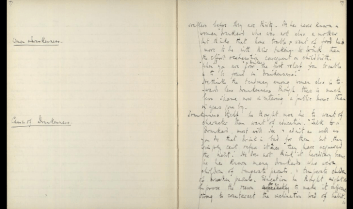
The notebook it self starts off by remarking on the maps, most likely the maps designed by Charles Booth outlining areas of poverty. George H. Duckworth noted on pages 173 to 175 the colouring of 5th district area of North Barns road London illustrated on Charles Booth’s map[6]. He comments [7]“To justify a darkening in the colour in the original map” [8]. The sensationalism surrounded by increased moral panic of drunkenness attracted the attention of not only the police but also social investigators.The source shown above is a prime example of communication between the different institutions on how to categorise the issues at hand by finding the source of the disturbance. Thus emerged the debate of “self-inflicted poverty by drunkenness”. This phrase became closely linked with the instability of the working classes. In 1876 the per capita consumption of beer was 34.4 gallons the highest it had been in over a century[9]. It is estimated that the average working class family spent one fifth of its annual income on alcohol as discussed by Joseph Rowntree and Arthur Sherwell[10]. Opium imports also rose with 17,302 pounds in 1827 to a staggering 61,269 pounds by 1859.[11] The rapid increase of alcohol and drug consumption had been closely related with the development of the British empire and an increased trading between colonies. However this did not disrupt the social unrest at large.
Many forms of popular culture from books to newspapers illustrated the high levels of substance abuse.
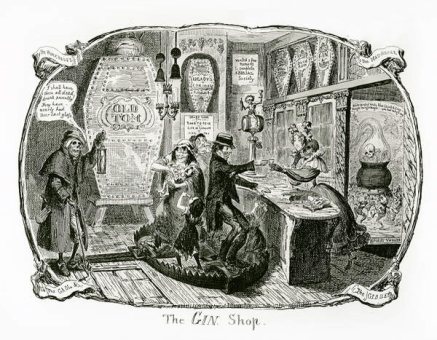
This engraving depicts what seems to be a middle to upper class lady serving some sort of alcohol most likely from the description of the engraving gin. Present with her is two older women who are presented to be unkempt and decrepit giving the impression of a lower class. One of the women who is more visible seems to be carrying an infant along with having a young child at her feet. Standing next to her is man, who also seems to be unkept and decrepit, being served the alcohol. Both figures are seen standing in a trap.
This symbolism is an indicator into the thoughts surrounding alcohol consumption. By presenting the women as older and decrepit it removes her femininity indicating her failings as a women and a mother due to her consumption of alcohol.
Another figure present at the door is a skeleton figure again dressed in a manner presumed to be working class, thus symbolizing the effect of alcohol consumption, by choosing the symbol of a skeleton it is a strong indicator that the thought of constant alcohol consumption led to death along with this the association with the working classes .
On closer inspection, it is visible of what seems to be the back room of the gin shop. A cauldron of some sorts, with a skull type image emerging from the fumes. with humanoid type figure dancing around the cauldron. Thus representing the demonisation of alcohol by incorporating common symbolism such as minicher devils, indicating a religious discourse with the consumption of alcohol. Again linking to the commonly held through that constant alcohol consumption led to death and ultimately being sent to hell.
Drinking and drug consumption was clearly more noted and referenced within the long 19th century[12]. The growing demonisation of substances abuse was rife within all aspect of society, with social and cultural aspects at the forefront. However attractive the study of alcohol consumption may be to social investigators such as Charles Booth, it was argued it did not warrant such outcry.
“There is, as regards these habits, a consensus of opinion which to my mind carries conviction, that while there is more drinking there is less drunkenness than formerly, and that the increase in drinking is to be laid mainly to the account of the female sex. The latter phase seems to be one of the unexpected results of the emancipation of women[13][14]
Although thought to be the culprit of the poverty stricken slums, alcohol and substance abuse was just a symptom of economic and cultural fluctuation following on from the work of Charles Booth.
references
[1] Moss,S,. ‘‘‘An abnormal habit’’: Alcohol policy and the control of methylated spirit
drinking in England in the 1920s and 1930s’ Drugs education, prevention policy 22:2 (2015) pp 119
[2] Dr Andrzej Diniejko, Dr Litt, ‘ victorian drug use’ (07 september 2002). Available online :http://www.victorianweb.org/victorian/science/addiction/addiction2.html Date accessed :05 December 2018.
[3] Dr Andrzej Diniejko, Dr Litt, ‘ victorian drug use’ (07 september 2002). Available online :http://www.victorianweb.org/victorian/science/addiction/addiction2.html Date accessed :05 December 2018.
[4] Aikens, Kristina. A Pharmacy of Her Own: Victorian Women and the Figure of the Opiate. Ann Arbor, MI: ProQuest, 2008
[5] Dr Andrzej Diniejko, Dr Litt, ‘ victorian drug use’ (07 september 2002). Available online :http://www.victorianweb.org/victorian/science/addiction/addiction2.html Date accessed :05 December 2018.
[6] George H. Duckworth’s Notebook: Police District 2 [Strand and St Giles], District 3 [St James, Westminster, Soho, All Saints and Tottenham Court Road], District 9 [Bethnal Green, North and South], District 22 [Cavendish Square and St John’s Paddington],District 23 [St Mary Paddington and Kensal Town] 1898, BOOTH/B/355 pages 173-178
[7] J.B.Brown, ‘The pig or The stye:drink and poverty in late victorian england’ international review of social History. 18:3 pp 380-395
[8] George H. Duckworth’s Notebook: Police District 2 [Strand and St Giles], District 3 [St James, Westminster, Soho, All Saints and Tottenham Court Road], District 9 [Bethnal Green, North and South], District 22 [Cavendish Square and St John’s Paddington],District 23 [St Mary Paddington and Kensal Town] 1898, BOOTH/B/355 pages 175-178
[9] J.B.Brown, ‘The pig or The stye:drink and poverty in late victorian england’ pp 382
[10] J.B.Brown, ‘The pig or The stye:drink and poverty in late victorian england’ pp 382
[11] M. London, Frepsych, ‘ History of addiction: A uk perspective’ The American journal on addiction. 14:97-105 2005
[12] J.B.Brown, ‘The pig or The stye:drink and poverty in late victorian england’ pp 380
[13] Drink And Drugs”, Charles Booth’S London, Poverty Maps And Police Notebooks, 2018 <http://Booth.lse.ac.uk/highlights/drink-and-drugs> [Accessed 6 December 2018].
[14] Charles Booth, Life and Labour of the people in loudon(loudon: macmillan, 1902-03), vol 17. P 59
 Derby's Dark Corners