Social investigators assisted in the exposure and reform of Britain’s slums, highlighting major issues that families faced whilst living in the ‘titillating squalor of the slums.’[1] One overriding social failing of Victorian Britain was the conditions in which working-class families were being forced to endure, such as overcrowding, poor housing and disease. In a bid to try and improve some of the problematic social aspects, members of the upper and middle-classes, or social investigators often took it into their own hands by visiting slums ‘to investigate and study the poor, and to succour them’[2], by doing ‘their best to publicise them in the name of social science, civic duty, and Christian love.’[3] The role social investigators played in improving family life for working-class citizens is one of great importance as their exposure of issues resulted in the start of a social shift that marks the very beginnings of Britain’s welfare system.
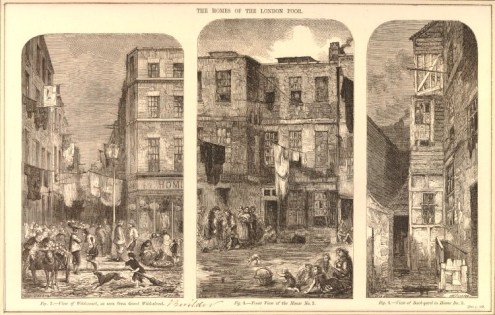
‘With increased concern with the dwelling conditions found in the nations urban slums this was expressed in a number of influential late nineteenth-century social and philanthropic tracts’ with housing reforms playing a pivotal role in social investigators work.[4] To take a look at what life was like for families living in the slums we can use a number of resources from social investigators such as illustrations, newspapers and reports. This particular illustration (Figure 1), taken from ‘The builder magazine’ (which focused on architecture), shows a depiction of what slum housing conditions were like, wooden shanty towns that were over occupied and lacking in necessities such as clean streets and water, which allowed for disease to breakout and spread easily.
When looking closely at this illustration there are a number of slum elements that are being exposed, however with it being published in a building magazine the main focal point was primarily the architecture. Key aspects that can be addressed from this source are, of course, the dilapidated state of the housing, but not only that, upon observation there is a large amount of people in comparison to the number of houses on the street in this London slum, this is because the ‘urban proportion of the population advanced from approximately 33% in 1801 to 50% in 1851, to 72% in 1891’ which led to mass overcrowding[5]. Overcrowding of slums was due to a number of reasons, some families simply could not afford rents elsewhere, and there is also the fact that Victorian working-class citizens often had larger families, both to help with income and due to high death rates resulting in many parents having more children in the case that some did not survive past infancy- due to this there would often be families of ten in two bedroom slum homes. Not only does overcrowding bare serious health and sanitation disadvantages, the harsh conditions families had to survive in caused further hindrance, with a lack of bare essentials that had to be spread across the entire family. In the middle section of the illustration there is a family sat begging for food, whilst all appearing in an unkempt, unhealthy state, a sight that was too common amongst slum districts for social investigators. Issues highlighted in this illustration are what many investigators focused on when observing how families lived amongst the slums and were often helped by charity organisations, such as Barnardo’s who provided aid to children in poverty by providing them with education, food, clothes and all basic necessities.
It was, however, the outbreak of Cholera that brought the most attention onto exposing
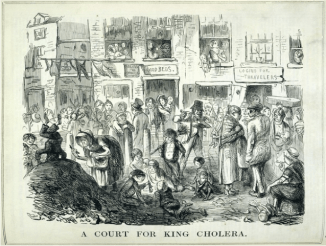
the slums and wanting to reform them, following the introduction of the Poor Law many had disregarded the conditions in which families were condemned to as the poor were believed to be idol and drunks. Due to the devastation left behind following the deaths of hundreds of thousands many social investigators took more action in trying to prevent further devastation to the broken families. one particular social investigator that exposed living conditions for poor families within a slum was, Henry Mayhew, who focused on disease and lack of sanitation within slums. Mayhew helped to expose the conditions of slums by writing a weekly column in the Gazette Newspaper, later known as London labour and the London Poor, where focuses on improving such conditions as he believed ‘it was crucial to the health, lives and character of the nineteenth-century poor.’[6] The exposure from Mayhew and others alike such as Edwin Chadwick resulted in improved sanitary conditions, including sewage systems and clean water made available to everyone, in order to aid the poor and prevent another Cholera epidemic.
Due to social investigators exposure of conditions for families in urban slums were able to improve, housing conditions were set standards, meaning that all houses would be ventilated efficiently unlike some in the back -to- backs that had no windows in some rooms. As well as general housing conditions, the sanitary improvements that were enforced due to the work of social investigators exposure allowed for great strides. However, the most important work that social investigators did was exposure of the truth of working- class families, that they are normal citizens who deserved a chance to survive, class structures were altered allowing for a better life for the working-class.
[1] Koven, S., Slumming: Sexual and social politics in London (Oxfordshire: Princeton University Press, 2004), P.5.
[2] Koven, Slumming: Sexual and social politics in London, P.5.
[3] Koven, Slumming: Sexual and social politics in London, P.5.
[4] Wilson, N., Home in British Working-Class Fiction (Surrey: Ashgate Publishing Limited, 2015) P.38
[5] Rodger, R., Housing in urban Britain 1780-1914 (Cambridge: Cambridge University Press, 1995) P.7
[6] Wilson, N., Home in British Working-Class Fiction (Surrey: Ashgate Publishing Limited, 2015) P.18
Illustrations
Figure 1
Sheers. W. Charles., The Homes of the London Poor. 1854, British Museum, London, available online: http://www.britishmuseum.org/research/collection_online/collection_object_details.aspx?objectId=3283178&partId=1&searchText=London+slums&images=true&from=ad&fromDate=1800&to=ad&toDate=1870&object=20898&page=1 Date accessed: 15 October 2018.
Figure 2
Gustave, Dore Dudley Street, Seven Dials, from ‘London: A Pilgrimage’, Engraving 1872, Museum of London, London.
 Derby's Dark Corners