The light of a new perception: Social Investigators and the challenge of class relations
The work of social investigators within the slums of London became the base for a new field of social science, or sociology. A reaction to the sensationalism of journalism and the press became a catalyst for the work of the social investigators, who challenged pre-conceived class boundaries in their methods and aimed to dispel the myths shrouding the slums.
The sensationalism of the press in reporting the conditions of London’s slums and the social stain of poverty can be epitomised by the engravings of Gustave Doré, under the commission of journalist William Blanchard Jerrold.[1] Figure 1 is an engraving from their collection, which totalled to 180 engravings. Figure 1 shows the poverty of London
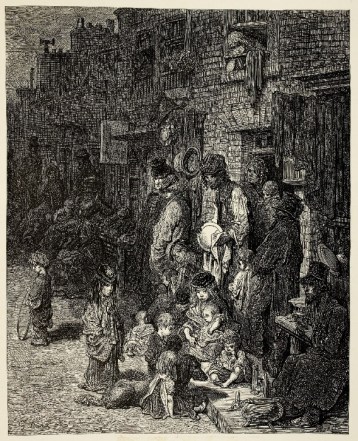
through the use shadow engraving. A shadow technique only adds to the personification of the ‘doom and gloom’ of the slums. The depiction in Figure 1 is one of desperation and chaos; a typical middle-class view of London slums. One of the main criticisms of this work was that the engravings focused on the extremes of poverty.[2] It was this extremism that social investigators wanted to challenge with their work.
Doré’s engravings represent a direct contrast to what social investigators aimed to portray. Figure 2 is an image of Charles Booth’s poverty maps, that were produced to give a statistical analysis of London’s slums. Booth’s maps were displayed to both the general public, and to a scholarly audience in an attempt to display the true nature of poverty to all classes.[3] Booth’s poverty maps classified the working classes to distinguish between different levels of poverty. This was illustrated by colours on the poverty maps, to visually highlight the problem of poverty. By including all levels of poverty, Booth moved the focus away from the destitute and extreme cases to include the working poor. This inclusion contrasts the extremism seen in journalism and in Figure 1. However, Hennock has argued that by creating a class A and class B, which distinguishes between a disorderly class and the very poor, Booth “dispels fear of overthrow of civilisation by barbarians of slums”.[4] Evaluating Hennock’s argument suggest that the classification of the working class by Booth achieved a statistical analysis of the slums, but this was completed in a way that would appeal to a middle class audience and calm any fears of poverty to gain support for reform.
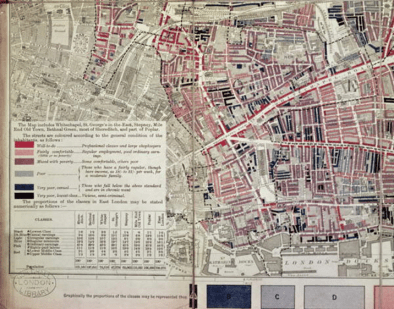
Furthermore, Booth’s poverty maps became an early example of social cartography[5]. The illustration of the geographical status of class continues to contrast sensationalism as highlighted in the use of cartography is a level of social mobility. The colour and categorisation of London’s slums used in the poverty maps reveals that boundaries between classes are more fluid than they first appeared.[6] Environmental factors and seasonal work led to many families engaging in precarious lifestyles that mobilised class definitions. Seasonal work was able to project families from one category to another and created social mobility amongst the working class that was not accounted for in a stereotypical middle-class view of the slums. Social mobility was recognised in this statistical analysis and income was used to define family’s level of poverty. The importance of an income-based categorisation that acknowledges social mobility rather than social class demonstrates the value of the work social investigators competed[7]. Booth’s method of categorisation of London’s slums breaks down rigid class hierarchies that were present in society, both through his methods of investigation and the presentation of social mobility.
Class boundaries in British society blurred how poverty was understood amongst the upper classes. It became fashionable in the middle classes to engage in ‘slumming’, a form of urban tourism amongst the roughest streets of the slums.[8] These tours exaggerated the role of sensationalism in portraying the conditions of the poor. Middle class anxieties of the poor as a “brutalised race” were echoed in sensationalist journalism and urban tourism.[9] These preconceived perceptions and fears altered the role of the social investigator, who broke down this hierarchical society to conduct their research. To challenge these fears, social investigators entered the slums not as tourists who objectified its occupants, but to “understand the causes and contributory factors to poverty”[10]. Using methods such as questionnaires and interviews with occupants of the slums created an unfiltered view of London’s poor, that contrasted against sensationalism. Overt methods dispelled class boundaries between the upper and working classes. Instead of viewing poverty from afar, the social investigators integrated with the working class to find true figures of poverty. However, these methods not only challenged stereotypical middle-class views of poverty but challenged Booth’s knowledge of the slums. For example, Booth did not expect his research to conclude such high levels of poverty in London and find that London’s slums were so close to an economic crisis.[11] This suggests that although Booth had realised the importance of a statistical analysis of poverty, even his view of poverty represented a naivety of his middle-class background. Therefore, class did impact social investigators.
The work of social investigators gave light to a new perception of the slums and dispelled the myths of sensationalism that were evident amongst the upper-classes. The use of scientific measures, such as cartography and statistical analyses created a credible report that would accommodate an audience capable of introducing reform[12]. Supporting this, the poverty maps not only showed the problem of poverty visually to cater for lower classes who had limited literacy skills, but arguably had an ulterior motive. The visual portrayal of poverty changed the public’s perception on the problem, and made it appear much smaller than upper classes had anticipated. This was purposefully done to encourage reform by creating the appearance than tackling poverty was a more manageable task. [13] Therefore, there is clear evidence to suggest that the role of the social investigator broke down class boundaries in their methods and challenged pre-conceived class constructs. Scientific works produced by this community paved the way for social reform that tackled the true causes of poverty. Nevertheless, class boundaries limited their ability to publish some statistics, as their findings had to suit an upper-class audience to some degree in order to gain support for reform. To conclude, a wider theme of social class in London both inspired and impact the role of the social investigators as they responded to the sensationalism of the slums.
References:
[1] Charney, W., ‘Dore after London’, Oz, Volume 11, article 9 (January 1989) pp. 30-35 page 30
[2] British Library, ‘London illustrations by Gustave Doré’ (Feb 2014), available online: https://www.bl.uk/collection-items/london-illustrations-by-gustave-dor date accessed: 9/12/2018
[3] Vaughan, L., Mapping Society: The Spatial Dimensions of Social Cartography (London: UCL press, 2018) page 74
[4] Hennock, E.P., ‘Poverty and social theory in England: The experience of the eighteen‐eighties’, Social history, Volume 1, Issue 1 (1976) pages 67-91 page 75
[5] LSE library: Charles Booth London, ’What were the poverty maps’, available online: https://booth.lse.ac.uk/learn-more/what-were-the-poverty-maps date accessed: 29/11/2018
[6] Englander, D., Retrieved riches; social investigation in Britain, 1840-1914 (Scholar press, 1995)
[7] Vaughan, L., Mapping Society: The Spatial Dimensions of Social Cartography (London: UCL press, 2018) page 69
[8] Roemer, ‘London and the East End as Spectacles of Urban Tourism’, The Jewish Quarterly Review, Vol. 99, No. 3 (Summer 2009), pp. 416-434 page 420
[9] Reeder, D., (ed) Charles Booth’s Descriptive Map of London Poverty 1889 (London: London Topographical Society, 1984 page 2
[10] Vaughan, L., Mapping Society: The Spatial Dimensions of Social Cartography (London: UCL press, 2018) page 67
[11] Maxwell, R., ‘Henry Mayhew and the Life of the Streets’, Journal of British Studies, volume 17, issue 2 (Jan 2014), pages 87-105 page 91
[12] Himmelfarb, G., Poverty and Compassion: The Moral Imagination of the Late Victorians (London: Vintage books, 1992) page 170
[13] Vaughan, L., Mapping Society: The Spatial Dimensions of Social Cartography (London: UCL press, 2018) page 76
Illustrations:
Figure 1: British Library, Wf1/1856, With illustrations by Gustave Dore. This a collection of 180 engravings of London., 1872. Available online: https://www.bl.uk/collection-items/london-illustrations-by-gustave-dor
Figure 2: London School of Economics Library, BOOTH/E/2, Maps Descriptive of London Poverty: hand coloured, 1894-1899. A collection of Booth’s 25 inch ordinance survey second edition base maps. They document the poverty of London and were produced in 1894-1899. Available online: https://archives.lse.ac.uk/Record.aspx?src=CalmView.Catalog&id=BOOTH%2fE%2f2
 Derby's Dark Corners