
School Board Visitors were highly unpopular among the working class population as officials became a human representation of compulsory education, Victorian surveillance and the enforcement of middle class values upon slum society. Historian Nicola Sheldon has deemed them the ‘foot soldiers’ of the local authority as they were faced with more opposition, and often violence, than support.[1] Such strong opposition towards Visitors culminated in public displays of middle and upper class defence of the role, as seen in The Wrexham Advertiser (figure 1) reflecting discrepancies between upper and lower class ideals. Whilst the newspaper article is valuable in gaining an understanding of the role, salary and hardships of Visitors, it must be treated with caution as its primary purpose is to defend the controversial job role thus is likely to exaggerate the complexities and hardships of School Board Visitors. Nevertheless, opposition towards School Board Visitors did exist for multiple reasons.
School Board Visitors were tasked with the job of enforcing school attendance, however compulsory schooling was unpopular in working class families for a multitude of reasons. Social legislation enforced in the latter half of the nineteenth century was viewed by the working classes as breaking with the morals of the past; most notably in the case of education policy, maintenance of family obligation and the need to work to survive.[2] Therefore opposition to schooling was also an opposition to forced changes in family life and hierarchy.
Moreover, schooling was not free in Britain until 1891, despite being compulsory from 1880 onwards, thus paying fees put extra stain on already struggling working class families before this time.[3] Contemporary figures such as activist Maud Pember Reeves recognised the burden children posed on working class households and subsequently noted a child’s wage or role in caring for younger siblings as vital to keeping the family out of the horrors of the workhouse.[4] Such perpetual views that a child was more useful as a wage earner could not be changed by legislation.[5] Further complication was added to the matter in the fact that fees did not just affect the poorest urban families, but also those in smaller towns and rural areas as local trade depressions could significantly impact the family economy.[6] While there were concessions made to those who could not afford fees this relied on parents disclosing personal information such as the family income to a complete stranger, which too was highly unpopular among working class parents.[7] Thus, compulsory education put great strain on many families who were already struggling to survive even with a child’s wage contributing to the household income.
In addition, working class society disliked the forms of surveillance they became subject to in the Victorian era, with School Board Visitors being just one of these forms. Nineteenth century Britain has been deemed the century of surveillance by historians such as Ellen Ross, with Victorians becoming enthralled with the practice of looking.[8] Surveillance was seen as a means of disciplining, controlling and pacifying the lower class population whilst also impersonally asserting hierarchical authority.[9] The importance of Visitor surveillance is reflected in figure 1 in the quotes “see with their eyes” and “hear with their ears”, suggesting that the role was founded on a desire to observe and subsequently interfere in lower classes society. Distaste to constant intrusion is evident in the response district visitor Dora Hope received upon apologising for her mentor intruding on a family’s meal time:
“You see, miss, it ain’t but what I’m very glad to see a lady now and again, but what with the landlord and the School Board and the district visitors, a man don’t feel as if his home’s his own.”[10]
Visitors did not just record and try to enforce school attendance, but also recorded intimate family details such as children’s admission to hospital, illegitimacy, marital splits and adoption, thus representing a power relationship founded on moral controversy and defective parenting.[11] Such intrusion on personal family affairs was bound to be unpopular among the working classes, especially when questioning came from those of a higher class. Furthermore, education in itself acted as a form of surveillance and discipline, as children were taught to be obedient, punctual, clean and deferential to authority.[12] However, this was less protested against compared to more intrusive and obvious forms of surveillance, such as School Board Visitors entering homes and interrogating parents.
Unpopularity also stemmed from the dislike of middle class values which were being enforced upon the lower classes in the latter half of the nineteenth century. Increases in support for education which culminated in the Education Act of 1870, have been viewed as a middle and upper class campaign against the vested interests and everyday needs of the working class population.[13] The Victorian middle classes also stereotyped working class parents as inherently neglectful, selfish and uncaring thus justifying such rigorous state intervention against them.[14] This argument gains plausibility when considering that working-class families were obliged to give personal details to School Board Visitors whereas middle class families were not.
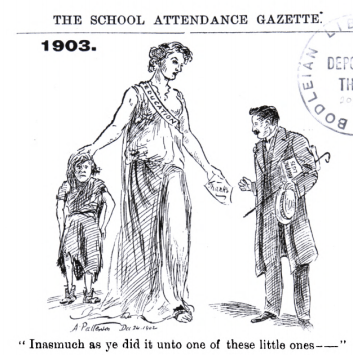
Furthermore, education as a middle and upper class value is reflected in the School Attendance Gazette cartoon (figure 2). The character representing education is depicted as godly and liberating, especially in comparison to the ragged child who the middle class School Board Visitor is thanked for ‘saving’, which resonates further as the Gazette would have had a middle to upper class audience, thus these values were well received by its readership. Of course, a modern day audience understands that education was not always advantageous for all in this period, as reflected in the arguments outlined above.
In conclusion, it was not the role of School Board Visitor which was objected to by the working-class population, but what they represented, stood for and tried to enforce. Visitors were the face of policies which were seemingly ignorant to the needs of slum families thus receiving harsh and often violent responses to what struggling parents perceived as terrible injustices.[16] They also characterised a surveillance culture that became increasingly unpopular in the late nineteenth century with many authorities subjecting almost all aspects of society to its unwelcome gaze.[17] Therefore, School Board Visitors were not opposed for their job, but as figures of authority representing unpopular newfound policies which went against their own values.
Sarah Miles
[1] Sheldon, N., ‘The School Attendance Officer 1900-1939: Policeman to Welfare Worker?’, History of Education, 36:6 (2007), p. 736.
[2] Brown, J., ‘Social Control and the Modernisation of Social Policy, 1890-1929’ in Thane, P. (ed.), The Origins of Social Policy (New Jersey: Croom Helm, 1978), p. 128.
[3] Shuter, J., Victorian Britain (Oxford: Heinneman Library, 2001) p. 17.
[4] Pember Reeves, M., ‘Round about a Pound a Week – The Poor and Marriage’ in Ross, E. (ed.) Slum Travellers: Ladies and London Poverty, 1860-1920 (California: University of California Press, 2007). p. 223.
[5] Davin, A., Growing Up Poor: Home, School and Street in London, 1870-1914 (London: Rivers Oram Press, 1996), p. 208.
[6] Hopkins, E., A Social History of the English Working Class 1815-1945 (London: Edward Arnold, 1979), p.125.
[7] Wise, S., The Blackest Streets: The Life and Death of a Victorian Slum (London: Vintage Books, 2009), p..161
[8] Ross, E., ‘Introduction’ in Ross, E. (ed.), Slum Travellers: Ladies and London Poverty, 1860-1920 (California: University of California Press, 2007), pp. 3 & 14.
[9] Crook, T., ‘Sanitary Inspection and the Public Sphere in Late Victorian and Edwardian Britain: A Case Study in Liberal Governance’, Social History, 32:4 (2007), p. 370.
[10] Dora Hope, ‘My District and How I Visit It’, Girl’s Own Paper, 23 October 1880.
[11] Sheldon, ‘The School Attendance Officer 1900-1939′, pp. 737-738.
[12] Abbot, P., and Wallace, C., An Introduction to Sociology: Feminist Perspectives, second edition (London and New York: Routledge, 2005), p.73.
[13] Perkin, H., The Rise of Professional Society: England since 1880 (Abingdon: Routledge, 1989), p. 121.
[14] Auerbach, S., ‘“The Law Has No Feeling for Poor Folks Like US!” Everyday Responses to Legal Compulsion in England’s Working-Class Communities, 1871-1904’, Journal of Social History, 45:3 (2012), p. 697.
[15] Wise, The Blackest Streets, p.161.
[16] Auerbach, S., ‘“The Law Has No Feeling for Poor Folks Like US!”. p. 701
[17] Croll, A., ‘Street Disorder, Surveillance and Shame: Regulating Behaviour in the Public Space of the Late Victorian British Town’, Social History, 24:3 (1999) pg.251
Illustrations:
Figure 1 – Anon, ‘Duties of a School Board Officer’, The Wrexham Advertiser, 15 February 1873
Figure 2 – The School Board Gazette cartoon, in Sheldon, N., ‘School Attendance 1880-1939: a study of policy and practice in response to the problem of truancy’, PhD Thesis, University of Oxford, 2008, pg.1
 Derby's Dark Corners