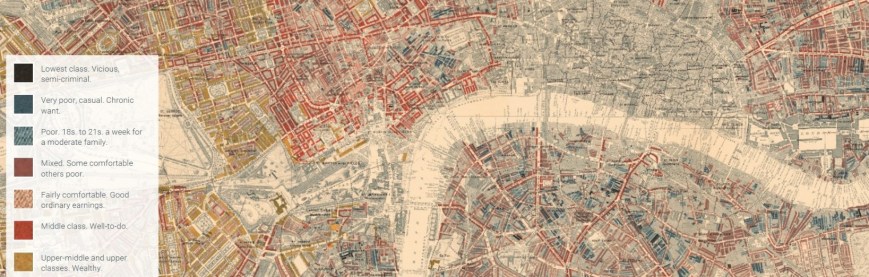
Charles Booth’s first survey of London titled ‘Life and Labour of the People in London’ was published in 1889, and consisted of three broad sections: poverty, industry and religious influences. The poverty series collected information from School Board Visitors who shared their knowledge of the varying levels of poverty within their district, as well as the different occupations of the people they kept records of.[1] The information gathered from the Visitors was used to create maps of London which displayed streets in different colours, in order to show the different levels of wealth and poverty.[2] It is said that these maps were ‘widely circulated and commented upon’, suggesting that the information provided by the Visitors influenced the views of countless people; this demonstrates why their input into Charles Booth’s inquiry of London is important.[3]
Historians Richard Elman and Albert Fried state that Charles Booth’s survey provides a suitable ‘introductory’ exploration of the people who lived in London during this time period.[4] This means that his work is accessible to individuals who have little prior-knowledge of the people living in nineteenth-century London, indicating that it is a useful source, not only for historians to use, but also members of the public who wish to find out how people lived in this period. Therefore, the fact that this source can be easily used by people of varying prior subject knowledge indicates that it is crucial to inspect this source, in order to determine whether the information provided in it is reliable and accurate. Indeed, there has been some controversy as to the reliability and accuracy of the information the Visitors provided, implying that historians need to analyse whether the survey provides valid information of poverty in nineteenth-century London.[5]
Although it cannot be denied that the information gathered from the Visitors could be seen as unreliable, it can be argued that the information is extremely valuable in providing an insight into attitudes towards poverty in the late nineteenth-century. Moreover, the disadvantages of Booth’s research are outweighed by the fact that both quantitative and qualitative methods were used, increasing the reliability of the data that was collected.[6]
When conducting research for the survey, Charles Booth, along with his assistants, interviewed each School Board Visitor for a total of twenty to thirty hours. The interviews involved the researcher noting down the information from the School Board Visitor’s records, as well as any verbal information communicated by the School Board Visitor.[7] This suggests that the data collected from the Visitors consisted of both fact and opinion, which at first glance may imply that the information gathered from these interviews may not be as reliable as hoped; this is because verbal information from memory is often unreliable, as an individual could forget important information. However, the researchers had notebooks which followed the format of the Visitors’ records, meaning that the data they recorded followed each district’s street plans in household order.[8] This shows that the information recorded was in a useful, practical format, since it allowed Booth to accurately create his maps of London which showcase the varying levels of poverty.[9] Therefore, even if some of the information they gathered was simply opinion, it is outweighed by the fact that the interviewers recorded their notes which describe the families of London, house-by-house. Furthermore, including the Visitors’ opinions within the survey is arguably an advantage of the research, because it means that it reflects their attitudes, which can therefore give us a wider insight into middle-class attitudes towards the working-class and the poor in this period.
One major criticism of gathering information from the School Board Visitors is that they may not have had access to all necessary information about people within their district. For example, there was no legal requirement for parents to provide information to the School Board Visitors and on top of this, Visitors did not have permission to enter homes or to inspect evidence of income.[10] Consequently, this suggests that the Visitors had to assess situations and make interpretations about people from external factors and with little information. Arguably, the fact that Booth’s survey relies on Visitors’ subjective assessment of circumstances, means that the accuracy and reliability of the information they provided is questionable. However, Booth took this into account and his comments regarding the use of Visitors in collecting data for the survey reflect that he not only understood the difference between fact and opinion, but that he wanted to gain information that could ‘be proved if disputed’.[11]
‘We can get from the Visitors an opinion on the earnings of each man and I should like to find some way of noting this down for averages; but I feel that at the end it is only an opinion and I hesitate to make it the basis of our classification…I should like to have the School Board Visitors’ view as one item of evidence’.[12]
These comments by Booth demonstrate that he knew he needed other sources of information in order to confirm his findings and to increase the reliability of his survey, since the information collected from the Visitors was predominantly based on opinion. Indeed, the fact that he states he wishes to use the information collected from the Visitors as only ‘one item of evidence’ signifies that the Visitors were only one category of people that he aimed to interview.[13] Furthermore, Booth acknowledged that he needed to find a way to increase the validity of the collected information, so he inspected many neighbourhoods after interviewing Visitors, in order to compare what they had said with what he had witnessed himself.[14]
Although many surveys of working-class life were carried out in the nineteenth century, this survey is the only one ‘for which the original notes and data have survived’, signifying that it is useful in providing primary insight into how people lived in nineteenth-century London, as well as insight of attitudes of poverty.[15] Booth used a variety of research methods for his survey and to create his maps of London, including recording the notes of Visitors’ censuses and even visiting poor areas of London himself, in order to make comparisons with his interviewees’ experiences.[16] Though Booth’s method of predominantly collecting information from Visitors for the poverty series of the survey has been criticised for being unreliable and inaccurate, Booth acknowledged the advantage of having their opinions, since they had ‘daily contact with the people’, so they knew what life for the poor in nineteenth-century London was like.[17] Thus, the Visitors’ input to Charles Booth’s survey of London is immensely useful, since they had knowledge of poverty in London, so they provide valuable insight into the attitudes towards the poor in the nineteenth century.
[1] London School of Economics and Political Science, ‘Charles Booth’s London: Who was Charles Booth?’ (2016). Available online: https://booth.lse.ac.uk/learn-more/who-was-charles-booth Date accessed: 26 November 2018.
[2] Yelling, J.A., Slums and Slum Clearance in Victorian London (London: Allen and Unwin Ltd., 1986), p. 36.
[3] London School of Economics and Political Science, ‘Charles Booth’s London: Who was Charles Booth?’ (2016). Available online: https://booth.lse.ac.uk/learn-more/who-was-charles-booth Date accessed: 26 November 2018.
[4] Elman, R.M., and Fried, A., Charles Booth’s London: A Portrait of the Poor at the Turn of the Century, drawn from his ‘Life and Labour of the People in London’ (Harmondsworth: Penguin Books, 1971), p. 9.
[5] Englander, D., and O’Day, R., Mr Charles Booth’s Inquiry: Life and Labour of the People of London Reconsidered (London: The Hambledon Press, 1993), p. 38.
[6] Spicker, P., ‘Charles Booth: The Examination of Poverty’, Social Policy and Administration 24.1 (1990): p. 21.
[7] Bales, K, ‘Charles Booth’s Survey of Life and Labour of the People in London 1889-1903’, in Bales, K., Bulmer, M., and Sklar, K.K., (eds.), The Social Survey in Historical Perspective, 1880-1940 (Cambridge: Cambridge University Press, 1991), p. 83.
[8] Bales, ‘Charles Booth’s Survey of Life and Labour of the People in London 1889-1903’, p. 83.
[9] London School of Economics and Political Science, ‘Charles Booth’s London: Maps’, (2016). Available online: https://booth.lse.ac.uk/map/14/-0.1174/51.5064/100/0 Date accessed: 29 November 2018.
[10] Englander, and O’ DAY, Mr Charles Booth’s Inquiry, p. 43.
[11] Englander, and O’ DAY, Mr Charles Booth’s Inquiry, p. 39.
[12] Englander, and O’ DAY, Mr Charles Booth’s Inquiry, p. 39.
[13] Englander, and O’ DAY, Mr Charles Booth’s Inquiry, p. 39.
[14] Bales, ‘Charles Booth’s Survey of Life and Labour of the People in London 1889-1903’, p. 83.
[15] London School of Economics and Political Science, ‘Charles Booth’s London: What was the Inquiry?’ (2016). Available online: https://booth.lse.ac.uk/learn-more/what-was-the-inquiry Date accessed: 26 November 2018.
[16] Booth, C., ‘Poverty and Labour in London in the 1880s’, in Marsh, I., Campbell, R., and Keating, M., (eds.), Classic and Contemporary Readings in Sociology (Abingdon: Routledge, 2013), p. 300.
[17] Booth, C., Life and Labour of the People in London (1903), accessed via Victorian London, ‘Education for the poor – School Board Visitors’ (2018). Available online: http://www.victorianlondon.org/education/schoolboardvisitors.htm Date accessed: 29 November 2018.
Illustrations
Figure 1 – London School of Economics and Political Science, ‘Charles Booth’s London: Maps’. (2016). Available online https://booth.lse.ac.uk/map/14/-0.1174/51.5064/11/0 Date accessed 29 November 2018.
Figure 2 – Booth, C., Labour and life of the people (Volume 1) (London: William and Norgate, 1891), accessed via JISC Historical Texts.
 Derby's Dark Corners