“Few persons who have not actual experience of the lives of the poorest classes can have any conception of the serious import to them of the Education Act.”[1]
George Sims, How the Poor Live, 1883
In retrospect, it is as easy to justify the role of the School Board Visitors’ contribution to Charles Booth’s influential investigation of poverty despite magazines like Punch satirising and mocking the position during the late nineteenth century. Punch, alongside other sources, highlighted the disdain for the role already common in popular opinion, ensuring that the image of an intrusive, middle-class and unsympathetic individual would endure as stereotype.[2] Other pages within this section of the exhibition look in greater detail at their unpopularity, as well as Booth’s reliance on the data they provided, but this stereotype is not the whole story of the School Board Visitor, which was the product of much wider moral development that must be regarded as progressive if imperfect in practice.
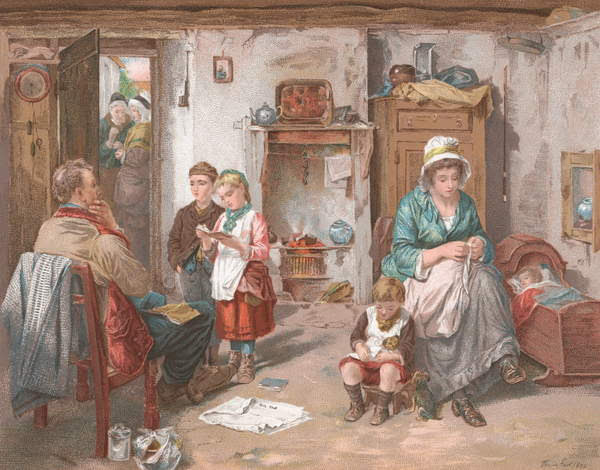
“…for that purpose we must inquire into the number of children of such an age that they ought to be at school, the school accommodation afforded them, and the quality of the education given…”[3]
Earl de Grey and Ripon, Elementary Education Bill, 1870
The late nineteenth century was the culmination of political change and government intervention. The need to appeal to a broader electorate after 1867 changed the rhetoric of both major parties.[4] Mounting interest and pressure to implement some form of national education system to catch up with continental rivals and tackle the issue of destitution was a large draw for new voters.[5] The Elementary Education Act of 1870 indirectly created the job of the Visitor by introducing School Boards, locally elected bodies with the power to build and mange schools in poverty-stricken areas, funded partly by government subsidy but also by rates collected from the local community. The quote above, taken from the reading of the 1870 Act in parliament, roughly outlines the role of the ‘School Board Visitor’.
Regular visits to homes within poor districts to ascertain family makeups, their living conditions, details of children before and after school age as well as collecting fees, reporting non-attendance and reminding legal consequences for failing to meet expectations, is often interpreted as a form of Orwellian control. Such interpretations are apt if hyperbolic, often exaggerating the extent of single accounts and mixing up the personalities of Visitors with the role’s purpose.[6] The rise of intervention and surveillance as tools of the Victorian government is far from dystopian. Self-awareness of the system’s imperfections were apparent from the outset despite a net benefit to British society as a whole,[7] yet local resentment of the School Board Visitor was not seen as a priority. Later Acts in 1876, 1880 and 1891 addressed far more significant issues, ending child labour, widening the ages for compulsory education and abolishing fees entirely. These progressive and morally-significant interventions are attributed to investigators such as Booth, amongst others, but were fundamentally built on data from Visitors.
Education served to elevate the working classes to the point that such monitoring and discipline could become less intrusive, retreating to the background once the benefit was realised.[8] The role of a School Board Visitor was temporary, a gauge to inform and enforce policies that challenged the status quo. Despite never intending to be complete and in the face of significant opposition, the Elementary Education Act of 1870 is regarded as a turning point for education and government attitudes, earning recognition and respect for those who conceived and passed it. Yet the same respect is not afforded to those who aided in implementing and maintaining the Act’s core principles. The legacy of national education in Britain relies to some extent on the role of the School Board Visitors, a contribution that may be small but is enough to justify the vocation.
Josh Halford
[1] Sims, G., How the Poor Live (1883).
[2] Punch, ‘“Sold!”’ (1879) – available from: http://www.victorianlondon.org/education/schoolboardvisitors.html.
[3] Elementary Education Bill (1870).
[4] Second Reform Act (1867).
[5] Haywood, W.A., ‘M.P.s and the 1870 Education Act: A Study in Human Motivation’, Journal of Educational Administration and History, 4:1 (1971), p. 22.
[6] Sims, G., How the Poor Live, (1883)
[7] Hamilton, R. ‘Popular Education in England and Wales before and after the Elementary Education Act of 1870’, Journal of the Statistical Society of London, 46:2 (1883)
[8] Otter, C., The Victorian Eye: A Political History of Light and Vision in Britain, 1800-1910, (Chicago: Chicago University Press, 2008)
 Derby's Dark Corners