The late nineteenth century has been traditionally viewed as a period of change from laissez-faire politics to state intervention, with inspections becoming a part of everyday life.[1] Numerous state initiatives were implemented in the era which focused on the morality of the working classes.[2] Nowhere is this more evident than in the State’s new found interest in the lives of children, most prominently in the fields of education and child labour, which made way for the newfound profession of the School Board Visitor.[3]
School Board Visitors, who were later known as School Attendance Officers, each had a district to manage and were tasked with keeping records about all of the families which lived there. School Board Visitors conducted daily house visitations in order to investigate and record children’s non-attendance to school, as well as the personal circumstances of each family.[4] Not only did Visitors have knowledge about families and their living conditions, but they also made sure to keep track of children both before and after they were of school age.[5]
Despite their unpopular intrusive methods, Visitors acted as agents of intervention by feeding data and information to local authorities in hopes of enforcing change and enlightening the slum. Thus, their role is easy to justify as ensuring attendance, collecting fees and surveying people were essential tasks in improving the condition of the working-class population.
In exploring the unpopularity of School Board Visitors, we gain an understanding of wider issues and difficulties of poverty, as well as the opposition the state faced when enforcing new moral policies. Working-class hostilities towards visitors did not just represent a dislike for compulsory education, but more prominently the unpopularity of Victorian surveillance and the enforcement of middle-class values upon lower society.
School Board Visitors were assigned the task of inspecting and following up attendance in schools across the whole of England and Wales in the late nineteenth century. However, the extent to which Visitors themselves fulfilled this task has been debated, and their role deemed on the whole weak. Thus, it is vital to explore the true impact of School Board Visitors on school attendance to gain a full understanding of their significance upon working class society.
Finally, School Board Visitor records became the basis for Charles Booth’s 1889 survey of London, particularly the series on poverty. However, some have criticised the use of these records in Booth’s data collection, calling into question the reliability and accuracy of Visitor records and to what extent they are useful in the modern day.[6]
Josh Halford, Lakiesha Kumari, Sarah Miles and Owen Roeton
[1] Crook, T., ‘Sanitary Inspection and the Public Sphere in the Late Victorian and Edwardian Britain: A Case Study in Liberal Governance’, Social History, 32:4 (2007), p.369.
[2] Jones, G.S., Outcast London: A Study in the relationship between classes in Victorian Society (Oxford: Oxford University Press, 1971), p. 271.
[3] Auerbach, S., ‘“The Law Has No Feeling for Poor Folks Like Us!” Everyday Responses to Legal Compulsion in England’s Working-Class Communities, 1871-1904’, Journal of Social History, 45:3 (2012) p.695
[4] Sheldon, N., ‘The School Attendance Officer 1900-1939: Policeman to Welfare Worker?’, History of Education, 36:6 (2007) p. 737.
[5] Charles Booth, Life and Labour of the People in London, 1903 available at: http://www.victorianlondon.org/education/schoolboardvisitors.htm accessed 20 November 2018
[6] Englander, D., and O’Day, R., Mr Charles Booth’s Inquiry: Life and Labour of the People of London Reconsidered (London: The Hambledon Press, 1993), p. 38.
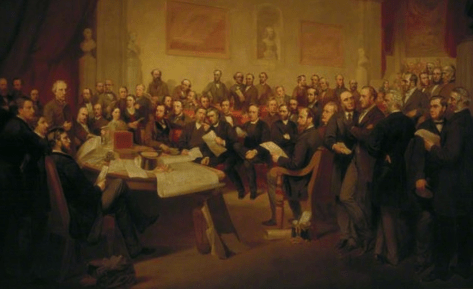
Illustrated Source:
John Whitehead Walton, The First London School Board, (1815-95). c.1873. 136 x 215 cm. Oil on canvas. Collection: Guildhall Art Gallery, London. – Available at http://www.victorianweb.org/painting/misc/waltonjw1.html accessed on 15 November 2018.
 Derby's Dark Corners