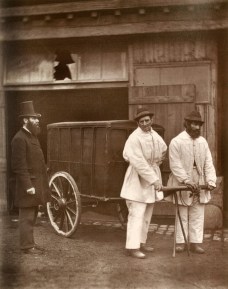
In this section we will focus on the public’s reaction to Sanitary Inspectors during a period of huge sanitary reform in Britain. With the introduction of the Public Health Act of 1948 the government decided that there had to be changes made in order to improve conditions. Despite the officer’s main focus being to rid an area of horrific disease that was often life –threatening, many members of the public were hesitant to accept the officer’s services. During the period, many people were strong supporters of Laissez faire and so did not want the government interference; however, localized epidemics were becoming far too common for those in charge to ignore. There was also news of similar fates in other countries and this put immense pressure on the government and by 1853, over 160 towns had a local health board.
This image shows two public ————-> disinfectors stood in a yard, accompanied and under the supervision of their sanitary officer. The Sanitary officer in this image is Mr. Dickson who the officer for the Parish of St. Georges and he was very well known by all who lived in his district. Sanitary officers were the face of sanitary change and improvement in their specified areas, therefore this could either result in them gaining backlash, but more so respect due to the fact that they undertook roles that not many would be up to doing. It can be argued that their reputation proceeded them whilst working and a good reputation meant that there was less chance that they would be turned away by members of the public.
Officers of nuisance were introduced to seek out which areas needed action, the term ‘Officer of Nuisance was later changed to ‘Sanitary Officer’ which was a small but important change that ‘represented a conscious change of attitudes no longer to uncover nuisance, but as a pre-emptive role.’ The legitimization of this role made people aware that this was a role that was essential if conditions were to get better.
Regardless of age, class or medical state, there was much hostility and weariness towards Sanitary Officers from the general public and ‘many cases were concealed from the authorities.’ It can be argued that the entire, newly implemented process was alien to the people of Britain and in Thompson and Smith’s Street Life in London it states that ‘the presence of men who deal with the most horrific sicknesses is certainly calculated to produce a painful impression on the debilitated mind’. There was also resistance due to the fact that many people believed that the new public health reforms were intrusive. In the beginning of the campaign before the officials were commonly known, they were often met with confrontation, fear and sometimes completely denied access to the home. In Tom Crook’s Sanitary Inspection and the Public Sphere, he writes that a London vestry clerk believed that the government’s interference had ‘reached its furthest known limits’ , ‘The Englishman’s castle is his own no longer, but rather the happy hunting ground of sanitary inspectors whose polite but firm “open sesame” is not to be withstood by the iron gates of the most secluded nunnery’. Officers could not force entry into places without permission; if they were not granted permission then they had to investigate further. If granted a summons from the police magistrate, then the officers could then force entry and any member of the public found to lie about the conditions would be fined or imprisoned. As well as the general public who did not welcome the sanitary reforms, many authority figures believed that the interventions of Sanitary Officers was a ‘mode of liberal surveillance’ with the government’s knowledge of medical situations providing an insight into other parts of the public’s lives.
Historian Tom Crook comments hugely about how the introduction of sanitary officers and their bid to be accepted into the everyday goings-on in Britain was in fact an intrapersonal pursuit. He comments that ‘public diplomacy was crucial’ in order for the officers to be successful and for their relationships with the public to be maintained. The government’s sanitary reforms were as much to do with each party working together and upstanding positive relations as they were to do with sanitary improvements. Without the prior, the latter could not be accomplished.
As much as there was an initial resistance towards Sanitary Officers, there was also a large acceptance of the newly implemented scheme. For those who were not ill, it ‘enhanced their admiration for devotion and courage’ and the officers and disinfectors often received ‘little gifts and perquisites’ for their hard work.
(1) P, Brimblecombe., ‘The Emergence of the Sanitary Inspector in Victorian Britain’, The Journal of The Royal Society for the Promotion of Health, 123.3 (2003) pg. 125
(2) J, Thompson, A, Smith., Street Life in London (London: Sampson Low, Marston, Searle and Rivington, 1877) pg. 16
(3) Thompson, Smith, Street Life in London, pg. 17
(4) T, Crook., ‘Sanitary Inspection and the Public Sphere in Late Victorian and Edwardian Britain: A Core Study in Liberal Governance’ Source History, 32:4 (2007) pg. 370
(5) T, Crook., Sanitary Inspection and the Public Sphere, pg. 370
(6) T, Crook., Sanitary Inspection and the Public Sphere, pg. 371
(7) T, Crook., Sanitary Inspection and the Public Sphere, pg. 371
(8) Thompson, Smith, Street Life in London, pg. 17
(9) Thompson, Smith, Street Life in London, pg. 18
Bibliography:
-P, Brimblecombe., ‘The Emergence of the Sanitary Inspector in Victorian Britain’, The Journal of The Royal Society for the Promotion of Health, 123.3 (2003)
-J, Thompson, A, Smith., Street Life in London (London: Sampson Low, Marston, Searle and Rivington, (1877)
-T, Crook., ‘Sanitary Inspection and the Public Sphere in Late Victorian and Edwardian Britain: A Core Study in Liberal Governance’ Source History, 32:4 (2007)
 Derby's Dark Corners