By 1900, London was able to boast two-hundred and sixty Sanitary Inspectors, Birmingham had sixteen by 1888 and Manchester had twenty-eight by the 1890s.[1] Despite hundreds of Sanitary Inspectors performing their duties nation-wide by the twentieth-century, relatively little has been discussed about their role. Their role, while subordinate to that of the Medical Officer of Health, involved the inspection of hundreds or possibly thousands of nuisances in towns of a ‘modest size’.[2] The post of Sanitary Inspector or Inspector of Nuisances, as they were also known, was arguably the lowest role within local public health administration,[3] and yet the requirements to be a Sanitary Inspector were vast.[4] When examining the notebook Sanitary Inspector, William Henry Tucker, it becomes clear, that their role was more than merely identifying and removing nuisances.[5] Their role included studying, having basic knowledge of science, enforcing the law and dealing with not only nuisances to health but also to convenience.[6] It can be argued that their role had the largest impact, despite historians consistently neglecting to report on them.
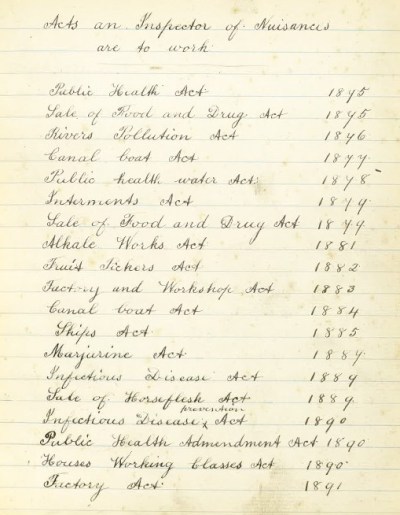
As seen in Figure 1, Inspectors of Nuisances were expected to have knowledge of the various acts that would have an impact upon their position. A large part of their role would have consisted of ensuring that these various acts were followed by those living in their town and offering recommendations if these laws were not abided by.[7] Figure 1 shows that there was a variety of acts from the Public Health Act of 1845 to the Factory Act of 1891. One particular law, in which an inspector by the name of William Henry Tucker talks about, is the Common Lodging Housing Act. The Common Lodging Housing Act was enacted in 1851, and meant that lodging houses had to be registered and regulated by local authorities such as the Inspector of Nuisances/Sanitary Inspectors.[8] Part of a Sanitary Inspectors role would include taking notes about the houses and inspections that he took out, he would write all of these notes within a book/notebook.[9]
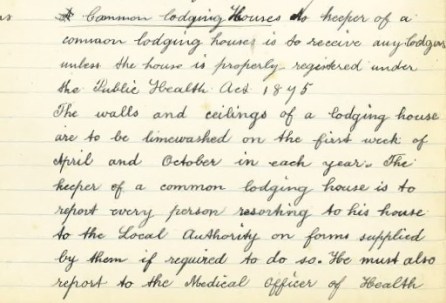
In Figure 2, the details of the Common Lodging Acts have been noted down by William Henry Tucker in detail, alongside recommendations which might be made for the lodgings. From both Figure 1 and Figure 2, it can be surmised that the Sanitary Inspectors needed extensive knowledge of the laws and legislation which were enacted during the nineteenth-century. As William Henry Tucker felt that he must keep detailed notes of the Common Lodgings Acts, it proves that this was a vital aspect of their role, an aspect which would have required the intelligence and dexterity of the inspector.[10]
Despite being a fundamentally inferior role within public health, it becomes evident that this does not necessarily mean that they were inferior in education. The sanitary inspector was required to have good literary knowledge and the ability to speak the ‘vernacular language’ of the district.[11] Furthermore, ‘special training’ was required once a candidate for the role of sanitary inspector was established.[12] The first set of exams for a sanitary inspector were carried out in 1877 by the Sanitary Institute of Great Britain, subsequently in 1899 a Sanitary Inspectors’ examination board was established in order to regulate training.[13] The success rate of these exams was only 55 percent,
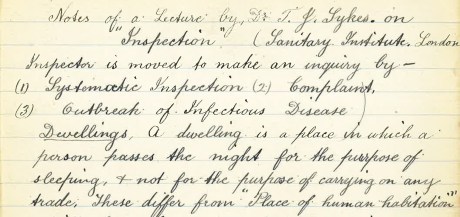
proving that these exams took expert knowledge in order to pass.[14] These exams tested their familiarity with “sanitary science” including; ‘elementary physics and chemistry; elementary statistical methods; practices of municipal hygiene…and by-laws relevant to inspection’.[15] William Henry Tuckers notebook, shown in figure 3, shows evidence of inspectors attending lectures and talks on various topics surrounding public health and the duties and responsibilities of a sanitary inspector.
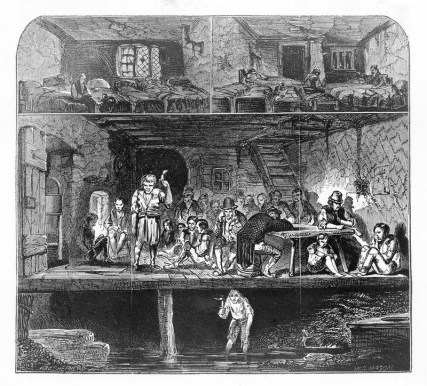
Figure 4 displays some of the issues that an inspector may have faced when entering a common lodging house. The image focuses on the overcrowding of a lodging house and the poor conditions of the surroundings. The beds are placed in close proximity to each other and many people can be seen to spend large amounts of time in the same room. Moreover, one individual can be seen to be in the cellar of the property, which is damp, dark and undoubtedly cold. These are issues that the inspector would have to address and offer recommendations about how they could be solved.
Inspecting the houses was naturally a significant part of the sanitary inspector’s role, and it would have called on all of the skills that they had learnt in their extensive training programme. Regular inspections were being carried out in larger towns by the 1880s and in towns such as Battersea, houses were being inspected at least twice a year.[16] As well as these regular inspections of dwellings, they would also inspect a house in their district if there was a suspected infection, fever or case of disease within the premises.[17] Approaching such a case would require the inspector to draw upon his training, as the presence of an inspector would not have always been welcome within the household he aimed to inspect. The sanitary inspector must draw on his literary skills and have a good repour with members of his district, in order to gain their trust and ensure their cooperation. If the inspector has been refused entry to a dwelling then he must investigate the issue further, through questioning neighbours or medical attendants to disclose the truth about the suspected case.[18] If suspicions about the spread of disease within a household is confirmed then they would be able to enforce summons from the police magistrate, and the person who aimed to evade the law and the Sanitary Act in particular, can be fined or imprisoned.[19]
Of course, a sanitary inspector’s role did not merely concern nuisances against health within houses or dwellings, but it also concerned inspections of sewage and drainage systems, privies, water-closets, street and nuisances against convenience.[20] For the Sanitary Inspector there would have been clear guidelines to follow when inspecting or dealing with these issues, all of which they should be able to find in a Sanitary Inspectors guide.[21]They were also responsible for inspiring legislation to be enacted and governmental intervention in the ‘slum’ environment.[22] Therefore proving that laws and by-laws were not only vital for the sanitary inspectors to perform their role but the inspectors themselves were fundamental in stimulating governmental change. Sanitary inspectors informed the governmental decision to fund the building of council houses to home the residents of the ‘slums’ and in turn replace the ‘slum’ housing altogether.[23]
The sanitary inspector’s role would have undoubtedly been vital in tackling the slum environment. Unlike the medical officer of health, for the sanitary inspectors the slums were a lived environment, a place in which they would have spent the majority of their time. Inspectors conversed with the inhabitants of the slums, worked closely with them and offered solutions to stop the spread of disease and filth in their district. Without the inspector, disease would likely have continued to spread and the conditions of the slums would have continued or may have worsened throughout the decades. Fundamentally, they ensured that laws regarding public health were abided by, and the health of their district improved. The notebook of the sanitary inspector William Henry Tucker proves that upholding the law was fundamental to their role and intensive knowledge on the topic was imperative. The sanitary inspector may have lacked publicity, but they most certainly did not lack impact.
[1] Crook, T., ‘Sanitary inspection and the public sphere in late Victorian and Edwardian Britain: a case study in liberal governance’, Social History 32.4, (2007), p.373
[2] Hamlin, C., ‘Nuisances and community in mid-Victorian England: the attractions of inspection’, Social History 38.3, (2013), p.346
[3] Hamlin, C., ‘Nuisances and community in mid-Victorian England: the attractions of inspection’, Social History 38.3, (2013), p.347
[4] Davies, D., ‘The training qualifications and duties of Nuisance-Inspectors’, British Medical Journal 2:1, (1871), pp.554-555
[5] Crook, T., ‘Sanitary inspection and the public sphere in late Victorian and Edwardian Britain: a case study in liberal governance’, Social History 32.4, (2007), p.373
[6] Crook, T., ‘Sanitary inspection and the public sphere in late Victorian and Edwardian Britain: a case study in liberal governance’, Social History 32.4, (2007), pp.373-378
[7] Crook, T., ‘Sanitary inspection and the public sphere in late Victorian and Edwardian Britain: a case study in liberal governance’, Social History 32.4, (2007), pp.373-374
[8] Trinder, B., ‘Banbury’s Victorian Lodging Houses’, Cake and Cockhorse 16.4, (2004), pp.140
[9] Hamlin, C., ‘Nuisances and community in mid-Victorian England: the attractions of inspection’, Social History 38.3, (2013), p.365
[10] Stewart, J., ‘Tackling the Slums: Inspectors of Nuisance and the Sanitary Inspectors: Part 1, 1848-1914’, (2017), Available Online: https://municipaldreams.wordpress.com/2017/06/27/tackling-the-slums-part-1/ Date Accessed: 13 October 2018
[11] Davies, D., ‘The training qualifications and duties of Nuisance-Inspectors’, British Medical Journal 2:1, (1871), p.554
[12] Davies, D., ‘The training qualifications and duties of Nuisance-Inspectors’, British Medical Journal 2:1, (1871), p.554
[13] Crook, T., ‘Sanitary inspection and the public sphere in late Victorian and Edwardian Britain: a case study in liberal governance’, Social History 32.4, (2007), pp.374-375
[14] Crook, T., ‘Sanitary inspection and the public sphere in late Victorian and Edwardian Britain: a case study in liberal governance’, Social History 32.4, (2007), p.375
[15] Crook, T., ‘Sanitary inspection and the public sphere in late Victorian and Edwardian Britain: a case study in liberal governance’, Social History 32.4, (2007), p.375
[16] Hamlin, C., ‘Nuisances and community in mid-Victorian England: the attractions of inspection’, Social History 38.3, (2013), p.348
[17] Thomson, J AND Smith, A., Street Life in London (London: Sampson Low, Marston, Searle and Rivington, 1877), p.16
[18] Thomson, J AND Smith, A., Street Life in London (London: Sampson Low, Marston, Searle and Rivington, 1877), p.16
[19] Thomson, J AND Smith, A., Street Life in London (London: Sampson Low, Marston, Searle and Rivington, 1877), p.16
[20] Crook, T., ‘Sanitary inspection and the public sphere in late Victorian and Edwardian Britain: a case study in liberal governance’, Social History 32.4, (2007), p.378
[21] Lemmoin-Cannon, H., The Sanitary Inspectors Guide, (London: PS King and Son, 1902)
[22] Stewart, J., ‘Tackling the Slums: Inspectors of Nuisance and the Sanitary Inspectors: Part 1, 1848-1914’, (2017), Available Online: https://municipaldreams.wordpress.com/2017/06/27/tackling-the-slums-part-1/ Date Accessed: 13 October 2018
[23] Stewart, J., ‘Tackling the Slums: Inspectors of Nuisance and the Sanitary Inspectors: Part 1, 1848-1914’, (2017), Available Online: https://municipaldreams.wordpress.com/2017/06/27/tackling-the-slums-part-1/ Date Accessed: 13 October 2018
Illustrations:
Figure 1‘Acts and Inspector of Nuisances are to work’, an extract from William Henry Tucker’s Inspector of Nuisance notebook, Cardiff, dated 1899 onward, from the collection of Hugh Thomas. Permission to copy granted by Hugh Thomas.
Figure 2’Common Lodging Housing Act’ an extract from William Henry Tucker’s Inspector of Nuisance notebook, Cardiff, dated 1899 onward, from the collection of Hugh Thomas. Permission to copy granted by Hugh Thomas.
Figure 3’Notes of a Lecture’ an extract from William Henry Tucker’s Inspector of Nuisance notebook, Cardiff, dated 1899 onward, from the collection of Hugh Thomas. Permission to copy granted by Hugh Thomas
Figure 4’Lodging House in Field Lane’ Credit: Wellcome Library
 Derby's Dark Corners