
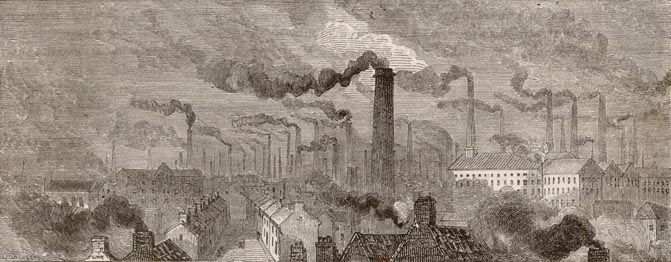
The Industrial Revolution changed the face of Britain forever. Previously a mostly rural island, the transition from an agricultural economy to a pioneering manufacturer altered the demographics of Britain like never had been seen before. As a result of the advances made during the Industrial Revolution, the population of England had doubled between the years 1800 and 1850.1 Not only was the population increasing, more and more people were moving from the countryside into the cities to find work in the factories. The cities of Britain were not prepared for such an influx of people however, as they were outdated and only adequate for smaller Eighteenth century populations.2 The rapid urbanisation led to the poor being segregated into ‘crowded and dilapidated’ accommodation, separated from the middle and upper classes in rather contrasting environments.3
These overcrowded, poorly built districts would come to be known as ‘slums’ during the Nineteenth century and would go on to emerge in many of Britain’s larger, industrialising cities such as London, Birmingham and Manchester. The usage of the term ‘slum’ became common around the middle of the Nineteenth century, coinciding with the acceleration of the aforementioned rapid urbanisation and social segregation of the poor.4 The culmination of these demographic factors led to serious problems regarding the prevalence of disease and quality of living in the poorer districts of these major cities.
The conditions within the slums presented a major health hazard for the denizens dwelling within them. It became clear to the Victorians that the slums were becoming a major problem for the expanding cities of Britain. This problem surfaced around the mid-point of the Nineteenth century as beforehand, the large numbers of poor were out of sight and mind, so to speak, within rural areas of Britain, spread out over the vast countryside.5 Once the ‘rural poor’ began to be recruited to become part of the Industrial Revolution, they had for the first time come under the jurisdiction of the various city authorities who were not prepared to deal with the influx of workers.
The Victorian policy makers believed that the emergence of the slums was a consequence of the isolation of the poor from the rest of society and their unwillingness to help themselves.6 This rather condescending view makes the assumption that the social isolation of the poor leads to poverty and squalor as the poor were isolated from their ‘social superiors’ and could not benefit from their moral influences.7 Whatever the reasons behind the emergence of the slums within the cities of Nineteenth century Britain, it was clear that there would need to be an administrative response to tackle the issues plaguing the poorer areas of the cities. This response would come in the form of the Sanitary Inspectors or Inspector of Nuisances. (Fig. 2)
Looking in greater detail into the conditions which forced the authorities to introduce the role of Sanitary Inspector, a closer look at the state of the slums in the cities of Birmingham and Manchester provides an interesting and eye-opening perspective into the conditions which the poorest of the working classes had to endure. Manchester was a perfect example of an industrialised city with a rapidly increasing population of factory workers. Edwin Chadwick, a Sanitary Commissioner and Chief Officer of the first General Board of Health, describes the unsanitary conditions present within the poorer districts of the city.8 A native of Manchester, Chadwick wrote an article in 1883 detailing these conditions in Manchester. The death rate in the county was one of the highest in Britain, and the account by Chadwick holds poor administration responsible.9
Prior to the installation of Sanitary Inspectors across the nation, there was no standardised legislative authority which required city or county authorities to address the situation of the slums.10 People such as Chadwick acknowledged this shortcoming in administration of sanitary improvement and advocated for a more efficient and dedicated administrative body which could tackle the problems of the slums at both a political level as well as on the streets themselves.11 The water supply in the slums was another major issue for the city of Manchester, Chadwick references the poorly filtered water from local reservoirs which is full of impurities, causing symptoms such as dyspepsia. The distribution system for the water was also an issue, as the lead pipes would cause lead poisoning among the population.12 To make matters worse, there was no system in place to remove waste water and excrement from the houses in the poorer districts, which as a result would accumulate in the narrow streets, causing illness and disease. This filth and squalor caused noxious fumes which polluted the air in the streets and caused even further illness and disease.13 These atrocious conditions led to a death rate which Chadwick states rose as high as sixty in every 1000 of the working classes. It was clear that new legislation and action on the streets was necessary.

Birmingham found itself in a similar position to Manchester, with its own slums which fared little better than Manchester’s during the Nineteenth century. There is evidence of this recorded by Dr Hill, a Birmingham City Officer of Health, within health reports written by him from 1897 and 1898.14 Hill’s reports describe an environment of tightly packed, ill-lit, ramshackle houses, surrounded by ill-paved, squalor ridden streets and courts. Figure five is an example of this, showing an open sewer in the middle of the street. The assessments of the interiors were just as damning, with descriptions of large families packed into small, damp, dark and cramped rooms with poor ventilation and even accumulations of excrement.15 Many of the houses in the Birmingham slums were built many years ago and not adequate for late Nineteenth century populations with some houses even not having any windows, the reports found that these houses had often been built by incompetent workers without supervision.16 Prior to the installation of the Sanitary Inspectors and the various committees in order to tackle the problem, it was often the responsibility of the landlords to improve the sanitary conditions of the accommodation they owned.17 Many of these landlords of the period were reluctant to spend money on these improvements, which was certainly played a role in forcing the authorities to install Sanitary Inspectors across the country.
- https://www.bl.uk/romantics-and-victorians/articles/slums
- https://www.bl.uk/romantics-and-victorians/articles/slums
- Ward, David, ‘The Victorian Slum: An Enduring Myth?’, Annals of the Association of American Geographers, 66 Issue 2, (1976) p.323
- Ward, ‘The Victorian Slum: An Enduring Myth?’ p.324
- Ward, ‘The Victorian Slum: An Enduring Myth?’ p.340
- Ward, ‘The Victorian Slum: An Enduring Myth?’ p.340
- Ward, ‘The Victorian Slum: An Enduring Myth?’ p.340
- Chadwick, Edwin, ‘On Sanitary Administration and on its Condition and Results in Manchester’, LSE Selected Pamphlets, (1883) p.3,4
- Chadwick, ‘On Sanitary Administration and on its Condition and Results in Manchester’ p.3
- Chadwick, ‘On Sanitary Administration and on its Condition and Results in Manchester’ p.4,5
- Chadwick, ‘On Sanitary Administration and on its Condition and Results in Manchester’ p.5
- Chadwick, ‘On Sanitary Administration and on its Condition and Results in Manchester’ p.6-8
- Chadwick, ‘On Sanitary Administration and on its Condition and Results in Manchester’ p.7-9
- Fallows, John Arthur, ‘The Housing of the Poor’, LSE Selected Pamphlets (1899) p.4,5
- Fallows, ‘The Housing of the Poor’, p.4-6
- Fallows, ‘The Housing of the Poor’, p.5
- Fallows, ‘The Housing of the Poor’, p.5
Illustrations
- Manchester from Kersal Moor, 1852, William Wyld, Credit: Royal Collection Trust
- ‘Street Life in London’, 1877, by John Thomson and Adolphe Smith, Credtit: LSE Digital Library
- Edwin Chadwick, Credit: LSE Digital Library
- Manchester in 1870, Credit: smithsonianmag.com
- Victorian street, Credit: dickens.port.ac.uk
 Derby's Dark Corners