The emergence of slums during the Victorian era presented a new challenge for the large cities of Great Britain. The population of England had doubled between the years 1800 and 1850, and due to the advances of the industrial revolution, the population of the country, once mostly residing in the countryside, began moving into the major cities to find work in the factories.[1] This demographic shift put immense strain upon the outdated cities of Britain which were only adequate for smaller Eighteenth century urban populations.[2] The inevitable overcrowding of the major cities, specifically in the poorer districts, caused serious problems in terms of high death rates, disease and squalor.[3]A health report from 1897 by the Birmingham Officer of Health, Dr Hill, exemplifies the appalling conditions within many Nineteenth century slums. The Report speaks of the tightly packed, poorly built houses, with large families packed into single rooms, poor ventilation and prevalent accumulations of excrement.[4]Prior to the committees and public authorities set up throughout the Nineteenth century to address the issues plaguing the slums, it was often the responsibility of the landlords to improve the sanitary conditions of the accommodation they owned, which many were reluctant to do.[5] This lack of action by landlords amid such appalling conditions for the working classes meant that new legislation and a new force of officials was required to tackle the issue. This eventually led to the installation of sanitary inspectors across the country.
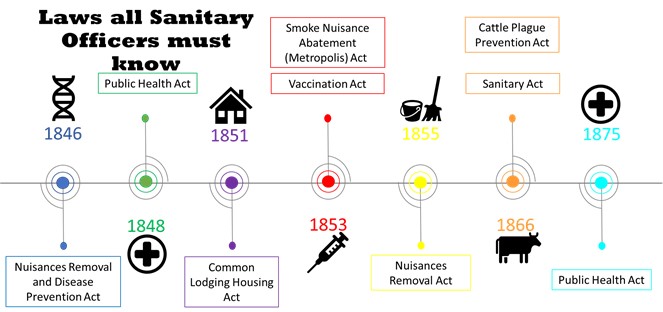
A forgotten and often underappreciated role, the role of the Sanitary Inspector has often been missing from popular histories about the ‘slums’. An integral role within nineteenth century public health, it is surprising that such a role could be forgotten. 1846 is an important year for the Sanitary Inspector as it was the year that the Nuisances Removal and Prevention Act was formed in order to deter the spread of Cholera.[6] In the four decades which proceeded after 1846, towns were authorised to appoint Sanitary Inspectors[7] and by the year 1900, there were hundreds of Sanitary Inspectors throughout Britain and 260 in London alone.[8] The Sanitary Inspector was heralded as the ‘eyes, nose and ears of sanitary authority’ in Edward Smiths Handbook for Inspectors of Nuisances, who in combination with the Medical Officer of Health become a ‘useful advisor’.[9] Tom Crook notes that the ‘principal duty’ of the Sanitary Inspector was to identify a nuisance and make arrangements to ensure that it was removed.[10]
The term ‘nuisance’ has its origins in the Middle Ages, however in the context of public health and common law, the term refers to a variety of offences which may be or become hazardous to health.[11] Offences to health could be environmental, social or civil and it was an Inspector of Nuisances role to deal with any offences which affected his district.[12]
Nuisances often fell into four categories:[13]
- Complaints made by neighbours about transgressions
- Conditions which the inspector himself thought required intervention
- Issues involving public services
- Infected persons
Alongside the introduction of new roles, such as the Sanitary Inspector, debates about the responsibility of fulfilling legislation and the application of sanitary laws was prevalent amongst the political elite as well as respected individuals such as A. Blythe, a medical officer of health[14].The debate surrounding the executive was related to the concept of Laissez-Faire policies and beliefs about the role of government in the private life of the individual. For Historian, A.Kidd, the role of central government was “envisaged as…an enabler”. This was achieved through legislating and creating a framework from which local authorities were free to implement as they saw fit[15].
Certainly, it was the Inspectors themselves that had to pay for their training and this too was questioned in debates. Furthermore, the training and maintenance of standards was left to the Sanitary Institute[16]. This institution was responsible for the standardisation of Inspectors training and would often publish in the newspapers detailing courses and prices[17].
Despite having very little written about the role of the Sanitary Inspector, their hard work paved the way for new legislative action to be taken place. Many notable figures began to tackle the growing problems surrounding the poor, such as shared housing and poor living conditions, by reforming the Poor Laws themselves. Edwin Chadwick, the Chief Commissioner on the Poor Law System, for example, sought to directly challenge the government themselves on the standards already implemented and thought to be satisfactory. In 1842, Chadwick published “The Report from the Poor Law Commissioners on an Inquiry into the Sanitary Conditions of the Laboring Population of Great Britain”. This report was the first national investigation of its kind, outlining the link between poor living standards and the spread of disease[18]. The Chadwick Report was ground-breaking research and was acknowledged as an act to create public health policy.[19]
With the introduction of Public Health Act in 1948, the role of the Inspector was a new and odd initiation into everyday life. Inspectors of Nuisance were received in a variety of ways, and these receptions were not always particularly based on the class, race or age of the public in which they were serving. Despite their intentions simply being to rid of disease and primarily improve the conditions of the public, they were not always warmly welcomed. In Thompson and Smith’s, Street Life in London, It states that ‘The presence of men who deal with the most horrific sickness is certainly calculated to produce a painful impression on the debilitated mind’.[20] In many cases sanitary inspectors were often met with denial, confrontation or were simply completely denied access. There were therefore laws implemented in response to this, in the effort to allow inspectors to work effectively and rid of as many illnesses and diseases as possible. On the other hand however, many people were often willing and even pleased to let the inspectors carry out their work and ‘with the spread and increase of education and sanitary knowledge, the inspector’s visits (were) courted rather than avoided’.[21] Many of the inspectors were generally well-known to the communities they worked in, they had reputations and were well respected, thus improving the success rate not only at which they worked, but of which they were initially well-received.
This selection of blog posts aims to explore the Sanitary Inspector through various themes and sources, such as: sanitary inspections as a necessity, the role of the Sanitary Inspector, governmental interventions, the impact of Sanitary Inspectors and response to the inspectors.
[1] Fanders, J., ‘Slums’, British Library, (2014), Available Online: https://www.bl.uk/romantics-and-victorians/articles/slums, Date Accessed: 30/11/2018
[2] Fanders, J., ‘Slums’, British Library, (2014), Available Online: https://www.bl.uk/romantics-and-victorians/articles/slums, Date Accessed: 30/11/2018
[3] Chadwick, E., ‘On Sanitary Administration and on its Condition and Results in Manchester’, LSE Selected Pamphlets (1883) p.4
[4] Fallows, J.A., ‘The Housing of the Poor’, LSE Selected Pamphlets (1899) p.5
[5] Unknown Author, ‘The Great Problem of our Great Towns’, LSE Selected Pamphlets, (1899) p.6
[6] Policy Navigator, ‘The Nuisances Removal and Diseases Prevention Act of 1846’ (n.d.) Available Online: https://navigator.health.org.uk/content/nuisances-removal-and-diseases-prevention-act-1846 Date Accesseed: 22 November 2018
[7] Hamlin, C., ‘Nuisances and community in mid-Victorian England: the attractions of inspection’, Social History 38.3, (2013), p.346
[8] Crook, T., ‘Sanitary inspection and the public sphere in late Victorian and Edwardian Britain: a case study in liberal governance’, Social History 32.4, (2007), p.373
[9] Smith, E., Handbook for Inspectors of Nuisances, (London: William Clowes and Sons, 1873), pp.vii-viii
[10] Crook, T., ‘Sanitary inspection and the public sphere in late Victorian and Edwardian Britain: a case study in liberal governance’, p.373
[11] Crook, T., ‘Sanitary inspection and the public sphere in late Victorian and Edwardian Britain: a case study in liberal governance’, p.373
[12] Crook, T., ‘Sanitary inspection and the public sphere in late Victorian and Edwardian Britain: a case study in liberal governance’, p.373
[13] Hamlin, C., ‘Nuisances and community in mid-Victorian England: the attractions of inspection’, Social History 38.3, (2013), p.353
[14] Blythe, A. ‘The Evolution of the Sanitary Inspector,’ British Architect, October, 1897, p. 319
[15] Kidd, A. ‘State, Society and the Poor,’ Hampshire: Macmillan Press, 1999, p.2
[16] Unknown Author, ‘Lectures for Sanitary Officers,’ British Architect, 31:7, 1889, p. 132
[17] Davies, D. ‘THE TRAINING, QUALIFICATIONS, AND DUTIES, OF NUISANCE-INSPECTORS’ The British Medical Journal, November 1871, p. 554 – 555
[18] Chadwick, E. (1842) Report on the Sanitary Conditions of the Labouring Poor.
[19] Morley, I. (2007). ‘City Chaos, Contagion, and Social Justice.’ Yale Journal of Biology and Medicine.
[20] Thompson, J., AND Smith, A., ‘Street Life in London’ (London, Sampson Low, Marston, Searle and Rivington, 1877) pg 17
[21] Thompson, Smith, ‘Street Life in London’, pg 16
Illustrations:
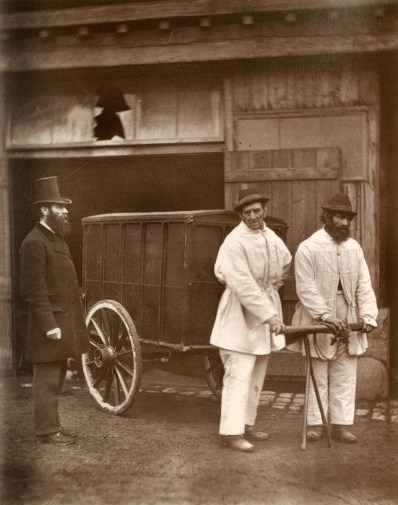
Figure 1: ‘Public disinfectors from the Parish of St. George, Hanover Square, London: two men wearing white overalls are shown pulling a covered hand-cart containing a mobile disinfection unit, observed by Mr. Dickson, Inspector of Nuisances. Woodburytype after a photograph by J. Thomson, 1877.’ by J. Thomson. Credit: Wellcome Collection.
 Derby's Dark Corners