Derby Town Council Sanitary Committee Meeting 1898
Within an article published in the Derby Mercury on the 11th May 1898[1] a ‘serious complaint about lodging houses’ was cited by the Town Councils sanitary committee. Inside this article came a discussion between members of the town council, Mr Russel, Alderman Harrison, and The Honourable F. Strutt regarding the conditions of the rooms contained in the lodging houses, the lodging houses they were specifically discussing were located on Willow Row and Walker Lane in Derby. There is a clear link produced between privacy and sanitary conditions mentioned within the article, this can be seen when discussing the overcrowding in the rooms, the first-hand eyewitness account states that within these lodging houses multiple rooms contained up to 6 beds, some of which were the home of married couples and some of individuals. The image you can see is a bedroom of a Manchester Lodging house, although not a full image of the room it shows how close the beds were situated next to each other and how the aim of these rooms was not to provide a comfortable place to sleep but to pack as many beds as possible within a space to ensure more fees can be taken. At the beginning of the article Mr Russel states that allowing people specifically married people, to inhabit these conditions was allowing a ‘good deal of immorality.’[2] The Honourable F. Strutt argues that the rooms shouldn’t be overcrowded, and Mr Russel states that as long as the beds themselves in the room were separated by dividers then there are no overcrowding or unsanitary conditions present to discuss or act on. What is interesting within this discussion is the aspect of ‘large board’ dividers placed in-between the beds. While analysing some of the council members responses after they have been told about the lack of dividers within this lodging house, it is clear to see that their opinion altered dramatically. It can be deemed from this that when there are dividers between the beds this is seen as a more sanitary acceptable environment compared to when there are no dividers it is deemed as unsanitary and something which needs to be acted upon.
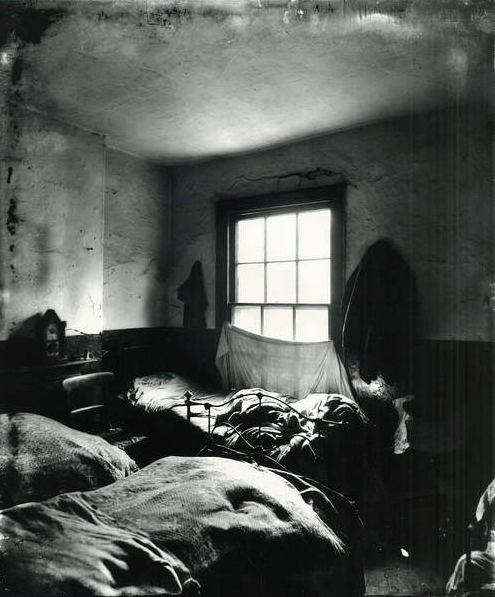
The dividers situated between the beds of those staying within the same rooms inside the lodging houses can take different forms and are not always made for purpose, as mentioned above some lodging houses used large boards to create a more permanent divider. Although some of these boards were in fact ‘two feet from the ground and two feet from the ceiling.’[4] Others were carpets draped over furniture to give the impression of a private space. The use of the dividers can be attributed to the want of privacy of couples and individuals while they are living and sleeping in a room of up to 12 other people, but they have another use which is to induce more sanitary conditions for them to inhabit. Disease was rampant through crowded and unsanitary conditions, and it can be seen as a physical barrier would prevent a physical disease from spreading allowing occupants to feel safer, which would have held much importance to those occupying the lodging houses of Walker Lane where between the 15th of June and the 14th of September 1847 75 cases of Typhus Fever was reported.[5] Although it is clear that the dividers themselves did not provide an adequate physical barrier for disease as between 1865 and 1866 there was a large outbreak of Cholera.
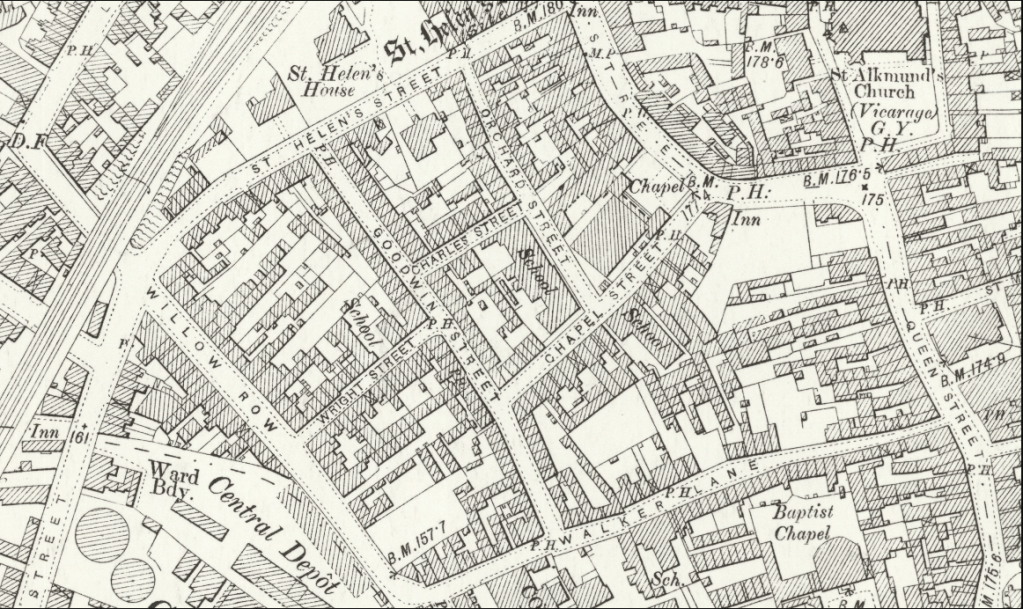
[6]Map showing the proximity of Walker Lane and Willow Row in Derby 19th Century.
During this period of time there were a multitude of acts introduced in relation to the lodging houses and the general urban population, including the Public Health Act of 1875 and the Lodging Houses acts of 1851 and 1853. The Public Health Act of 1875 implemented changes that predominantly related to unsanitary conditions within the Urban city areas due to the increase in the spread of infectious diseases such as Typhoid and Cholera. The Act itself put the responsibility and emphasis on the individual local councils themselves such as Derby to ensure they improved the living conditions of their inhabitants. First of all, they had to create and maintain sewers to ensure sewage and water was removed safely as opposed to being in the streets, they also had to ensure that clean drinking water was available, and toilets flushed. They also had to begin regulating lodging houses to ensure they were sanitary liveable conditions, to do this they had to have a sanitary inspector and an officer of health whose job was to ensure this act was followed. However, the success of this act and the changes it was intended to make were variable for each council as the implantation was not compulsory. The common lodging houses act of 1851 which is also known as the Shaftesbury act was introduced to regulate the lodging houses and to make sure they are registered by the council. Proprietors of the lodging houses were also required to inform the council of any infectious diseases that were apparent. The implementation if the 1851 act which was given further controls by the 1853 act, was to give more power to the local authorities to create by-laws regarding the lodging houses in their area[7], one of those laws which was commonly implemented was the segregation of sexes within the bedrooms not including married couples or children under 10 years of age, and it also allowed for councils to dictate how many people were allowed to inhabit certain rooms which would reduce overcrowding and therefore provide more sanitary conditions.
Within the Victorian lodging house, it is apparent due to the overcrowding mentioned that privacy is not a given for those staying there. The link between privacy and sanitary conditions can be seen in many ways, most specifically with the dividers placed between beds. The emphasis placed on the importance of those dividers within the Derby town council sanitation meeting in 1898 shows that with the removal of the dividers the sanitary condition of the lodging deteriorates immensely even though the cleanliness is not impacted, therefore linking the need for privacy to the need for sanitation.
[1] Anon, ‘Derby Town Council’., The Derby Mercury, 11th May 1898, P 8
[2] Anon, ‘Derby Town Council’., The Derby Mercury, 11th May 1898, P 8
[3] Unknown n.d., Illustration, Available Online: https://www-bridgemaneducation-com.ezproxy.derby.ac.uk/en/asset/3273350/summary?context=%7B%22route%22%3A%22assets_search%22%2C%22routeParameters%22%3A%7B%22_format%22%3A%22html%22%2C%22_locale%22%3A%22en%22%2C%22filter_text%22%3A%22victorian+lodging+house%22%7D%7D Accessed 10th January 2023
[4] Anon, ‘Derby Town Council’., The Derby Mercury, 11th May 1898, P 8
[5] https://geneageek.com/the-slums-of-derby/ Accessed 3rd January 2023
[6] Unknown n.d., illustration. Available online: https://geneageek.com/the-slums-of-derby/ Date accessed: 15 Jan. 2023.
[7] https://www.parliament.uk/about/living-heritage/transformingsociety/towncountry/towns/tyne-and-wear-case-study/about-the-group/housing/lodging-houses/#:~:text=This%20included%20fixing%20a%20maximum,Lodging%20Houses%20Act%20of%201851. Accessed 10th January 2023
 Derby's Dark Corners