The Metropolitan Police faced its peak of criticism following the Whitechapel murders of 1888.[1] The police came into criticism due to them failing to catch the murderer more popularly known as ‘Jack the Ripper’. Paul Begg and John Bennett state that the Metropolitan Police file of the murders refers to the murders which took place in the East End slums between Emma Smith in April 1888 and Frances Cole in 1891, with it stating that the Ripper committed five of these murders.[2] This added to the failure of the police to catch the culprit is highlighted in many of the criticisms aimed at the police.[3] The Whitechapel murders attracted a large amount of public interest as a result of the moral panic caused by the newspapers and press of the time.[4] It was this moral panic which resulted in the criticism, within the slums, which was aimed towards the Metropolitan Police in the wake of it.
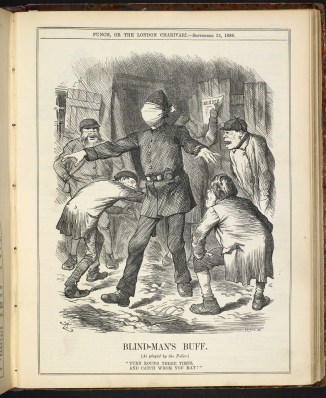
The police faced criticism from publications such as the satirical Punch magazine. This is most evident in the cartoons of John Tenniel, who produced a number of anti-police cartoons such as White-Chapel, 1888 (figure 2) and Blinds-Man’s Buff (figure 1) both published in the year of the murders. The cartoons reflect the anti-police feelings which were a result of the Whitechapel Murders and the moral panic which stemmed from them. This is experienced in Blinds-man’s Buff within which it depicts the policeman as being blindfolded, scrambling around trying to catch the criminal representing how the public viewed the police because they compared the investigation into the Whitechapel murders as a game of Blinds-man’s buff.[5] Christine Corton suggests that the cartoon was published at the height of the moral panic which gripped the population as a result of the murders, being extremely critical of the police forces who were hindered in their investigation scrambling to try and catch the criminal.[6] This highlights how Tenniel jumped on the bad wagon of the press spreading anti-police ideas within the slums because as a result of the panic the population no longer felt safe on the streets in which they lived.[7]
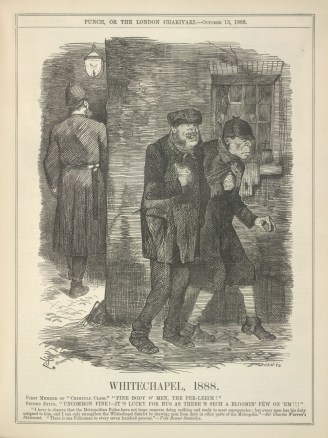
Tenniel’s other cartoon from 1888 simply titled Whitechapel, 1888 again stirs anti-police ideas as it depicts two lower-class criminals sneaking behind a police man saying “its lucky for Hus as there’s sech a bloomin few of em!!!”.[8] Once again highlighting the criticism faced by the Metropolitan Police in the fact that they were mostly outnumbered and were letting criminals go past without being seen. The time of publication again highlights the moral panic at its height because publishing a carton of this nature would scare the population more than they already would have been. These cartoons were a part of the Punch magazine which poked fun at the British constabulary whose readership crossed the classes, showing the bad relationship the police crossed class boundaries.[9] These two cartoons reflect the impact that the moral panic stemming from the Whitechapel Murders had in causing police criticism within the slums as well as society as a whole.
Newspapers were another cause of the bad relations which the police faced in the wake of the Whitechapel murders. This is highlighted by Drew Gray who states that the newspapers such as the Pall Mall Gazette and the Birmingham Daily Post maintained a steady criticism of the police throughout the Whitechapel murders, with the post stating that “They have no clue, and there seems very little possibility of their obtaining one”.[10] This highlights the bad relationship the press had with the police which would be passed down onto their readers ultimately resulting in the police gaining a bad reputation and relationship with the population as a whole, most prominently in the Slums.
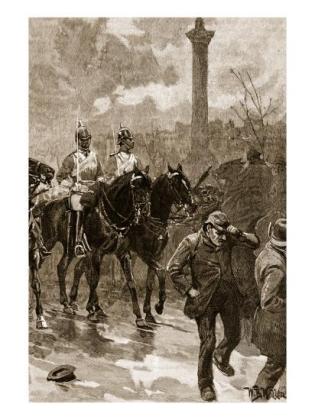
Bad relationships with the Metropolitan Police originated in the year preceding the Whitechapel murders, 1887. This was due to, as stated by Judith Walkowitz, ‘Bloody Sunday’ which was when protesting working classes tried to march into Trafalgar Square but were violently put down by the Metropolitan Police Force.[11] This resulted in a large amount of resentment from the working classes of the East End slums as they were attacked with batons, leaving hundreds injured and three dead, for trying to better their situation.[12] This bad relationship ultimately led to the moral panic which came as a result of the Whitechapel murders making the relationship almost irreparable. Clive Emsley furthers this by arguing that the moral panics caused by the events of 1887 and the Whitechapel Murders a year later were all played on and blown out of proportion by the press leading to criticisms of the police.[13] Thus, reinforcing the point that moral panics resulted in police criticisms which led to the bad relationships between the population and the police force.
Slums were often at the centre of the moral panics. This is witnessed in the Whitechapel murders as the slums, which were home to the poorest of society, were the location of the murders and thus at the heart of police investigations.[14] The murders highlight the power the police held over the working classes within the slums of the East End. This is supported in the argument of Robert Haggard, who states that the police had the power to search any building in the slum adding that many of the arrests were made of people from the lower classes, further claiming that the investigation highlighted the late Victorian class tensions as it shows fear of the working classes.[15] The investigation can be seen as causing the bad relationship with the police because the working classes felt victimised by the police as they were being accused for the murders as well as being arrested for prostitution and costermongering, while the real victim was able to murder more women.[16] This shows that the moral panics which stemmed from the press and other publications drove home the bad relationship which the police experienced from the population of the slum and the middle classes.
In conclusion the police experienced a negative relationship with the population of London. This was due to the press generating moral panics in regards to the Whitechapel murders (1888) and the events of Bloody Sunday (1887). These moral panics generated a lot of criticism towards the police which were most evidently seen in the Punch cartoons by John Tenniel. It was this criticism that led to the bad relationships because the population, both inside and outside of the slums, did not trust that the Metropolitan Police would keep them safe and the metropolis crime free.[17] Thus it was moral panics and the criticisms these generated which caused bad relationships with the police.
References:
[1] Fisherman, W, J., ‘Crime and Punishment’ in Warwick, A & Willis, M (eds),. Jack the Ripper; media, culture, history,(Manchester: Manchester University Press, 2007) P232
[2] Begg, P & Bennett, J,. Jack the Ripper: The Forgotten Victims, (London: Yale University Press, 2013)P65
[3] Dimolianis, S., Jack the Ripper and Black Magic: Victorian Conspiracy Theories, Secret Societies and the Supernatural Mysique of the Whitechapel Murders, (London: McFarland & Company, 2011)P28
[4] Green, J, P., ‘Ripping Yarns: Capturing (not catching) and constructing the myth of Jack the Ripper in Nineteenth-century London’ in Storey, J (eds),. The Making of English Popular Culture, (London: Routledge, 2016) P217
[5] Tenniel, J., ‘Blind-man’s buff’ Punch Magazine, (London: Punch Ltd, 1888) Available online: https://www.bl.uk/collection-items/blind-mans-buff-from-punch date accessed: 7 September 2018
[6] Corton, C, L., London Fog: The Biography, (London: Harvard University Press, 2015) P124
[7] Emsley, C., The English Police: A Political And Social History, (Essex: Longman Limited, 1991) P259
[8] British Library, P.P.5270, ‘Whitechapel, 1888’, 1888
[9] Mitchell, S., Daily Life in Victorian England, (London: Greenwood Press, 1996) P237
[10] Gray, D, D., London’s Shadows: The Dark side of the Victorian City, (London: Continuum international, 2010)p25 &115
[11] Walkowitz, J, R., City of Dreadful Delight: Narratives of Sexual Danger in Late-Victorian London, (London: Virgo Press Limited, 1992)P28
[12] Kerr, D., Conan Doyle: Writing, Profession, and Practice, (Oxford: Oxford University Press, 2013)p133
[13] Emsley, C., The English Police: A Political And Social History, (Essex: Longman Limited, 1991) P70
[14] Emsley, C., The Great British Bobby: A History of British Policing From the 18th Century to the Present, (London: Quercus, 2009)P144
[15] Haggard, R, F., ‘Jack the Ripper as the threat of outcast London’, in Warwick, A & Willis, M (eds),. Jack the Ripper; media, culture, history,(Manchester: Manchester University Press, 2007) P205
[16] Rawlings, P., Policing: A Short History, (London: Routledge,2002)P175
[17] Emsley, C., The English Police: A Political And Social History, (Essex: Longman Limited, 1991) P259
illustrations:
figure 1: Tenniel, J., ‘Blind-man’s buff’ Punch Magazine, (London: Punch Ltd, 1888)
figure 2: British Library, P.P.5270, ‘Whitechapel, 1888’, 1888
figure 3: Wollen, W, B, “Bloody Sunday”: The life guards holding Trafalgar Square, engraving, 1887, Private Collection/ Bridgeman Images,
 Derby's Dark Corners