The Formation of the police force in England began with the creation of the Metropolitan police force in 1829, by Sir Robert Peel. As a result of increasing lawlessness, slumming, and incompetent ‘policing’ across the city, it was believed that changes must be made. While the Bow Street Runners (1749) gave the Metropolitan police force its starting point, Sir Robert Peel led the creation of this revolutionary police force. Work on the formation of a coherent criminal code and a competent form of law enforcement to accompany this started before the creation of the force in 1829. While in the Home Office, Sir Robert Peel set to work consolidating and reforming criminal law and statutes in 1823, thus his work in the Home Office at this time can be said to be laying the foundations for the Metropolitan Police Act of 1829.[1]
“The police are the public and the public are the police; the police being only members of the public who are paid to give full-time attention to duties which are incumbent on every citizen in the interests of community welfare and existence.”
Sir Robert Peel in his original principles, 1829. Found in: John S. Dempsey, Linda S. Forst and Steven B Carter, An Introduction To Policing, 9th edn (Cengage Learning, 2018), p. 372
The origins of the Metropolitan police, and our police force today, can be seen in Henry Fieldings’ Bow Street Horse and Foot Patrol, later known as the Bow Street Runners of 1749.[2] Beattie notes that a large amount of expenditure went on the work of “detection, apprehension and prosecution” therefore one could say that these were the primary functions of the Bow Street Runners.[3] It is important to note that whilst this creation of a new policing system was arguably what London needed, its scale and reach was far too small. J.L Lyman notes that prior to the Metropolitan Police Act, twelve London parishes were left without night police, and that the harsh criminal code, later reformed by Peel, was in fact the only deterrent that was recognized; thus highlighting the lack of law enforcement across London.[4] It is important to note that concern prior to the creation of the police force was surrounding the large quantity of crime rather than “quality”, and that the belief that there is a link between criminality and class became more prominent.[5] The 1750s marked the beginning of the policing of the poor for Fielding and his Bow Street Runners. Fielding noted that keeping artificers, servants and labourers in “good order” was in fact the “object of the police”.[6] He furthers this with the observation that “serious crime was the consequence of moral failings” and so the notion of control became entwined with that of law enforcement.[7]
Prior to the creation of the Metropolitan Police Act, the fractious state of local watches, increasing crime, and constant reliance on the military in order to deal with disorder became a concern for Sir Robert Peel and the government.[8] J.L Lyman notes that prior to the creation of the Metropolitan Police Force in 1829, both the security of property and public safety were dealt with entirely in a “makeshift” manner.[9] It became clear that in a society that believed that crime and disorder were not things that could exist in a civilized society, the need for a more uniformed and effective police force strengthened.[10] The new force were tasked with the prevention of crime, with every effort to be solely directed towards this cause.[11] With the Select Committee of 1838 noting that other benefits that derive from their initial aims should be pursued, other improvements were suggested.[12] Improvement schemes relating to both improved public health and morals were suggested as priorities in order to remove “vice and misery” in addition to this, ‘street improvement’ became of particular concern to the force as it became a method of not only increasing traffic circulation, but also an “instrument” of slum clearance.[13]
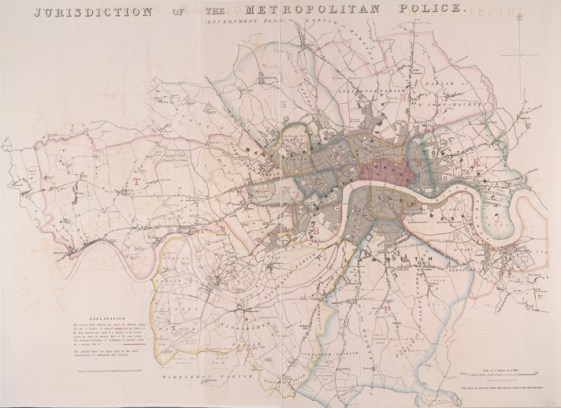
While the Metropolitan Police Force was created in 1829, it underwent a multitude of changes, expansions and reforms in the following decades. These changes were primarily in the name of expanding the police force that was so successfully implemented in the metropolis to other cities and towns across the country. Acts such as the Municipal Corporations Act (1835), County Police Act (1839) and the County and Borough Police Act (1856) aimed at creating similar police forces across the country – something that was in fact achieved, as by 1860 there were as many as 226 police forces across England and Wales.[14] Things such as supervision of police activity, financial arrangements, record keeping, and forming centralised government control of each force were just some of the notable changes made in these subsequent acts.[15] While these changes signify a successful creation of law enforcement, it must be noted that it could not be solely approved of by parliament and legislation, but rather Peel found himself relying heavily on public approval as it was crucial for the forces’ survival.[16] In order to gain public approval it was incredibly important to be as distant to the frequently called on military as possible. Therefore, uniform was blue and consisted of swallow-tail coats and top hats, in an attempt to distance themselves from the British Infantry and gain the trust and approval of the public; in addition to this weapons were very limited with truncheons being standard issue, and pocket pistols for inspectors being the only weaponry on the force.[17] Although Peel tried so desperately to liken the police to the public, and distance them from the military, he still found himself battling many criticisms and had to deal with both these and public mockery.
To conclude, the reasons for the formation of the Metropolitan Police Force in 1829 have their origins in the increasing concern surrounding seemingly uncontrollable lawlessness, poverty and an incompetent form of law enforcement. Furthermore, the growing notion of morality and criminality, and the connection between these, ultimately can be said to be of importance in relation to the creation of the Metropolitan Police Force. In the years following its creation additions and reforms appear to be of great concern to the Home Office, with the aim of using this model of law enforcement to create an extended and comprehensive system of policing across England and Wales. While the explicit aims of the Metropolitan Police Act went not much further than the prevention of crime, it can be argued that control and morality are undeniably present in this mission to stamp out criminality.
[1] J. L. Lyman, “The Metropolitan Police Act Of 1829: An Analysis Of Certain Events Influencing The Passage And Character Of The Metropolitan Police Act In England”, Journal Of Criminal Law And Criminology, 55.1 (1964) p149
[2] Bruce L Berg, Policing In Modern Society (Boston, Mass.: Butterworth Heinemann, 1999), p. 26.
[3] J. M Beattie, The First English Detectives (Oxford: Oxford University Press, 2012), p. 54.
[4] J. L. Lyman, “The Metropolitan Police Act Of 1829: An Analysis Of Certain Events Influencing The Passage And Character Of The Metropolitan Police Act In England”, Journal Of Criminal Law And Criminology, 55.1 (1964), p149
[5] Clive Emsley, Crime And Society In England: 1750-1900, 3rd edn (Harlow: Pearson Education Limited, 2005), p. 56
[6] J. M Beattie, The First English Detectives (Oxford: Oxford University Press, 2012), p. 44
[7] J. M Beattie, The First English Detectives (Oxford: Oxford University Press, 2012), p. 44
[8] Clive Emsley, The Great British Bobby (London: Quercus, 2010), p. 40.
[9] J. L. Lyman, “The Metropolitan Police Act Of 1829: An Analysis Of Certain Events Influencing The Passage And Character Of The Metropolitan Police Act In England”, Journal Of Criminal Law And Criminology, 55.1 (1964), p141
[10] Clive Emsley, The English Police (London: Routledge, 2014), p. 16.
[11] The National Archives: MEPO 8/1 in J. M Beattie, The First English Detectives (Oxford: Oxford University Press, 2012) p.253
[12] Harold James Dyos, David Cannadine and David Alec Reeder, Exploring The Urban Past (Cambridge: Cambridge University Press, 1982), p. 84
[13] Harold James Dyos, David Cannadine and David Alec Reeder, Exploring The Urban Past (Cambridge: Cambridge University Press, 1982), p. 84-85
[14] Ian K McKenzie, Law, Power, And Justice In England And Wales (Westport, Conn.: Praeger, 1998), pp. 57-58.
[15] Ian K McKenzie, Law, Power, And Justice In England And Wales (Westport, Conn.: Praeger, 1998), pp. 57-58.
[16] J. L. Lyman, “The Metropolitan Police Act Of 1829: An Analysis Of Certain Events Influencing The Passage And Character Of The Metropolitan Police Act In England”, Journal Of Criminal Law And Criminology, 55.1 (1964), p152
[17] Clive Emsley, The English Police (London: Routledge, 2014), p.26
 Derby's Dark Corners