The Metropolitan Police was formed in 1829 by Sir Robert Peel. The formulation of the police had its origins with the Bow Street Runners of 1749, who were London’s first organised law enforcement.[1] The police was formed due to a growing need for a uniformed police presence as the Bow Street Runners were criticised for being ineffective.[2] While the Metropolitan police were unique to London, they were later used as an example for other provincial towns. The new “centralised and unified” police system can be seen as revolutionary in regards to policing in England.[3] With the belief that crime emanated from the poorer districts of the slum such as Whitechapel, Old Nichol and Spitalfields, one could anticipate problems with the relationship between law enforcement and the poor. While the duties of the police were not set in legislation, it would appear that their understanding of the job did not go much further than the prevention of crime in the newly established Metropolitan Police district.[4] When looking at the police in relation to the slum areas of London, their primary aim was to clear the streets of costermongers with the aim of protecting property.[5]
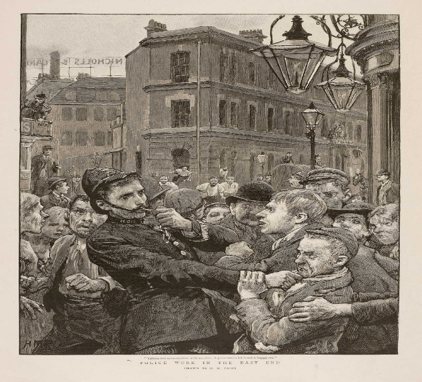
The roles and responsibilities of the Metropolitan Police during the nineteenth and early twentieth century are widely debated both by social commentators and historians. They also changed over the period. In a newspaper article in 1828, crimes were classified into 6 different classes depending on what was deemed to be more serious.[6] The police had a duty to observe the ‘magnitude of evil’, improve the slum and be aware of the problems in the slum and to constantly work with vigour and consistency.[7] Taylor argues, that maintaining order and decorum in the slum was a main responsibility of the police and how this was managed affected relations between the slummers and police.[8] As the century developed, police activity rose in the 1880s due to the social cleansing movement which saw a number of women arrested for nuisances.[9] Furthermore, Shpayer-Makov argues that detectives and journalism evolved at the same time during the nineteenth century.[10] Therefore, we can see the responsibilities and roles of the police by looking at what social problems were being reported about because journalists helped detectives become more accepted within society by writing about the good work they had done.[11] Shpayer-Makov argues, that both were fighting for the good of the public and by the Edwardian period they had become authoritative figures.[12]
Throughout the nineteenth century and early twentieth century, the police held both good and bad relationships with the working classes. Traditional historians hold the belief that the creation of the Metropolitan police was met with hostility, evidence for which can be found in the Coldbath Fields Riots in 1833.[13] However, as time went on the realisation for a uniformed police form was needed leading to less attacks on police between the 1850s and the 1910s.[14] Clive Emsley has argued, that it was the concern of the middle class over the poor and their ‘immoral’ behaviour that led to a realisation that the working class needed to be restricted and surveyed.[15] The idea of the police being used as a form of surveillance naturally led to closer relationships with the people of the slum. However, as Robert Storch has argued, these relationships were created in order to survey and control the people of the slum.[16] This idea of control comes from direct relationships from the people of the slums or becoming friends with owners of institutes such as public houses. Sarah Wise argues, that the police officers were an invaluable asset to the community who were “humane, brave and effective” however others were “corrupt, violent and provoke street fights”.[17]
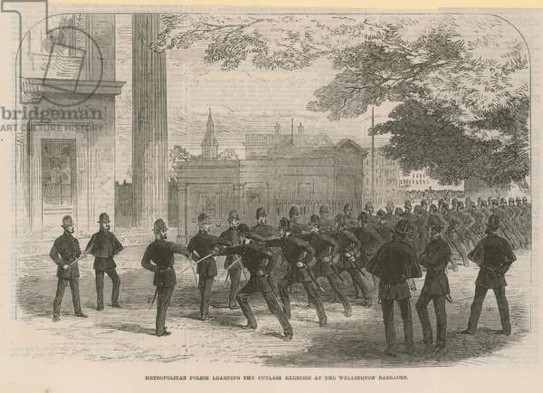
However, the police faced criticism from the working class throughout the period. Most evident with their failure to catch the Whitechapel murderer in 1888. As a result of the murders there was a rise in moral panic caused by the new form of journalism leading to a fear in the working classes within the slums whose anger was aimed at the police.[18] A prime example of this is John Tenniel in his Punch cartoons such as Whitechapel, 1888 and Blinds-Man’s Buff. In which the police are depicted as being hopeless in catching working class criminals.[19] This resulted in a bad relationship with the police from the working classes within the slums as was as the middle classes in the rest of London. The moral panics that followed the Whitechapel murders had the slums at the centre of attention. This resulted in the working classes becoming under serve suspicion from the police and their surveillance increased.[20] This increased suspicion which led to a break down in the relationship between the working classes and the police. This was because the slum residents felt they were victimised as the police were accusing them for the murders. The bad relationship originated in 1887 with the events of ‘Bloody Sunday’ when the police put down a working class protest using violent force.[21] The bad relationship that stemmed from the moral panic in which crossed class boundaries was damaging to the police whose job relied on good relationships and trust with the slum population.
The slums were at the heart of the British police force. As the growing fear of the working classes causing crime was the main reason for the Metropolitan police creation in 1829. The connection between the slums and the police is most evident in the aims of the police being to control the working class areas of London. Crimes were classified in six different classes based on seriousness and it was the duty of the police to observe these types of crimes within the slum with the aim of improving and cleaning the slum areas of London. This ultimately led to good relationships being developed. However, these good relationships were on a smaller scale as the main purpose of these relationships were one of control. These supposed good relationships turned bitter and eventually toxic with the moral panics that surrounded the 1880s.
References:
[1] Emsley, Clive. The English Police: A Political and Social History. (Oxford: Routledge, 2014) p24
[2] Beattie, J, M. The First English Detectives: The Bow Street Runners and the Policing of London. (Oxford: Oxford University Press, 2012) p235
[3] J. L. Lyman, “The Metropolitan Police Act Of 1829: An Analysis Of Certain Events Influencing The Passage And Character Of The Metropolitan Police Act In England”, The Journal Of Criminal Law, Criminology, And Police Science, 55.1 (1964) p141
[4] Beattie, J.M. The First English Detectives: The Bow Street Runners and the Policing of London (Oxford: Oxford University Press, 2012) p244
[5] Johnston, H. Crime in England 1815-1880: Experiencing the Criminal Justice System. (Oxon: Routledge, 2015) p49
[6] ‘The police of the Metropolis’, The Morning Chronicle, (London, England.) Monday, July 28, 1828; Issue 18368. British Library Newspapers, Part I: 1800-1900.
[7] ‘The police of the Metropolis’, The Morning Chronicle, (London, England.) Monday, July 28, 1828; Issue 18368. British Library Newspapers, Part I: 1800-1900.
[8] Taylor, D. ‘Class, Coverdale and Consent’ The Journal of the Social History Society 12:1 (2015) pp.113-136 p118
[9] Taylor, D. ‘Class, Coverdale and Consent’ The Journal of the Social History Society 12:1 (2015) pp.113-136 p119
[10] Shpayer-Makov, H. ‘Journalists and Police Detectives in Victorian and Edwardian England: An Uneasy Reciprocal Relationship’ Journal of Social History 42:4 (2009) pp.963-987 p964
[11] Shpayer-Makov, H. ‘Journalists and Police Detectives in Victorian and Edwardian England: An Uneasy Reciprocal Relationship’ Journal of Social History 42:4 (2009) pp.963-987 p969
[12] Shpayer-Makov, H. ‘Journalists and Police Detectives in Victorian and Edwardian England: An Uneasy Reciprocal Relationship’ Journal of Social History 42:4 (2009) pp.963-987 p979
[13] Johnston, H. Crime in England 1815-1880: Experiencing the Criminal Justice System. (Oxon: Routledge, 2015) p50
[14] Churchill, David. Crime Control & Everyday Life in the Victorian City The Police & The Public. (Oxford: Oxford University Press, 2017) P218
[15] Emsley, Clive. Crime and Society in England.(Harlow: Pearson Education Limited, 1987) p57
[16] Storch, D Robert. “The Problem of Working-Class leisure. Some Roots of Middle Class Moral Reform in the Industrial North: 1825-1850”. In Donajgrodzski, A.P. (eds.), Social Control in Nineteenth Century Britiain. (London: Croom Helm, 1977) p143
[17] Wise, Sarah. The Blackest Streets: The Life and Death of a Victorian Slum. (London: Vintage Books, 2008) P106
[18] Green, J, P, ‘Ripping Yarns: Capturing (not catching) and Constructing the Myth of Jack the Ripper in Nineteenth-Century London’ in Storey, J (eds.). The Making of English Popular Culture. (London: Routledge, 2016) p217
[19] Tenniel, J., ‘Blind-man’s Buff’ Punch Magazine, (London: Punch Ltd, 1888) Available online: https://www.bl.uk/collecion-items/blind-mans-buff-from-punch Date accessed: 7 September 2018 and British Library, p.p. 5270, ‘Whitechapel, 1888’, 1888
[20] Haggard, R, F., ‘Jack the Ripper as the Threat of Outcast London’, in Warwick, A & Willis, M (eds.). Jack the Ripper; Media, Culture, History. (Manchester: Manchester University Press, 2007) p205
[21] Walkowitz, J, R. City of Dreadful Delight: Narratives of Sexual Danger in Late-Victorian London. (London: Virgo Press Limited, 1992) p28
 Derby's Dark Corners