by Ariana Fox
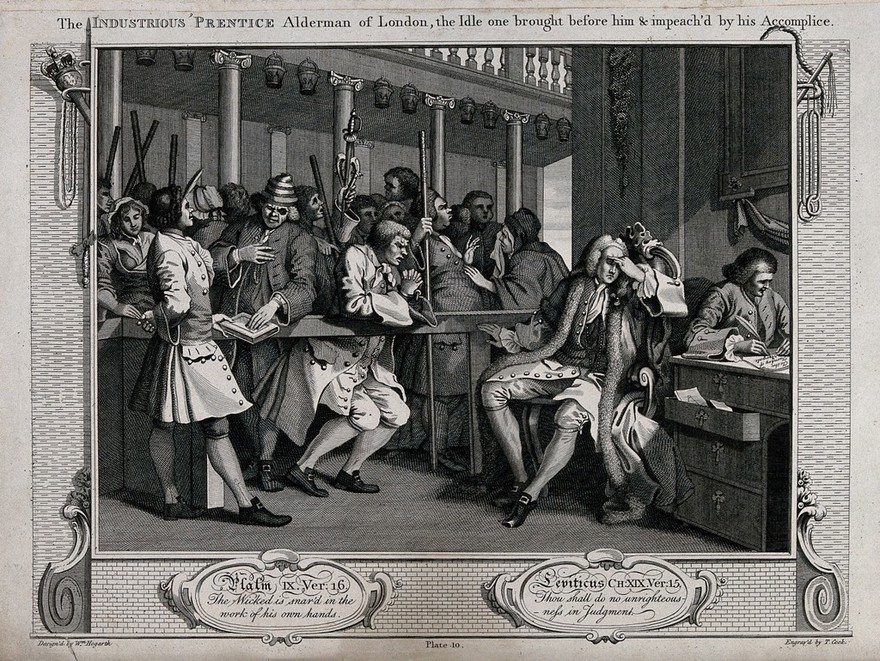
Hogarth, H., ‘The Industrious ‘Prentice Alderman of London, the Idle one brought before him & impeach’d by his Accomplice’[1] – The usage of quotes is paralleled within the coverage of this case.
“Nay, take my life and all, pardon not that:
You take my house, when you do take the prop
That doth sustain my house; you take my life
When you do take the means whereby I live.”
Merchant of Venice[2]
This is the quote used by the Derby Mercury to encapsulate the case and proceedings of The Derby Local Board of Health v. Minnitt that occurred in 1856. Mr. Thomas Minnitt, who set up the business of a tallow chandler on St. Helens Street, is brought before the Board on the grounds that he has commenced the business of tallow melting for the purpose of making candles without their permission. Mr. Minnitt argues that he is not a tallow melter under the meaning of the Public Health Act, merely a tallow chandler.
At first, he is convicted and has to pay a fine of £50, however there is significant doubt surrounding the case and an appeal is applied for. Was he a tallow chandler, or a tallow melter? Later, the proceedings pivot to condemning Mr. Minnitt’s trade due to nuisance instead. Did the Board truly have the wellbeing of the street in mind, or were they cruelly trying to remove a man’s livelihood? Were the signatures on the petition passed around to Mr. Minnitt’s neighbours obtained legitimately, or through intimidation? And who are the individuals who were wounded by such an accusation?
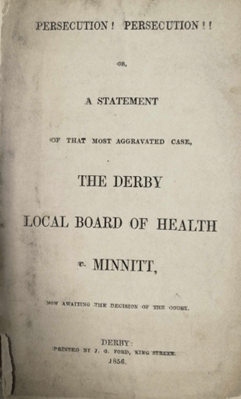
The Derby Mercury’s coverage of this case begins flamboyantly, using the words “persecution” and “aggravated” to begin to draw the reader in to the spectacle that is about to unfold and the characters to be revealed. It then opens on a quote from The Merchant of Venice, setting the stage and already subtly implying the unfairness of the case. A parallel can be drawn between this and Regard’s analysis of W.T. Stead’s infamous article The Maiden Tribute, which begins by informing the reader of the story of virgins being sacrificed to the minotaur as a tribute.[4]
The Board begins by alleging that the business conducted by Mr. Minnitt is ‘highly offensive and injurious to health, inasmuch as the stomach of a female servant was… unable to retain its food.’[5] Such a description already conjures up the potential smell coming from the street, or specifically Mr.s Minnitt’s conducted business.
The Derby Mercury’s journalistic approach towards this case appears to differ from how another journalist or they themselves may have covered conduct of the poor and the slums. Mr. Minnitt is framed as a respectable man, having his lawful and fair business threatened by a tyrannical authority ‘and thus the ground was taken from under their feet’[6] when the pivot towards nuisance regarding the case was raised. There is no need for a journalist in this case to “slum” it and disguise themselves to fit in to the image of the poor at the time, like how Donovan & Rubery, Vorachek and Sales have explored the way journalists would peer into the underworld both as themselves and undercover.[7] As well as this, in accordance with Edward Cresy’s observations of St. Helens Street, it is possible that the frontage of the street was more respectable, if melting animal fat is the biggest stench on the street. He notes slaughterhouses and cramped dwellings, even referring to one as ‘really an object of horror’.[8] Therefore, there seems to be a divide against its business oriented individuals and those in cramped courts.
There is also a fascinating back-and-forth between the Board and those who are alleged to have gotten the signatures for Mr. Minnitt’s petition under intimidation, using the medium of the Derby Mercury as part of their scuffle and an attempt to protect their integrity that had been so ‘grossly impugned’.[9] As such, there appears to be a certain “properness” involved in the proceedings, with Mr. Treece and Mr. Miles’ honour and reputation hanging in the balance. They write to Dr. Bent, Mr. Cooper and then Mr. Mozley is called out publicly by a letter to the Editor-in-Chief of the Derby Mercury.
As a reader experiences Mr. Minnitt’s case unfold, they may find themselves identifying with the plucky underdog who faces off against authority and legality and his associates who rise to support him. The Board and its lackeys attempt to undermine and discredit Mr. Minnitt’s claim to life itself and the reputations of Mr. Treece and Mr. Miles, as the Derby Mercury frames with two separate quotes, one from The Merchant of Venice, the other translated from Latin by the poet Alexander Pope.
“Get wealth and power, if possible, with grace,
If not, by any means, get wealth and place.”
Passage from Horace[10]
Mr Minnitt was apparently successful in his plight to prove that he was a tallow chandler, not a tallow melter andhe was even able to win back his court expenses too.[11] Mr. Minnitt was not a poverty stricken man, however, the framing of his plight lends credibility to the idea that if this court case were to succeed and he were to lose his livelihood, he may have been doomed to a life in the courts of St. Helens or other courts of Derby, where far more nasty smells would have been around than mere tallow. The fear and threat of poverty outlines the entire chronicling of the case, as though Mr. Minnitt’s fate hangs over a dangerous decline.
[1] Hogarth, H., The Industrious ‘Prentice Alderman of London, the Idle one brought before him & impeach’d by his Accomplice, engraving with etching, created at some point in 1697-1764, Wellcome Collection, Available online: https://wellcomecollection.org/works/bw7v52qa/items Accessed December 2023
[2] Shakespeare, William, The Merchant of Venice, reproduced in Derby Local Studies and Family History Library, BA 614.04 Acc. 49450, ‘Persecution! Persecution!!, or a Statement of That Most Aggravated Case, The Derby Local Board of Health v. Minnitt’, from the Derby Mercury, 1856, p. 3
[3] ‘Persecution! Persecution!!, p. 2
[4] Regard, F., ‘The Sexual Exploitation of the Poor in W. T. Stead’s ‘New Journalism’: Humanity, Democracy and the Tabloid Press’ in Korte, B. & Regard, F. (eds.), Narrating Poverty and Precarity in Britain (Berlin: De Gruyter, 2014), pp. 77-78
[5] Persecution! Persecution!!, p. 3
[6] Persecution! Persecution!!, p. 5
[7] Donovan, S. & Rubery, M. ‘Doing the Amateur Casual: Victorian Investigative Journalism and the Legacy of James Greenwood’s “A Night in a Workhouse”’ Victorian Studies, 63.3 (2021), pp. 401-430
Vorachek, L., ‘”How little I cared for fame”: T. Sparrow and Women’s Investigative Journalism at the Fin de Siécle’ Victorian Periodicals Review, 49.2 (2016), pp. 333-361
Sales, R., ‘Platform, Performance and Payment in Henry Mayhew’s London Labour and the London Poor’ in Campbell, K. (ed.), Journalism, Literature and Modernity: from Hazlitt to Modernism (Keele: Keele University Press, 1999), pp. 54-71
[8] Cresy, E., Report to the General Board of Health on a preliminary inquiry into the sewerage, drainage, and supply of water, and the sanitary condition of the inhabitants of the Borough of Derby, 1849, p. 15 Available online: https://emlib.ent.sirsidynix.net.uk/client/en_GB/search/asset/162/0 Accessed December 2023
[9] Persecution! Persecution!!, p. 11
[10] Horace, quote translated by Alexander Pope as reproduced in Persecution! Persecution!!, p. 7
[11] Mountford, G., ‘The Minnitt family and the Old Vaults St Helens Street’ Derbyshire Family History Society, 156 (2016), pp. 58-60
 Derby's Dark Corners