The advocacy for the Public Health Act of 1848 by Edwin Chadwick pushed for the appointment of each town having a Medical Officer of Health (MOH).[1] Through their work, the MOH used cartography as a means of providing a visual representation of their reports by explaining the distribution of diseases, most prominently cholera, and the sanitation of a town.
Early Exploration:
The development of medical cartography can be brought up to show the relation it had to the work of nineteenth-century MOH. E. W. Gilbert discusses the impact of maps in the work of medical history in their work, Pioneer Maps of Health and Disease in England. Gilbert discusses that the noteworthy outbreaks of Asiatic cholera within the first half of the nineteenth century “seem to have been the factor which first stimulated cartographic work of this kind”, which is directly suggesting that the use of mapping in the work of the MOH seems to be a mechanism in order to show where the disease was starting from.[2] It can be shown through the work of Dr. John Snow, and his cholera maps, that MOHs caught onto the mapping trend. Gilbert directly discusses Snow’s cholera map (or as Snow called it, a “cholera field”[3]), which showed “the distribution of deaths from cholera in the Broad Street district of London in 1854”.[4]
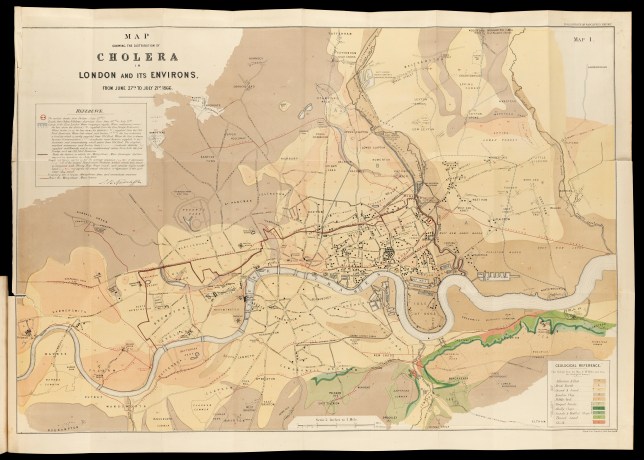
The distribution of the cholera outbreak in London in the summer of 1866 was one of the major outbreaks that affected the city in the latter half of the nineteenth century. The work of John Netten Radcliffe highlighted the outbreak in relation to the geographical build-up of the earth in the area. Radcliffe was the assistant medical officer to George Buchanan, the MOH for the St Giles district of London.[5] The relation between the earth and the outbreak can be shown through the map that Radcliffe produced in Figure 1. The map is clear in identifying the outbreaks of the disease, which can be identified by the use of black dots. Furthermore, the map is showing that the earth in the surrounding areas with most of the outbreaks occurring in areas that consisted of the earth being made up of gravel and sand. Radcliffe’s work is predominantly based around the East London Company and the spread of the disease through the infected water that was being supplied to the areas of London. W Luckin discusses Radcliffe’s rejection and opposition of the miasmatically- based theories of the outbreak of cholera in London and suggests that he based the outbreaks as an occurrence of a bad supply of water.[6] It is clear to see that Figure 1 conveys Radcliffe’s findings as a result of showing that the water being supplied to the areas where the outbreaks occurred came from the companies of the area.
Mapping Cholera:
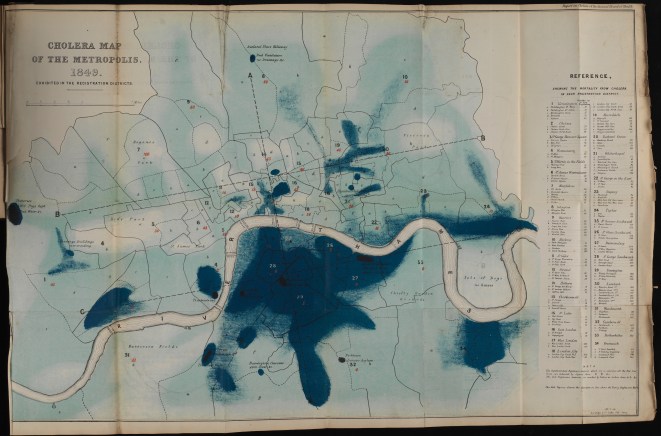
In terms of how the MOH can be considered an explorer of their time, the mapping of the earlier outbreaks of cholera can be used to show how cartography came to be part of their work. One of the most intriguing works when looking at the mapping of the London cholera outbreaks of the nineteenth century is Richard Grainger’s 1849 ‘Cholera Map of the Metropolis’, which can be seen in Figure 2. Grainger’s map emphasises the greatest amount of the outbreak occurring in the areas on the south bank of the River Thames, whilst also showing the occasional outbreaks that occurred on the northern side of the river.[7] The map also identifies the districts in which the outbreaks took place, with Newington being the central location for the outbreaks that Grainger focused on. However, it is notable to mention that the map has not included information about the water that was supplied to the districts.
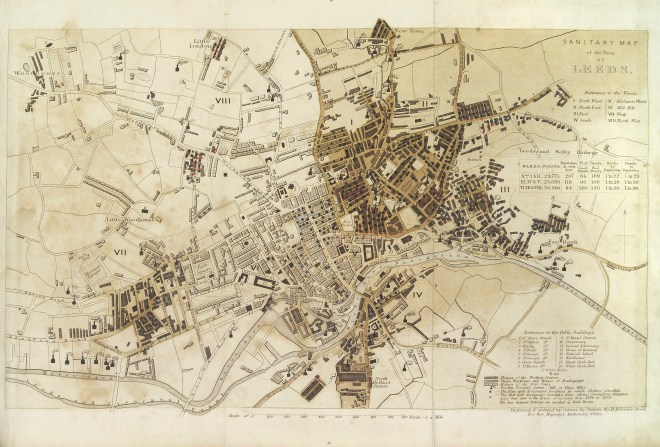
In her book, Mapping Society, Laura Vaughan discusses the use of social cartography, particularly in reference to the work that arose in the nineteenth century, and how it became a feature of the work of the MOH and Boards of Health. Vaughan argues that John Snow’s maps were a direct result of the “desire to capture the apparent disorder of the urban areas and to solve what are still seen to be urban problems”.[8] Although this is talking in terms of social problems, such as crime, it can be applied to Snow’s work around the cholera outbreak as he used cartography as a means of showing where the outbreaks took place and, most notably, which water supply pump was found to be the source of the cholera-infected water. Vaughan’s work also brings to discussion the sanitation maps that were produced by Edwin Chadwick. While Chadwick was not a MOH himself, he was a strong advocate for the Public Health Act of 1848 that led to each town appointing a MOH. This can imply that cartography became part of the work of the MOH as it allowed them to show the distribution of diseases, in direct relation as to where it stemmed from. Particularly looking at Chadwick’s sanitation map of Leeds, as seen in Figure 3, Vaughan notes that “disease is presented here as being associated with dirt”, which can be linked back to Radcliffe’s map of cholera due to the fact that disease is being linked directly to the earth of the surrounding area.[9]
In conclusion, cartographical work that was produced by nineteenth-century Medical Officers of Health directly shows that they were the Dora’s of their generation. Their exploration and creation of detailed medical and social maps help to show that it was not only general reporting on medical conditions that played a prominent role in their work and position. Without the MOH’s use of mapping the outbreaks of disease, in terms of the bad water supply, the direct cause of the spread of cholera may not have been discovered since there were still many theories surrounding they outbreaks up until 1866.
References:
[1]“The 1848 Public Health Act”, UK Parliament, available online: <https://www.parliament.uk/about/living-heritage/transformingsociety/towncountry/towns/tyne-and-wear-case-study/about-the-group/public-administration/the-1848-public-health-act/>
[2]Gilbert, E. W., ‘Pioneer Maps of Health and Disease in England’, The Geographical Journal, 124:2, (1958), p. 173
[3]Gilbert, ‘Pioneer Maps’, p. 174
[4]Gilbert, ‘Pioneer Maps’, p. 174
[5]Sheard, S., and Donaldson, L. J., The Nation’s Doctor: The Role of the Chief Medical Officer 1855-1998(Abingdon: Radcliffe, 2006), p. 20
[6]Luckin, W., ‘The Final Catastrophe—Cholera in London, 1866’, Medical History, 21:1 (1977), p. 40
[7]Koch, T., and Denike, K., ‘Aaron’s Solution, Instructor’s Problem: Teaching Surface Analysis Using GIS’, Journal of Geography, 106:2 (2007), p. 70
[8]Vaughan, L. Mapping Society: The Spatial Dimensions of Social Cartography(London: UCL Press, 2018), p. 19
[9]Vaughan, Mapping Society, p. 27
Illustrations:
Figure 1: Radcliffe, J. N., ‘Map showing the distribution of cholera in London and its environs, from 27thJune to 22ndJuly 1866′, Reports of the medical officer of the Privy Council and Local Government Board, 1867, Wellcome Library, London. Available online: https://wellcomecollection.org/works/t4cgjqxa?query=cholera%20map%201866
Figure 2: Grainger, R., Cholera Map of the Metropolis, 1849, Exhibited in the Registration Districts, Wellcome Library, London. Available online: https://wellcomecollection.org/works/hjutkspw?query=cholera%20map%201866
Figure 3: Chadwick, E., ‘Chadwick’s Sanitary Map of the Town of Leeds, 1842’, Wellcome Library, London. Available online: https://wellcomecollection.org/works/u35gkmj5?query=sanitary%20map%20of%20leeds
 Derby's Dark Corners