From the Slums to the Seas:
The implementation of the first Medical Officers of Health (MOH) William Henry Duncan and John Simon in Great Britain by 1848[1] was quickly and efficiently adapted into a nation-wide success with regards to public health and health administration.
By the turn of the century every jurisdiction in the nation was appointed a Medical Officer of Health. whose responsibilities were concerned with the prevention of the spread of deadly disease through means which included ‘analysis of mortality and morbidity data, liaison with scientific and medical experts, and investment in local facilities to improve diagnosis and treatment’[2].
The health of Britain and its inhabitants was of growing concern throughout the nineteenth century, however following the end of the Victorian Era in the twentieth century this concern had expanded to a matter of imperial importance.
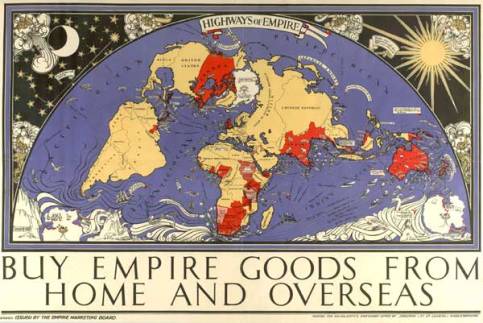
This poster accurately shows the British Empire in the late 1920s, the vast connections across the globe allowed for vast amounts of trade, both to and from the British Isles, these vast imperial connections meant that the exportation of great assets within British society was inevitable.
The office of Medical Officer of Health was thus exported across the waves and throughout The British Empire in the years following its success in Great Britain. The export of British health administration was implemented in order to combat the same issues that were under siege by the Medical Officer of Health at home, such as infectious disease, poor housing conditions and the issue of overpopulation throughout The Empire.

Mounties and medicine:
Canada:
One area of the Empire which saw a successful implementation of the office was Canada, many reports are available which concern themselves with the role and the effectiveness of the Medical Officer of Health.
One such advocate for the Medical Officer of Health was, Dr. F. Roberts, the minister for health in the Canadian region of New Brunswick during the 1920s once stated that the Medical Officer of Health was
‘perhaps one of the oldest and one of the most important aspects of the modern system of public health administration’[3]
This extract indicates the positive outcome of the implementation the work undertaken by the Medical Officers of Health in Britain, in the seventy years prior to F. Roberts speech, the speech is also indicative of the notoriety of the success of the office in Great Britain and thus his desire to see it implemented within his region of Canada
Roberts also states
‘In England, where I think the office was first instituted, or at any rate first fully and efficiently developed, the part played by them is of first-rate importance’[4]
Further displaying the respect that Dr. F. Roberts has with regards to the Medical officer of health. what is of great importance with regards to extracts such as this is the fact that notable and respected members of the medical profession as well as government figures such as Dr. F. Roberts have an esteemed respect for the office and praise the system wholly, which too is indicative of the great successes of the new medical and administrative systems within Great Britain.
This respect was further felt within Canada with Dr James Roberts, Medical Officer of Health being implemented in the Ontario region with the objective of combating the constant outbreaks in the regions which included outbreaks of
‘smallpox, typhoid fever, diphtheria, septic sore throat, scarlet fever, measles, whooping cough, pneumonia, mumps, chickenpox, tuberculosis, meningitis and influenza. He is also charged with the administration of the V. D Act'[5]

The powers and abilities of the new colonial healthcare specialists allowed for them to be just as effective across the colonies as they were in great Britain, For example, the Medical Officers for Health across Canada were tasked with combating disease
‘where any communicable disease is found to exist in any municipality, the medical officer of health and the local board shall use all possible care to prevent the spread of infection or contagion by such means as in their judgement is most effective for public safety[6]
This extract indicates the abilities of the Medical Officers of Health within Canada, it mirrors those of the Medical Officers of Health within Great Britain, which emphasizes the importance of the roles that they undertakes as forerunners in preventative measures relating to disease.
The Cape of Good Health:
South Africa:

With the health of the nation and that of the wider empire becoming a popular topic of debate in Britain, it was inevitable that the administrative prowess of the Medical Officer of Health was implemented in other far flung areas of The Empire. Implemented in the colonies of south Africa which in the 1890s had seen a rise in
‘a multitude of infections and parasitic diseases and saw the failure of a totally inadequate public health to deal with their prevention’[7].
The Colonial Office thus appointed Medical Officers of Health within the Cape Colony of South Africa, in an effort to alleviate concerns about
‘the general level of social welfare in African protectorates and emphasized the need for more educational facilities that could be used to improve social work, particularly medicine’[8]
Soon after their implementation into the South African Colonies and the induction of their preventative medicine, there came a clear understanding that
‘basic health services were provided in hospitals for officials and the community at no cost’[9].
These extracts are from a later analysis of the health care system within South Africa, the importance of administrative public health becomes prevalent when looking at the history of medicine within the colony due to these being the first steps taken towards a health care system in the area, this almost implies an image of heroism towards Officers of Health and effective administration of healthcare systems within the colony. The impact of these free facilities and services on the populations of the colony is difficult to analyse, however it is not impossible to infer the underlying impact of the implementation of the Medical Officer of Health. In implementing a system of administrative public healthcare throughout the empire allowed for a greater level of fitness and productivity, this in turn allowed for the Empire to become more efficient, productive and healthy. Resulting in a better functioning empire, imperial economy and to an extent, seen within the numbers of soldiers from across the Empire that were deployed during The Great War (1914-1918). this is especially seen with regards to Indian soldiers in the British Army.
Sources:
- Gorsky M, Local leadership in public health: the role of the medical officer of health in Britain, 1872–1974
Journal of Epidemiology & Community Health 2007;61:468-472. - Joseph Melling, Pamela Dale: Medical Officers of Health, Gender and Government Responses to the Problem of Cancer in Britain, 1900–1940. Volume 53, Issue 4 October 2009 , pp. 537-560
- The Responsibilities of Medical Health Officers Wm. F. Roberts, The Public Health Journal, Vol. 11, No. 8 (AUGUST, 1920), pp. 348-352, Published by: Canadian Public Health Association,
- The Responsibilities of Medical Health Officers Wm. F. Roberts, The Public Health Journal, Vol. 11, No. 8 (AUGUST, 1920), pp. 348-352, Published by: Canadian Public Health Association,
- James Roberts, M.D, THE SPECIFIC DUTIES OF MEDICAL OFFICERS OF HEALTH IN DEALING WITH COMMUNICABLE DISEASES PART I—SMALLPOX, TYPHOID FEVER, DIPHTHERIA, 1927
- James Roberts, M.D, THE SPECIFIC DUTIES OF MEDICAL OFFICERS OF HEALTH IN DEALING WITH COMMUNICABLE DISEASES PART I—SMALLPOX, TYPHOID FEVER, DIPHTHERIA, 1927
- S. 8. GILDER: South African medicine In the 1890s, SA MEDICAL MAGAZINE SPECIAL EXPENDITURE 29 JUNIE 1983
- Grietjie Verhoef, From Friendly Society to Compulsory Medical Aid Association: The History of Medical Aid Provision in South Africa’s Public Sector, 1905–1970, Social Science History Vol. 30, No. 4, Special Issue: The Persistence of the Health Insurance Dilemma (Winter, 2006), pp. 601-627
Illustrations and images:
- A British poster from 1927 called ‘Highways of Empire’ (National Archives) http://www.nationalarchives.gov.uk/education/empire/g2/cs1/g2cs1s3.htm
- The First Christmas Stamp December 25th 1898 available online: https://www.historymuseum.ca/cmc/exhibitions/cpm/chrono/ch1898ae.html
- Women Posing outside their workplace during the ‘Killer Flu’ in the Alberta Region. available online: https://www.canadashistory.ca/explore/arts-culture-society/killer-flu
- Map of Cape Colony, Orange Free State, and South African Republic, available online: https://www.alamy.com/stock-photo-colonial-south-africa-cape-colony-orange-free-state-sa-republic-1899-103741743.html
 Derby's Dark Corners