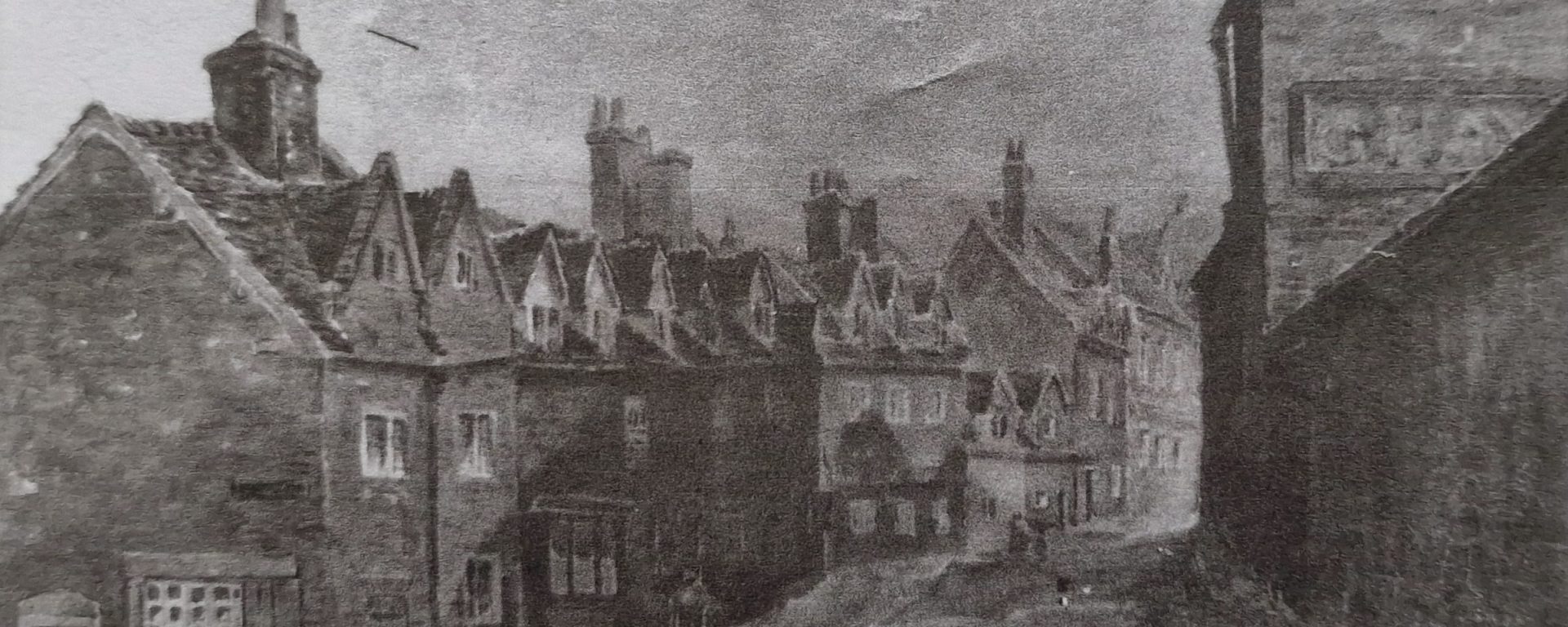
by Davina Naylor
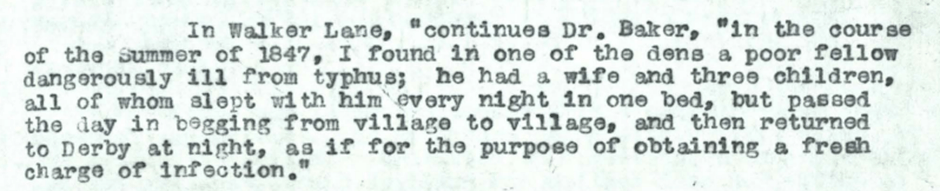
Cresy, Edward. Report to the General Board of Health on a Preliminary Inquiry into the Sewerage, Drainage, and Supply of Water, and the Sanitary Condition of the Inhabitants of the Borough of Derby. W. Clowes & Sons for H.M.S.O., 1849.
This primary source is a snippet of an inquiry into the sanitary conditions of the borough of Derby by Edward Cresy. The document was intended for officials and this part of the source is about the conditions of lodge housing. Lodge housing was an element of the slums that alarmed many people and was part of the negative ‘image’ of the slums. It also impacted a lot of people’s lives negatively. These sources identify different elements of the lodging houses, from the quality of the water to sickness, that contributed to the bad reputation of ‘the slum’ more generally.
In the Walker Lane area of Derby there was a lot of lodge housing, which were beds/rooms which were rented out for living or staying in temporarily, often only a couple of days. Conditions in these houses were often deplorable, because they were aimed at poorest of people often at very low rent, meaning basic facilities, such as access to water and shelter. But also, they often had to share bedrooms with many other people, beds were close together and not very comfortable[1]. Cresy mentions that a husband, and wife and three children had to sleep in one bed, showing how desperate people must have been to be in that situation.
With the closeness of the beds in the bedrooms and the amount of people they had to share a house with, sickness became prevalent in the areas where lodge housing was. In Walker Lane, there were reported 75 cases of typhus fever between June 15 and September 15, 1847. This is a large number of cases reported in such a small-time window, indicating that lodge housing was a serious issue that needed to be dealt with. Many people would die because of these diseases as well due to the lack of medication and medical assistance with the diseases as well as not being able to afford certain medical care.[2] Children under five years of age was around one-third of all deaths. This was mainly due to overcrowding, with younger children most affected by as they had less developed immune systems which makes them more vulnerable to diseases.
The conditions of these lodging houses would have affected the overall ‘image’ of the slums and of the people living there. The houses had rules, one of which was to not partake in any prostitution, gambling or drunkenness on the property. These rules were frequently broken, indicating that the individuals living in these houses were often troubled. Many were alcoholics and some participate in prostitution.
Many people within these lodging houses would take to crime, mainly petty crime, such as stealing; even if a person did not take part in petty crime, the average person would assume that they would at some point. [4]Crime was high on Walker Lane; this could be related to the many lodge houses that were situated on this street. The lodgers would protect what small property they had because it could potentially get stolen, the kitchens doubled as brothels, these are just the other crime activities that took place within these houses. People living in lodge houses often m had some sort of mental condition or illness,[5] this again would relate back to the ‘image’ of the slum, stigmatising all those who lived there.
Overall, the lodge housing was a serious concern when it came to the slums, the diseases that would spread would kill many adults and children, because of the lack of medical assistance they had access to. The ‘image’ of the slum was also affected because of the bad behaviour of some of the people within these houses. The amount of space people had in these houses were not a lot and was a strong contributor to the spread of diseases; there were many of these houses on Walker Lane and there could be 5 or 6 people per bedroom, with possibly even more at times. This overcrowding a real issue and was at the heart of the overall ‘image’ of the slums as a whole.
[1] SCHOALES, J. S. “IMPORTANCE OF HOUSING AND LODGING-HOUSE INSPECTION.” The Public Health Journal, vol. 7, no. 11, 1916, pp. 470–80. JSTOR, http://www.jstor.org/stable/41996920. Accessed 16 Dec. 2023.
[2] SCHOALES, J. S. “IMPORTANCE OF HOUSING AND LODGING-HOUSE INSPECTION.” The Public Health Journal, vol. 7, no. 11, 1916, pp. 470–80. JSTOR, http://www.jstor.org/stable/41996920. Accessed 16 Dec. 2023.
[3] Orwell, George. “COMMON LODGING HOUSES.” New Statesman, vol. 128, no. 4464, 29 Nov. 1999, p. 49. Gale Academic OneFile, link.gale.com/apps/doc/A58467160/AONE?u=derby&sid=bookmark-AONE&xid=6645e888. Accessed 16 Dec. 2023.
[4] Orwell, George. “COMMON LODGING HOUSES.” New Statesman, vol. 128, no. 4464, 29 Nov. 1999, p. 49. Gale Academic OneFile, link.gale.com/apps/doc/A58467160/AONE?u=derby&sid=bookmark-AONE&xid=6645e888. Accessed 16 Dec. 2023.
[5] “Infectious Diseases In Lodging Houses.” The British Medical Journal, vol. 2, no. 1811, 1895, pp. 666–666. JSTOR, http://www.jstor.org/stable/20233011. Accessed 16 Dec. 2023.
 Derby's Dark Corners