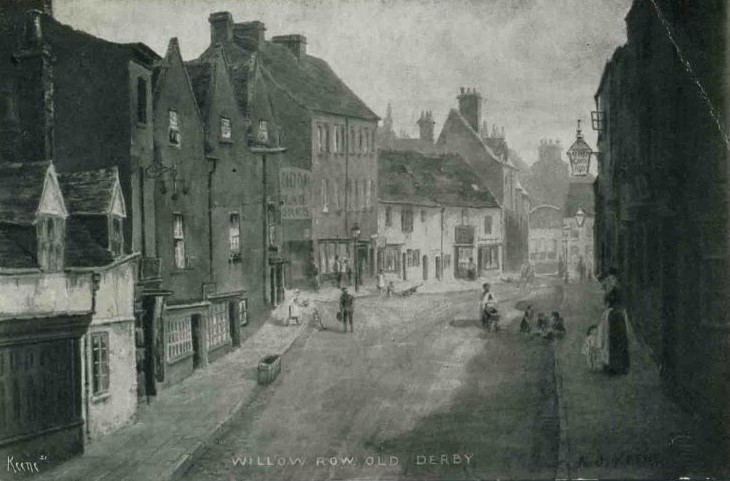
In 1842, Edwin Chadwick’s Report on the Sanitary Condition of the Labouring Population of Great Britain stated that lodging houses were unsatisfactory for occupation.[1] Often called common or low lodging houses, they were an option for those seeking temporary accommodation. The names of lodging houses were used to differentiate them from the middle-class boarding house and dosshouses, whilst also connecting them with the ‘laziness’ associated with the poor. These common lodgings were found regularly within the Victorian slum.[2]
In order to improve understandings of the lodging house of the nineteenth and twentieth centuries, our group have identified four prevalent themes associated with the lodging house: prices, people, privacy, and perceptions of morality. Each of these themes will be examined in relation to sources that are Derby-specific, like for example, census records, newspaper reports, and official byelaws.
The common lodging houses offered housing to the transient whether it was people who were seeking out housing or temporary workers who migrated around. The differing of prices in common lodging houses are a factor that comes into play with regards to the geography of the houses. The common lodging houses were very often in high demand and as such were subject to poor conditions and overcrowding, which factors into discussions around price. The professions of those who frequented the common lodging house is part of the discussion when looking at the price of lodgings as this acts to give an indication of the income of lodgers. The ultimate questions of focus when looking at the price of lodging houses is who was paying to stay in them, how much were they paying and how was the perception of value for money.
Upper-class perceptions of propriety were projected onto the people of the Derby lodging house. Nineteenth-century ideals on cleanliness and morality informed society of the level of propriety a person was expected to have. If cleanliness could not be achieved, occupants were often viewed as morally unclean. Subsequently, they became subjects of intrigue and concern for social explorers, journalists, reformers and, in certain circumstances, the local government. This section will consider Derby Council’s byelaws from 1930, and how changing attitudes towards propriety and morality, in terms of behaviour and public health, impacted the decision to implement these byelaws.
Whilst examining the lodging house, it is vitally important to investigate the people that both owned and occupied the lodging houses. In knowing who owned a lodging house, it becomes crucial information in understanding the other three themes associated with the lodging house. To fully understand the people associated with the lodging houses, it is vital to look at the trends of who occupied the rooms, how many lodgers were occupants at one time and their jobs to answer the question: what type of people used these houses? In order to do this, this section will be using census data from the Derby Slums of the nineteenth century to examine the trends and get an idea of who the lodgers were and who lived in the slums of Derby.
Privacy is not something which is often found within lodging houses and is a luxury not afforded to its occupants due to crowded conditions. The lack of privacy is often linked to the unsanitary conditions found within the lodging houses, evidence of this is mentioned heavily within town council sanitary committee meetings. The implementation of improving this can be seen in laws passed during the period such as the Public Health Act of 1875 and with this the grant of more power and control to local authorities. This section will focus on the connection between privacy and sanitation in Derby lodging houses and also the idea that a physical barrier will prevent physical disease.
It is important to investigate lodging houses so that perceptions of the slum can be challenged. For example, many myths about the lodging house have been perpetuated by middle-class writers of the nineteenth century, who, in certain cases, sensationalised stories written about the lives of ordinary people.[3] Lodging houses assumed crucial roles in the lives of the poor, so it is, therefore, important to use primary source analysis in tandem with historical debate to allow readers to grasp a better understanding of the realities of slum living.
[1] Hamlett, J., At Home in the Institution: Material Life in Asylums, Lodging Houses and Schools in Victorian and Edwardian England (Basingstoke: Palgrave Macmillan, 2015), p.111; Crook, T., ‘Accommodating the outcast: common lodging houses and the limits of urban governance in Victorian and Edwardian London’, Urban History 35.3 (2008), p.417.
[2] Hamlett, At Home in the Institution, p.114.
[3] Donovan, S., and Matthew Rubery, ‘Introduction’, in Donovan, S., and Matthew Rubery (eds.), Secret Commissions: An Anthology of Victorian Investigate Journalism (Peterborough: Broadview Press, 2012), p.16.
 Derby's Dark Corners