“much of health and longevity depends upon the water and air we draw into the system. Stagnate moisture is hurtful, but this is prevented by the air passing through an open valley, some miles over, which admitting a free passage promotes exhalation and purifies itself. Agues are rather prevalent. Rheumatisms are not” The neglect of drainage and neglect in confining the flood waters, in all probability produced these diseases, which prevailed here in the middle ages.
W. Hutton in Report to the General Board of Health on a preliminary inquiry into the sewerage, drainage and supply of water, and the sanitary conditions of the inhabitants of the Borough of Derby, 1848.
Throughout the Victorian Period water systems and drainage have been linked to poor health, especially within overcrowded slums. This was no different within Derbyshire, where one seventh of the boroughs petitioned for improvements, leading to a report by E. Cresy to the General Board of Health, in which he discusses the sanitary issues within the different boroughs, and the effects they were having on the population.[1] This report helps give an official view on the sanitation problems effecting the slums in 1849. This page will focus on different diseases and how the drainage and sanitation of water affected those within the slums.
What was the General Board of Health
After a number of pandemics in the 1830s the government asked Edwin Chadwick to write an enquiry on the sanitation within cities, in which links between sanitation, living conditions and disease were made.[2] This report lead to the creation of the General Board of Health in 1848 with Chadwick as its first director.[3] The boards job was to review reports and administer improvements to the cities of England to improve health and relieve stress on the welfare system that was in place at the time.[4]
Who was E. Cresy and What did he report
E. Cresy was an English architect, and superintending inspector, who after visiting the boroughs of Derby, wrote a report to the General Board of Health, stating the diseases each borough was affected by, as well as a solution for them. Within his report Cresy discusses the five Parishes within the borough of Derby; St. Alkmunds, St. Michaels’, All Saints’ or All Hallows, St. Peter’s and St. Werburgh’s. Most inhabitants of these parishes were working class finding employment within the silk mill and surrounding factories; however, employees were not responsible in looking after their employees.[5]
Water and Disease
In this report E. Cresy uses a quote from the W. Hutton, a historian of Derby, to establish why the Derbyshire boroughs were prone to common diseases. Hutton observed that ‘much of help… depends upon water and air we draw into the system.’, within Derbyshire much of the water came from streams and brooks, and from the result of flooding.[6] Within Victorian Slums, very few had their own drainage system, instead whole courts; a number of buildings centred around a small garden or patio, shared a few privies and one water pump, usually between hundreds of people.[7] This close proximity of citizens, often multiple families within a single dwelling, lead to diseases easily being transferred between people. This section will look at the most prevalent diseases, their symptoms, and how those within slums were affected by them.
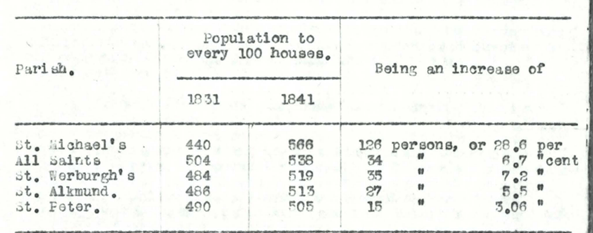
Figure 1 – Table of Derbyshire Boroughs populations from Report to the General Board of Health on a preliminary inquiry into the sewerage, drainage and supply of water, and the sanitary conditions of the inhabitants of the Borough of Derby, 1848.
Cholera;
Cholera was prevalent within Victorian societies, at first being believed to be transmitted through miasma, through the air.[8] Although the first pandemic of cholera did not occur to after the report was filled to the General Board of Health, smaller cases with the same symptoms were recorded, however doctors and surgeons were not familiar with them.[9] In 1848, the same year as Cresy’s report of the Derbyshire boroughs, John Snow started to investigate the cholera pandemic, putting forward the idea of disease being transferred through contaminated water, the same ideas that was presented by Hutton, however this was largely ignored to begin with.[10]
Typhoid:
Throughout the Victorian Period Typhoid was one of the deadliest diseases to affect those within the slums, being transferred through the waste and sewage within drinking water, the two of which were often the same river.[11]
Plague;
Since the sixteenth century, plagues have occurred across England and the rest of the world, being especially prevalent within overcrowded cities. There were many strands of different plagues that effected England throughout the Victorian period.
Mortality Rates
Within his report E. Cresy discusses the mortality rates within the Derbyshire broughs, from June 1837 to September 1848, when the report was written. This table shows that the death rates within the slums slowly increased from year to year, meaning that the average death percentage was higher than the average within most of England.[12]
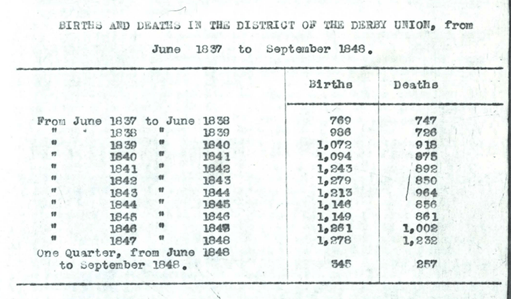
Figure 2 – Table to Birth and Death Rates within the Derbyshire Boroughs from Report to the General Board of Health on a preliminary inquiry into the sewerage, drainage and supply of water, and the sanitary conditions of the inhabitants of the Borough of Derby, 1848.
Conclusion
The Victorian slums were a place rife with diseases, and the Derbyshire broughs were no different. E. Cresy’s report to the General Board of Health is a key example in how disease and water sanitation was presented towards the government. Due to the contamination of water within the slum’s diseases such as plague, cholera and typhoid, were spread easily throughout the close quarters. This report led to the improvements of the drainage within Derbyshire Boroughs by the 4th of August 1848.[13] Overall this report is a key source and example of how drainage affected those within the Victorian era, in slums.
Beth Perchard
[1] E. Cresy, Report to the General Board of Health on a preliminary inquiry into the sewerage, drainage and supply of water, and the sanitary conditions of the inhabitants of the Borough of Derby, 1848.
[2] https://www.sciencemuseum.org.uk/objects-and-stories/medicine/cholera-victorian-london (Accessed 17/12/2022)
[3] https://www.sciencemuseum.org.uk/objects-and-stories/medicine/cholera-victorian-london (Accessed 17/12/2022)
[4] E. Cresy, Report to the General Board of Health on a preliminary inquiry into the sewerage, drainage and supply of water, and the sanitary conditions of the inhabitants of the Borough of Derby, 1848.
[5] https://www.bl.uk/victorian-britain/articles/health-and-hygiene-in-the-19th-century (Accessed 30/12/2022)
[6] E. Cresy, Report to the General Board of Health on a preliminary inquiry into the sewerage, drainage and supply of water, and the sanitary conditions of the inhabitants of the Borough of Derby, 1848.
[7] https://www.bl.uk/romantics-and-victorians/articles/slums (Accessed 30/12/2022)
[8] hhttps://www.sciencemuseum.org.uk/objects-and-stories/medicine/cholera-victorian-london (Accessed 17/12/2022)
[9] hhttps://www.sciencemuseum.org.uk/objects-and-stories/medicine/cholera-victorian-london (Accessed 17/12/2022)
[10] https://www.sciencemuseum.org.uk/objects-and-stories/medicine/cholera-victorian-london (Accessed 17/12/2022)
[11] https://victorianerahealthandmeds.weebly.com/list-of-the-top-diseases-in-the-victorian-era.html#:~:text=Diphtheria%201%20This%20disease%20may%20have%20been%20the,spread%20through%20water%20and%20the%20sewage%20systems.%20 (Accessed 03/01/2023)
[12] E. Cresy, Report to the General Board of Health on a preliminary inquiry into the sewerage, drainage and supply of water, and the sanitary conditions of the inhabitants of the Borough of Derby, 1848.
[13] E. Cresy, Report to the General Board of Health on a preliminary inquiry into the sewerage, drainage and supply of water, and the sanitary conditions of the inhabitants of the Borough of Derby, 1848.
 Derby's Dark Corners