
by Jon Hawkins
Edward Cresy’s damning report in 1849 highlighted the terrible sanitary conditions some of Derby’s inhabitants had to endure in the mid-nineteenth century. Cresy was the Superintending Inspector of the Board of Health and his preliminary enquiry, covering sewerage, drainage, and supply of water to the inhabitants of Derby, reveals appalling conditions, particularly in the ‘West End’ of Derby. He describes the desperation at the properties in Bridge Street, ‘This dwelling is never free from fever and the court is frequently flooded. It is unnecessary to abstract from my daily accounts any more instances of filthy cesspools, want of drainage, and a proper supply of water’.[1] What is clear is that in virtually all cases, slums were simply buildings built badly. The builders, in many cases, had cut corners, with not enough regulation present to ensure sewage and drainage were to a high standard. However, in stark contrast, other buildings in Bridge Street advertised during 1849, were described as ‘very open and dry, most substantially built and well finished’.[2]. Whilst the Victorians dealt with death and burial in a very dignified manner, there was a clear definition between the middle and working classes, and property defined this even further.
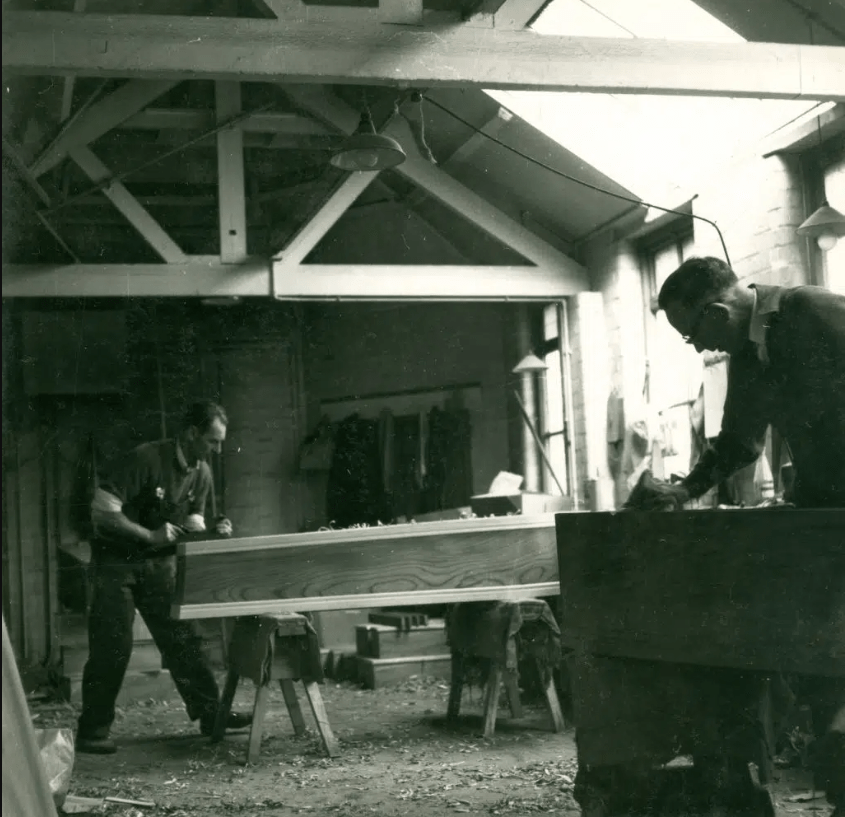
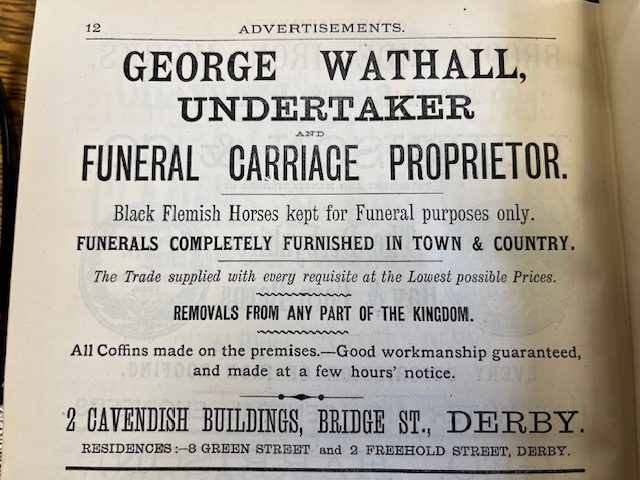
In 1858 one resident of Bridge Street, George Wathall decided to diversify his father, Leonard’s cabinet-making business, in Siddall’s Lane and make the logical transition to coffin manufacturing as Derby’s population was increasing rapidly. In 1831 it was 27,190 and by 1841, it had risen to 37,431.[3] This was creating an environmental crisis for Derby, and this is further highlighted in Cresy’s report of the ‘lack of burial grounds for the dead’[4] Wathalls are today Derby’s longest-established funeral directors and still operate from many locations within Derby.
Although middle-class Victorians cherished death and took great comfort from the mourning rituals and customs, it was a very different story for those who could not afford a proper burial: A pauper’s burial was surrounded by stigma and in many cases, a lack of dignity, as ‘the pauper coffin bore little or no indication of the individual personality of the corpse or those who mourned it’.[5] However, there is strong evidence that pauper burials were not always synonymous with mass burials, and in their article, Elizabeth Hurren and Steve King suggest that there were ‘continuities around the feelings, experiences, and motivations of the poor and the multi-layered significance of the pauper funeral’.[6]
In January 1877, Sir Henry Thompson, the President of the British Cremation Society, began the debate for cremation on the grounds of sanitary and the need to ‘eliminate the repulsive offensiveness of graveyard pollution’.[7] In his book, John Morley spells out the situation. ‘It seemed inevitable that the growing population would eventually demand every waste spot be utilised for food and shelter: The country could not be polluted with dead bodies.’ [8] He furthered the debate with the question, ‘to burn or not burn’.[9] During the 1870s. cremation societies were formed in Europe and America; however, it remained illegal in England and when this decision was reversed, it was still ‘regarded as heathen and unnatural’. [10]
Therefore, Derby had to continue to bury its dead, whether you died a pauper or had sufficient funds for an extravagant funeral with George Wathall and his black Flemish horses from Bridge street, you were guaranteed to end up at the same destination. It was Edward Cresy who also identified Derby’s rapid population increase, and how the ‘laboring classes’ were inhabiting badly built houses, with poor drainage and no main sewers. And it was Cresy who had the foresight to advocate a cemetery outside of the city and its ‘very crowded state of the churchyards and other burial places’.[11] The horrendous conditions highlighted by Cresy concluded that disease and premature mortality needed to be addressed immediately and The Derby Burial Board, formed in 1853, who were tasked to find cemetery space for the town. They managed to locate a plot two years later, comprising of undulating ground and 32 acres was secured in Nottingham Road, Chaddesden, located a mile east of Derby Cathedral. William Barron, a designer of national renown was heavily involved with the design, with Henry Isaac Stevens, a local architect, also of note, designing the associated buildings.
Finally, there was another unwelcome alternative to either a good burial or cremation, and was also a trigger for a minor moral panic towards the end of the Victorian period. As Stanley Cohen identified in 1972, a moral panic began with a perceived threat and in this case, it was the fear of being buried alive. There was a deep mistrust of the medical profession yet ‘The British medical establishment held that not one authenticated case of premature burial had been unearthed in a generation’[12]However, as George Behlmer points out, The London Press, fuelled the fire of the publics anxiety with headlines such as ‘ The Dead Alive’, ‘Mistaken for Dead’ and ‘Sounds from Another Coffin.[13] The Derby Mercury also managed to jump on the moral panic bandwagon, with their eye-catching headline ‘The Matlock Churchyard Story’. An anonymous writer had sent a letter to the editor on the 19th of February 1864 and claimed his evidence could be verified following discussions with ‘a gentleman of the legal profession.[14] Following the funeral of a local woman, whilst the sexton was alone in the churchyard filling the grave, he distinctly heard three knocks on the coffin. To verify this, he quickly summoned the clergyman, Mr Melville, who also struck three knocks, only to hear three knocks from the coffin in answer. A doctor was immediately called, and the woman’s body was exhumed. There was no indication that the poor lady had been buried alive and to further develop this mystery, The Derby Mercury also claimed ‘the deceased women was at violent enmity with a neighbour and has said, if she could not be quits with her in life, she would knock on her coffin’.[15] A very strange story and one that would almost certainly increase the sales of the Derby Mercury during this worrying time.
[1] Report to the General Board of Health into sanitary conditions of the Borough of Derby: Cresy, E. 1849
[2] “Advertisements & Notices.” Derby Mercury, 24 Jan. 1849. British Library Newspapers, link-gale-com.ezproxy.derby.ac.uk/apps/doc/BA3200004093/BNCN?u=derby&sid=bookmark-BNCN&xid=2788381d. Accessed 5 Nov. 2023.
[3] Glover, S, Glovers Derby. The History and Directory of the Borough of Derby (Bath, 1992) p.13.
[4] Report to the General Board of Health into sanitary conditions of the Borough of Derby: Cresy, E. 1849
[5] Strange, Julie-Marie. “Only a Pauper Whom Nobody Owns: Reassessing the Pauper Grave c. 1880-1914.” Past & Present, no. 178, 2003, pp. 148–75. JSTOR, http://www.jstor.org/stable/3600760. Accessed 17 Nov. 2023
[6] Hurren, Elizabeth, and Steve King. “‘Begging for a Burial’: Form, Function and Conflict in Nineteenth-Century Pauper Burial.” Social history (London) 30.3 (2005): 321–341. Web.
[7] Jalland, P, Death in the Victorian Family (Oxford: Oxford University Press, 1996) P.203
[8] Morley, J, Death, Heaven and the Victorians (London : Studio Vista, 1971) P.93.
[9] Morley, Death, p.91
[10] Jalland, P, Death in the Victorian Family (Oxford: Oxford University Press, 1996) P.209.
[11] Report to the General Board of Health into sanitary conditions of the Borough of Derby: Cresy, E. 1849
[12] Behlmer, George K. “Grave Doubts: Victorian Medicine, Moral Panic, and the Signs of Death.” The Journal of British studies 42.2 (2003): 206–235. Web.
[13] Behlmer, Grave Doubts: 206–235. Web.
[14] “THE MATLOCK CHURCHYARD STORY.” Derby Mercury, 24 Feb. 1864. British Library Newspapers, link-gale-com.ezproxy.derby.ac.uk/apps/doc/BA3200033173/BNCN?u=derby&sid=bookmark-BNCN&xid=d6a1a7ac. Accessed 3 Dec. 2023.
[15] THE MATLOCK CHURCHYARD STORY.” Derby Mercury, 24 Feb. 1864. British Library Newspapers, link-gale-com.ezproxy.derby.ac.uk/apps/doc/BA3200033173/BNCN?u=derby&sid=bookmark-BNCN&xid=d6a1a7ac. Accessed 3 Dec. 2023.
 Derby's Dark Corners