
by Lauren Childs
The Derbyshire Hospital for Women was opened on 20 Bridge Street Derby opposite St John’s Church in 1891, where it operated until 1929. It was founded by ladies of the Mundy and Newton Families.
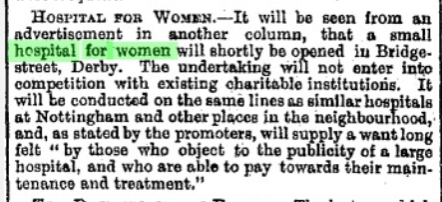
The Derby Mercury reported on the 18th of February 1891 that ‘a small hospital for women will shortly be opened in Bridge street, Derby, the undertaking will not enter into competition with existing charitable institutions… by those who object to the publicity of a large hospital and who are able to pay towards their maintenance and treatment.’[1]
A few minutes walk away from Friar Gate ‘Great Northern Station’, the Derbyshire Hospital For Women was recommended as a good place to train Nursing Progress: How And Where To Train in 1899. It stated that: “10 beds; 1 nurse; 2 probationers; candidates are accepted for training for a year and are awarded certificates upon satisfactory completion of the program. The Salary for probationers was nothing; after training, it is £12 an hour.[3]” The Derbyshire Hospital for Women was recommended as providing a good learning environment for nursing candidates. The ten beds allowed for ample patient experience while providing necessary supervision and support from a nurse and two probationers. [4].
In 1892, the hospital authorities implemented a set of rules to manage and ensure the smooth and effective functioning of the hospital. These rules were meticulously designed and applied to both in-patients and outpatients, dictating the terms of their stay[5]. The rules were established to maintain a safe and secure environment for all patients and staff, ensuring that the highest standards of care were met. Any patient who violated these rules would be subjected to disciplinary action, which could include expulsion from the hospital and having to return home[6].
In the early 1900s, the hospital was managed by a committee of women and supported by wealthy ladies from the area, who contributed items from the parish, such as grocery items, books, linens, and tableware[7]. Subscriptions and donations played a vital role in the smooth running of the hospital. To boost hospital funds, the Friends Of The Hospital and the ladies’ committee would organise fundraising events such as balls and fetes to raise hospital funds. They also took flowers, papers, and confectionery to the patients in the hospital, In addition, the League of Friends organised fundraising events and decorated the patients’ rooms when money was scarce[8].
The NHS was not established in the UK until 1948[9]. Before the establishment of the NHS, healthcare facilities in the country used a different system of care. Patients seeking medical attention in hospitals were required to pay a weekly fee of £1.1s. In addition to this payment, they were also responsible for providing their bedding and towels during their stay. Specifically, patients were instructed to bring at least three sets of bed linen, two large towels, and a pair of slippers for comfort. Patients were also responsible for providing their own soap, toothpaste, and other toiletries.
There was a significant increase in the Derby population in 1902 from 1891, when there were 94,140 people, to 105,785 people by 1902[10]. This paved the way for the construction of a ward with six beds in the hospital and the employment of a matron. This led to the hospital’s expansion three times over the next decade. The hospital also implemented an advanced telephone system in 1903, utilising the latest technology.
It was Mrs. Emily Mundy’s generous gift of land to the trustees in 1907 that led to the building of an extensive new extension on the back side of Bridge Street. As a result of her charitable donation of more land adjoining the hospital in 1919, she was able to increase the number of beds in the hospital to 26, thereby expanding it from 16 to 26 beds[11].
Despite the multiple extensions, the hospital still needed help with the growing demand for beds and services. Hence, a new building needed to be found to cater to the needs of the increasing number of patients.
A brand-new hospital building was opened at the intersection of Large Street and Friar Gate in 1929. With the ability to accommodate up to 30 patients, the facility was later expanded to house 52 individuals[12]. On the 12th of October in 1929, the hospital was inaugurated by the Duke of Devonshire, marking a significant milestone for the healthcare sector in the area[13].
The women’s hospital faced various challenges during the First and Second World Wars, affecting operations and patient care. During the First World War, there was a shortage of medical personnel due to the war, which led to the hospital being closed for August. This allowed the staff to recover and prepare for the expected influx of patients in the coming months.
During the Second World War, the hospital faced a different challenge. As air raids and evacuations became more frequent, the safety of newborns and infants became a significant concern. To protect them, the hospital staff used long wooden trolleys to transport the babies to safety during these events[14]. These trolleys were designed to keep the babies secure and comfortable and were used extensively throughout the war[15].
The Women’s Hospital held a noteworthy place in Derby’s history as it was a bustling and beloved institution that catered to women’s healthcare needs for almost a century. However, due to the outdated facilities of the old Friar Gate building, it was unable to keep up with the advanced and modern facilities provided by the City Hospital. Hence, merging the Women’s Hospital with the City Hospital became necessary to ensure better healthcare services for women.
[1] “Local News.” Derby Mercury, 18 Feb. 1891. British Library Newspapers, link-gale-com.ezproxy.derby.ac.uk/apps/doc/BA3202802379/BNCN?u=derby&sid=bookmark-BNCN&xid=e51df176. Accessed 16 Nov. 2023.
[2] Laura Roffey. A History of Derby’s Medical Institutions in the Nineteenth and Twentieth Centuries. 2008
[3] Sir Henry Burdett.K.C.B. The Nursing Profession : How and Where to Train. scientific press, 1899. Historical Texts, Jisc, https://ukmhl-historicaltexts-jisc-ac-uk.ezproxy.derby.ac.uk/ukmhl-b21945330.
[4] Sir Henry Burdett.K.C.B. The Nursing Profession : How and Where to Train. scientific press, 1899. Historical Texts, Jisc, https://ukmhl-historicaltexts-jisc-ac-uk.ezproxy.derby.ac.uk/ukmhl-b21945330.
[5] Laura Roffey. A History of Derby’s Medical Institutions in the Nineteenth and Twentieth Centuries. 2008
[6] Laura Roffey. A History of Derby’s Medical Institutions in the Nineteenth and Twentieth Centuries. 2008
[7] Laura Roffey. A History of Derby’s Medical Institutions in the Nineteenth and Twentieth Centuries. 2008
[8] Laura Roffey. A History of Derby’s Medical Institutions in the Nineteenth and Twentieth Centuries. 2008
[9] Laura Roffey. A History of Derby’s Medical Institutions in the Nineteenth and Twentieth Centuries. 2008
[10] Rosemary Lockie,. ‘Derby: Its Rise and Progress – Table of Population, Etc. (H.W. Davison, 1906)’. Wishful Thinking, 2016, https://texts.wishful-thinking.org.uk/Derby1906/Population.html.
[11] Laura Roffey. A History of Derby’s Medical Institutions in the Nineteenth and Twentieth Centuries. 2008
[12] Laura Roffey. A History of Derby’s Medical Institutions in the Nineteenth and Twentieth Centuries. 2008
[13] Laura Roffey. A History of Derby’s Medical Institutions in the Nineteenth and Twentieth Centuries. 2008
[14] Laura Roffey. A History of Derby’s Medical Institutions in the Nineteenth and Twentieth Centuries. 2008.
[15] Laura Roffey. A History of Derby’s Medical Institutions in the Nineteenth and Twentieth Centuries. 2008.
 Derby's Dark Corners