In exploring the case study of death and burial across Derbyshire, we will first explore how the act of burial and internment of the dead was a mechanism of state security. Throughout the nineteenth century, Britain experienced episodic periods of demographic change. Migrants from across Britain and the British Isles increasingly swept into the urban areas. The concern that this created demanded action, an action that would cultivate a whole paradigm of conduct and behaviour around burial. In line with this, from 1852 to 1899 approximately 52 Parliamentary Acts were passed to regulate issues associated with burials and burial grounds[1]. These policies began to fade the divide between sanitation and morality. This cultivated a particular middle-class code of ethics and ritual around burial. The act of internment and sites of burial became standardised and regulated according to the pattern of middle-class conduct. As a result of this, cemeteries became sites for organising and observing an increasingly shifting and fractious population. This, therefore, highlight that social class and rank is a common theme and will be explored throughout this webpage.
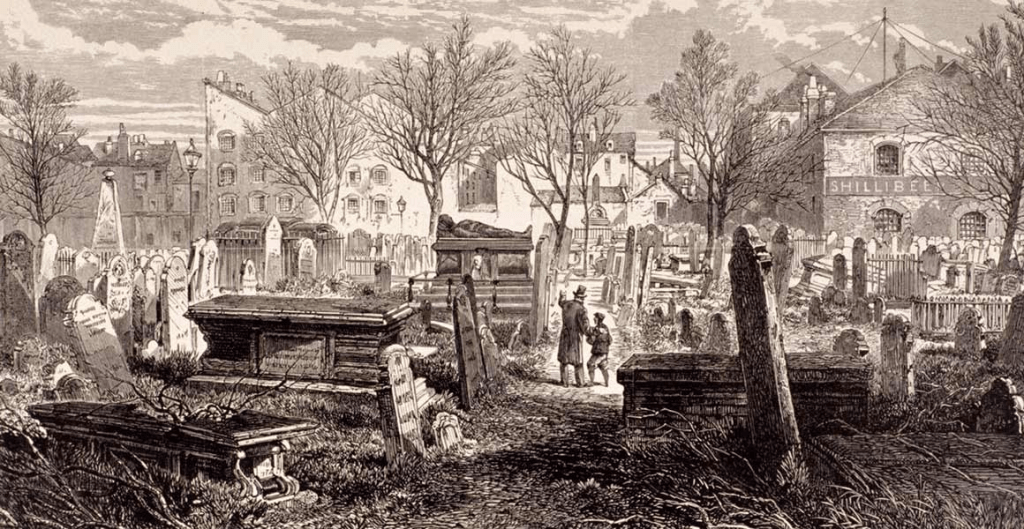
Notions of class and social ethics were reflected in the ritual and material culture of nineteenth-century burial grounds and burials. A person’s class was identifiable through the aesthetic presentation of their grave and their burial, since how a person’s death was commemorated solidified their social class, even after death[2]. Burials and burial grounds sought aesthetic appreciation from flowers, mural tablets, and the decoration of graves. This meant that death became commercialised, and created a diverse economy divided by social hierarchy.
The commercialisation of burial and burial grounds led to the development of new skills and professions. The financial consumption of death was portrayed through the role of an undertaker, and customs associated with burials and burial grounds became fixed in nineteenth-century society. These new institutions led to competition for roles involved in the new, everchanging industry surrounding burial and burial grounds. This led to the cost of burials skyrocketing and thus creating a clear distinction between the lower and upper classes became apparent. The cost for these burials and plots within burial grounds was evidence of social hierarchy.[3] The real estate of certain graves in specific plots was proof of social mobility; this actively demonstrated the rich-poor divide and how certain burial grounds very obviously catered towards just the upper classes or just the lower classes.
‘The early nineteenth-century burial grounds were a source of social concern, a matter of medical alarm and a political outrage which demanded municipal, private and, ultimately, national intervention’[4].
Reference list:
Laqueur, T., ‘Bodies, Death, and Pauper Funerals’, Representations 1 (1983), pp. 109-131.
Walvin, J. ‘Dust to Dust: Celebrations of Death in Victorian England’ Historical Reflections 9.3 (1982), pp. 353-371.
unknown, Cemetery at Bunhill Fields. 1866. Photograph. Finsbury, London. Natural History Museum. Website. Date accessed: 19/01/2023. https://www.nhm.ac.uk/discover/a-history-of-burial-in-london.html accessed: 19/01/2023
[1] Walvin, J. ‘Dust to Dust: Celebrations of Death in Victorian England’ Historical Reflections 9.3 (1982), pp. 353-371.
[2] Laqueur, T., ‘Bodies, Death, and Pauper Funerals’, Representations 1 (1983), pp. 109-131.
[3] Laqueur, T., ‘Bodies, Death, and Pauper Funerals’, Representations 1 (1983), pp. 109-131.
[4] Hargrave, A. E. (1847), Walker, G.A. (1839) and Holmes, B. (1896) cited in Walvin, J. ‘Dust to Dust: Celebrations of Death in Victorian England’ Historical Reflections 9.3 (1982), pp. 353-371.
 Derby's Dark Corners