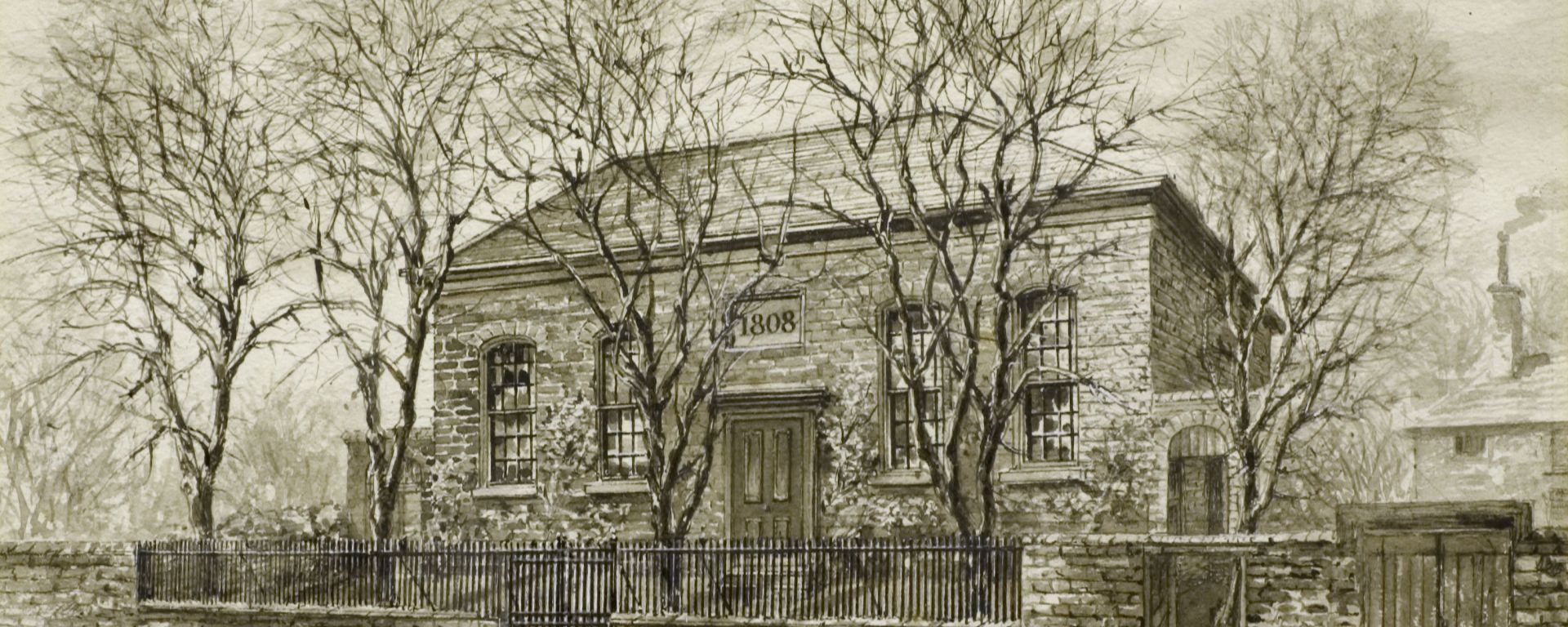
by Samuel Starsmore
In 1849, the British architect and civil engineer Edward Cresy (1792-1858) wrote a report entitled ‘Report to the General Board of Health on a preliminary enquiry into the sewerage, drainage and supply of water, and the sanitary conditions of the inhabitants of the Borough of Derby (1849). The purpose of this report (apart from testing the boundaries of how long a Victorian title could be) is relatively self-explanatory – to provide the British Government with an understanding of the current situation in Derby, relating to those topics in the title. The picture he paints is a bleak one indeed. As Cresy writes, Derby is incredibly impoverished and filthy, with many streets a scene of dilapidation, disease and decay. St. Helen’s Street – the subject of our focus – is one of those mentioned:
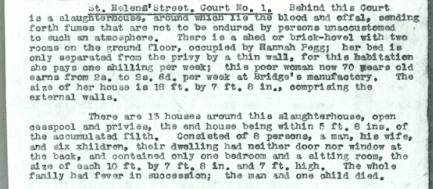
Cresy, E., Report to the General Board of Health on a preliminary inquiry into the sewerage, drainage and supply of water, and the sanitary conditions of the inhabitants of the Borough of Derby (1849) p.15
The existence of animals within the slum cannot be disputed. There are a great many documents which prove the presence of cows, chickens, sheep and goats living alongside their owners, usually contributing towards the filth. Pigs are especially interesting, as they are only reared by humans for one thing – their meat – which naturally requires specialised facilities and tradesmen, such as slaughterhouses and butchers. Still, cows made up the large majority of the meat eaten in Victorian England.1 Despite the destitution that many people lived in, these services were still required.2 However, for the slaughterhouse on St. Helen’s street, apart from Cresy’s report, there is nothing that officially documents its existence.
Within the 1848 and 1852 directories of Derby there is no mention of any butchers living and working from St. Helen’s Street.3 Additionally, looking at the census data for both 1841 and 1851 reveals that there were also no individuals living on St. Helen’s Street who were listed as having the occupation of ‘butcher’, or anything else that would suggest working in or owning a slaughterhouse.
It might seem that the lack of information about this slaughterhouse means that it is perhaps impossible to know much about it, but there are a few ways in which we can learn more. One example is the description of offal being thrown into the street, as this is one that was not unique to St. Helens street in Derby. This allows us to conjure an image of what slaughterhouses were like during this period, as other reports from different places also illustrate similar scenes of ‘blood in the streets’.4
The slaughterhouse during this time was entirely a private establishment, whereas abattoirs were larger and open to inspection at any time.5 This often resulted in slaughterhouses gaining shady and unscrupulous reputations.6 Tainted meat was often sold by particularly unscrupulous butchers, resulting in the spreading of sickness, and standards of hygiene were as low as one can imagine, consequently ensuring the meat spoiled and/or became infected, and blood running into the streets which was a clear health hazard.7 One can only imagine the smell, insects and diseases that would accompany this matter, especially on a hot day, and with the description that Cresy gives, there is no reason to think that St. Helen’s Street was not like this.
It is easy to demonise the butchers (as individuals from the time did) for their poor sanitation and willingly preparing and selling tainted meat. However, it might be more useful to view this as an issue that arose out of necessity, rather than malice. In the same way that people did not wish to live in their own waste but were forced to by their financial situation and lack of infrastructure in the rapidly built and overpopulated slums, butchers would have very little way of disposing of the refuse from their profession. Additionally, running a slaughterhouse in such impoverished and desperate areas, one could forgive the butchers for selling whatever they could get their hands on cheaply in order to make money. This is especially true during times where food availability was limited, and the people buying the meat just simply needed it to survive. Through this, not only can a greater understanding about why conditions like those seen at St. Helen’s Street arose, but also allows us to give agency back to these individuals as we attempt to understand their actions that are so easily vilified.
However, the phenomena of ‘blood on the streets’ would not last the entirety of British Slumdom. By the second half of the nineteenth century, most larger cities in the country were implementing ‘nuisance’ investigators, and sanitary nuisances fell into their jurisdiction. 1875 saw the passing of the Public Health Act which defined these nuisances and helped to proliferate the formal standard that slowly saw the occurrence of such problems become less and less common.8 This period also saw the emergence of the R.S.P.C.A. and it was in this time that it developed its. The R.S.P.C.A. was one of the main groups that lobbied for the better treatment of animals that were to be killed for their meat, and in order to do this they pushed for the development of French-style abattoirs where the killing and butchery of meat could be done in a clean, safe and purpose-built locations so as to reduce the misery of the animals. Despite pushback from slaughterhouse operators, legislation was put forward that meant abattoirs would soon become far more common in no small part due to the R.S.P.C.A. ‘s efforts.9
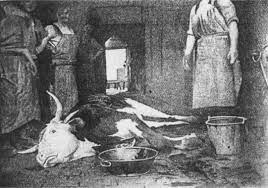
1907)
To conclude, despite the lack of information regarding the slaughterhouse on St. Helen’s street, Cresy’s description’s similarities to others allows us to infer a number of details about it, even though Cresy’s report exists only to describe the slaughterhouse at one particular time on one particular day. Particularly, it is interesting as even though it would have been necessary for feeding the population of that area, there was a contradictory duality with it being a nuisance and health hazard to those who consumed the products it produced and lived in the immediate area. Additionally, what happened to this establishment later in the time period can be inferred from the fate of other similar slaughterhouses – as legislation, nuisance inspectors and philanthropic groups such as the R.S.P.C.A. lobbied for changes to be made that ensured that the phenomenon of ‘blood on the streets’ – at least that vitae which had non-human origins – became a less common occurrence. Perhaps the most poignant conclusion to draw though, is that like most other unfortunate elements that existed in day-to-day life in British slumdom, the awful living conditions were the product of necessity.
References
- Otter. C., ‘The Vital City: public analysis, dairies and slaughterhouses in nineteenth-century Britain’, Cultural Geographies 13:4 (2006) p.526 ↩︎
- Crook, T., ‘Sanitary Inspection and the Public Sphere in Late Victorian and Edwardian Britain: A Case Study in Liberal Governance’, Social History 32:4 (2007). Throughout this article there are repeated references to animals, pig styes, slaughterhouses and butchers.
Dyos, H., ‘The Slums of Victorian London’ in Cannadine, D., & Reeder, D. A., Exploring the urban past: essays in urban history (Cambridge: Cambridge University Press, 1982) p.141, 145
↩︎ - Bagshaw, S., History, Gazetteer and Directory of Derbyshire (1846, printed by William Saxton, sold by Bagshaw himself in Sheffield) p.134-135
Freebody,1852 Derby Directory (London: Richardson and Son, 1852) p.172
↩︎ - Otter, C., The Victorian Eye: A Political History of Light and Vision in Britain, 1800-1910 (Chicago: University of Chicago Press, 2008) p.105
Otter, ‘The Vital City’, p.527
MacLachlan, I., ‘A bloody offal nuisance: the persistence of private slaughter-houses in nineteenth-century London’, Urban History 34:2 (2007) p.237
↩︎ - MacLachlan, ‘A bloody offal nuisance’, p.227-228 ↩︎
- Harrison, B., ‘Animals and the State in Nineteenth-Century England’, English Historical Review 88:349 (1973) p.812-813. This entire article is very enlightening to the role of the R.S.P.C.A. during this time, and the great efforts they made to bring about new legislation.
Otter, ‘The Vital City’, p.527
↩︎ - MacLachlan, ‘A bloody offal nuisance’, p.238, 245
Otter, The Vital City’, p.527
↩︎ - Otter, The Victorian Eye, p.101
↩︎ - Harrison, ‘Animals and the State in Nineteenth-Century England’, p.812-813 ↩︎
Illustrations and Photographs
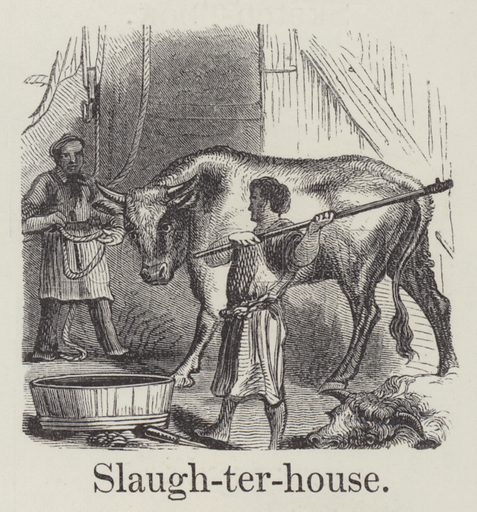
Illustration one: Slaughterhouse. An illustration for ‘An Illustrated Vocabulary For The Use Of The Deaf And Dumb’, (SPCK, 1857)
Illustration Two: C. Cash, Our Slaughter-House System: A Plea for Reform (London,
1907)
 Derby's Dark Corners