Joshua Waring
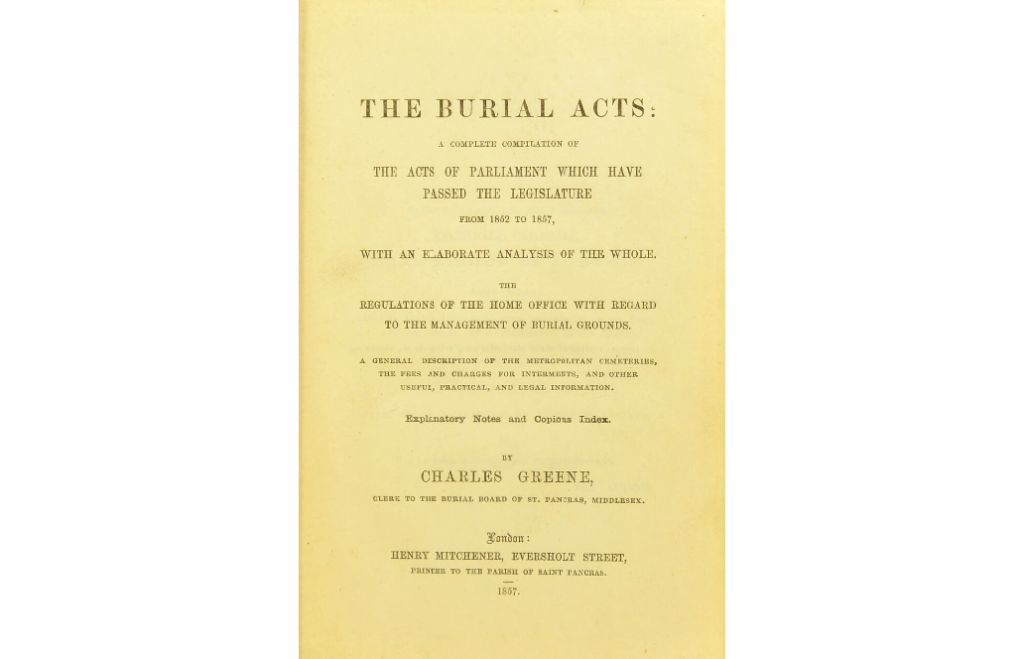
Throughout the twentieth century, sociologists and historians have sought to examine the Victorian state and its efficacy in governance. The nineteenth century was a period of laissez-faire politico-economic policy, in which the government sought to have minimal interaction in the affairs of the state. Many sociologists and historians argue that instead of direct intervention, the British government in the nineteenth century sought to exercise power in more subtle, less interventionist ways, which would condition society into conforming to a particular conduct of obedience.[1] This section of Burial and Burial Grounds will, therefore, utilise Charles Greene’s 1857 book on the Burial Acts to explore how the standardisation of burial practices, which sought to promote religious morality whilst mitigating the spread of disease, was a mechanism of state power. The marriage of sanitary concerns alongside moral unease fostered a particular mode of conduct and expressed state power. A power that surveyed, disciplined and governed nineteenth-century society.
Governing Conduct
For much of the twentieth century, historians, philosophers, and sociologists alike have sought to understand and critique the liberal form of governance that perpetuated the nineteenth century. The laissez-faire policies of the Victorian Era attempted to organise and direct social conduct, whilst investing minimal capital into regulation and intervention. Historians like F.M.L. Thompson and sociologists like Nikolas Rose and Michel Foucault have postulated that governance occurred through more subtle, incoherent, and anatomical means. This apparatus of power was designed to condition a model behaviour so that the centralised government could remain distant.[2] Although it deals primarily with the dead, burial practices were significant means of establishing middle-class notions of respectability and moral order, without jeopardizing the liberal doctrine.[3] Charles Greene’s 1857 publication The Burial Acts from 1852-1857 documents the previous five years of burial reform and its subsequent amendments. This is an enlightening read for anyone seeking to understand how burial contributed to a form of liberal governance. Greene’s book, addressing the many amendments of the Act to Make Better Provisions for the Interment of the Dead, indicates what Foucault calls Governmentality.[4] That is a particular rationality behind governing populations by intervening as little as possible, often by cultivating behavioural patterns. Foucault and Osbourne argue that central to nineteenth-century governmentality, or governmental rationality, was the politicisation of the ‘vital sphere’. That is to say, the biological sphere of human life.[5] The Burial Acts makes this connection very clear from the start. Greene addresses how concerns over Cholera, Typhus, and noxious miasmas made England’s cemeteries unconducive to ‘public decency’.[6] The concerns raised in Greene’s book present a means by which the government sought to organise and govern a population undergoing major demographic changes. Government, essentially, was expressed by moulding the population into a certain code of conduct. We can identify these morals and the impact thereof around Derbyshire and Nottinghamshire. Paul Elliot points out that the East Midlands underwent rapid population growth in the 1830s.[7] Informed by the works of vital statisticians like Reginald Martin, overcrowding by transient populations quickly stimulated worries about immoral lawlessness which was conducive to teaming infection.[8] In an entry in the Derby Mercury from 1854, we can see how the middle-class landowners perceived the wandering paupers. The Duke of Devonshire attempted to distance himself from the poor by contributing to the establishment of the Nottingham Road Cemetery, including its extensive drainage to make it more sanitary.[9] The ‘good Duke’ shows us, therefore, that middle-class philanthropy was perhaps not so straightforward. Instead, it reflected a liberal mode of governing the poor by cultivating a ‘biopolitical’ mentality in which sickness was conducive to violence and disobedience, something that the population was encouraged to expunge.[10]
Hence, by standardising practices of burial at a localised level, the state could observe and monitor a potentially diseased, and ethically dangerous, population. Philanthropy further reinforced the liberal art of governmentality around conduct, for it promoted, according to the ideals of sanitation as conducive to social order, a beautification of burial sites. Lord Brabazon, the utopian founder of the Metropolitan Public Garden Association, sought to produce, what Tim Brown calls, Ethicohygienic spaces.[11] Built on cemeteries, these were ‘medico-moral environments’ in which it was believed that fresh air and sanitation would physiologically improve moral conduct.[12] These moral and medical crusades found their way into government reports and local legislation. Reports, such as Chadwick’s Sanitary Conditions of the Labouring Population, as well as localised legislative action like the drainage of Derby Cemetery, all culminated to establish a standard.[13] However, where there is a normal, there is also a pathological.
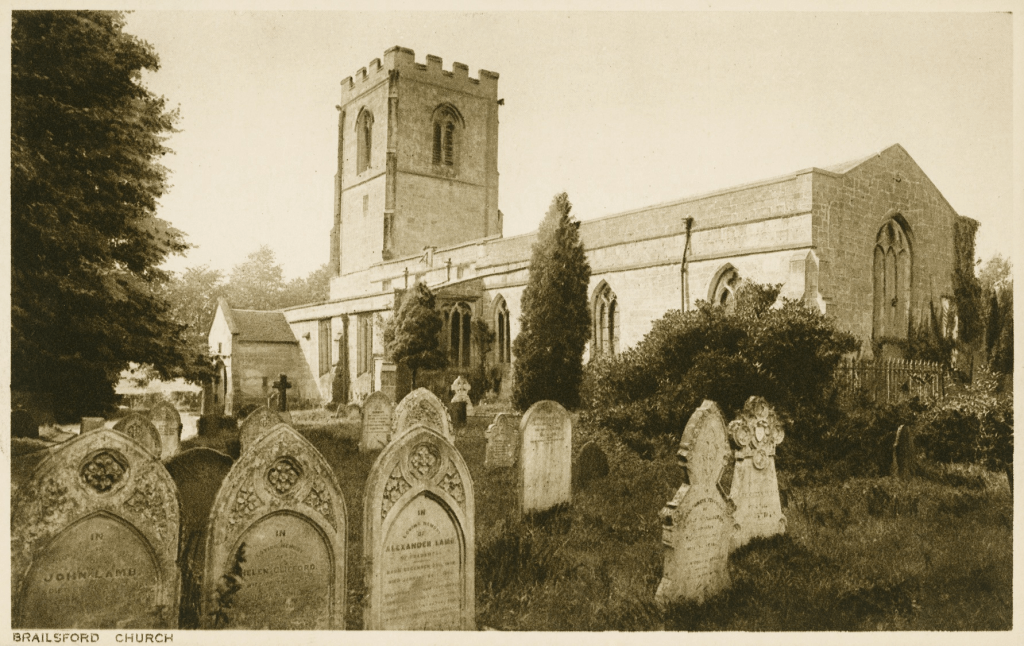
Becky, ‘Derbyshire Burials’, Derbyshire Record Office, (2020), accessed on 10/01/2023, Available Online: https://recordoffice.wordpress.com/2020/05/04/derbyshire-burials/
‘No One Will Grant Us Deliverance’: Burying the Pauper
Whereas private burials in clean cemeteries demarked an individual’s personhood through memorialisation and symbolised their respectability, those who could not afford such luxury were condemned.[14] Paupers symbolised the pathological elements of society, the faceless masses of the diseased and discontent. As above, so below, for pauper burials were regarded as both unhygienic and immoral.[15] Julie Strange points out that the lack of religious observances during pauper burials gave them an air of godlessness. Meanwhile, their shallow, unmarked, and overcrowded graves festered with fears of noxious miasmas and Typhus.[16] To ‘be buried like a dog’ in communal, unmarked graves was regarded as the price to pay for disrupting the medico-moral conduct of Victorian sensibility and standardised burial.[17] This reveals how burials became sites of informing the conduct of liberal government. According to Strange, this forced paupers into positions where they would have to contribute to the economic system to retain some semblance of humanity in death.[18] The condemnation of pauper burial became so extreme that the poor would seek to avoid it at all costs, and by raising money to engage in the standardised funereal practice, the state could keep its eyes on them. As Greene’s Burial Acts suggests, by participating in standardised burial, it informs the local governments as to the identity of the dead.[19] By having an ethical and sanitary burial according to the Burial acts of the 1850s, the government was able to monitor and survey the dead, mitigating the faceless masses of the disobedient poor.
Hence, burial sites and the process of interment were a strategic technology of state government which sought to establish an epistemic mode of conduct and order. Through achieving this, it was able to condition behaviour around death with minimal centralised action. This system coerced by means of social alienation the poorest in society to adhere to the moral order of the bourgeoisie. If they could not, they were condemned to exclusion in death.
[1] Foucault, Michel, Security, Territory, Population: Lectures at the Collège de France 1977-1978, Eds. Michel Senellart, (New York: Palgrave Macmillan, 2004) p. 37
[2] Rose, Nikolas, ‘The Human Sciences in a Biological Age’, Institute for Culture and Society Occasional Paper, 3.01, (2012) p. 5; Thompson, F. M. L. ‘Social Control in Victorian Britain.”’ The Economic History Review, 34.02, (1981) p. 195
[3] Foucault, Security, Territory, Population, p. 37
[4] Greene, Charles, The Burial Acts from 1852-1857, (London: Henry Mitchener, 1857) p. 13; Lemke, Thomas, Foucault’s Analysis of Modern Governmentality, (London: Verso, 2019) p. 177
[5] Osbourne, Thomas, ‘Security and Vitality: Drains, Liberalism and Power in the Nineteenth Century’, in Barry, Andrew; Osbourne, Thomas; Rose, Nikolas, (eds.) Foucault and Political Reason, (London: UCL Press, 1996) p. 100
[6] Greene, Burial Acts, p. 13
[7] Elliott, Paul. ‘Death, Landscape and Memorialisation in Victorian Urban Society: Nottingham’s General Cemetery, 1837 and Church Cemetery, 1856.’ (2021)
[8] Elliot, ‘Death Landscape and Memorialisation’, p.
[9] Anon, ‘Derby Burial Board’, Derby Mercury, (1854) p. 1
[10] Lemke, Thomas, Foucault’s Analysis of Modern Governmentality, (London: Verso, 2019) p. 136
[11] Brown, Tim. “’The Making of Urban ‘Healtheries”: The Transformation of Cemeteries and Burial Grounds in Late-Victorian East London.’ Journal of historical geography 42.100 (2013) p. 15
[12] Brown, ‘Making of Urban Healtheries’, p. 15
[13] Brown, ‘Making of Urban Healtheries’, p. 15; Anon, ‘Derby Burial Board’, Derby Mercury, (1854) p. 1
[14] Strange, Julie-Marie, ‘‘Only a Pauper Whom Nobody Owns’’: Reassessing the Pauper Grave, 1880-1914’, Past and Present (2003), p. 149
[15] Hurren, Elizabeth, and Steve King. “‘Begging for a Burial’: Form, Function and Conflict in Nineteenth-Century Pauper Burial.” Social history, 30.3 (2005) p. 322
[16] Strange, ‘Only a Pauper Whom Nobody Owns’, p. 163
[17] Sayer, Duncan. ‘Death and the Dissenter: Group Identity and Stylistic Simplicity as Witnessed in Nineteenth-Century Nonconformist Gravestones.’ Historical Archaeology, 45.04, (2011) p. 115
[18] Strange, ‘Only a Pauper Whom Nobody Owns’, p. 151
[19] Greene, Burial Acts, p. 66; Eyler, John M., ‘Mortality Statistics and Victorian Health Policy: Program and Criticism.” Bulletin of the History of Medicine, 50.03, (1976), p. 339
 Derby's Dark Corners