Much like we see today there was a variety of housing options available during the Victorian era into the early 20th century. The common lodging house was an affordable option for those who were migrating for their jobs or who may have just required a place to live. The common lodging houses fell into two categories primarily the legal and legitimate the ones with licences and those who operated unlicensed, which given that in many cases criminals stayed there it was unlikely to have cause upset to the lodgers[1].
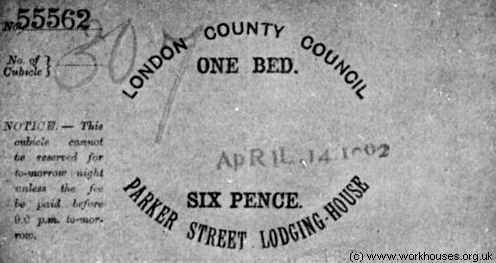
When looking into the cost of common lodging housing it is important to recognise that in different areas and for those who run their houses illegally records may differ or simply not exist. We are able to get a rough estimation of how much lodging houses may have cost from existing records as well as lodging housing tickets like the one shown in the photograph. One other problem that may be encountered when trying to get a good idea of pricing of lodging houses is it that may have been a difference in pricing based on season. As already mentioned common lodging houses acted as a home for the transient and as such this meant that at different times of the year there may have been a difference in requirement for rooms or more beds in lodging houses.[2]
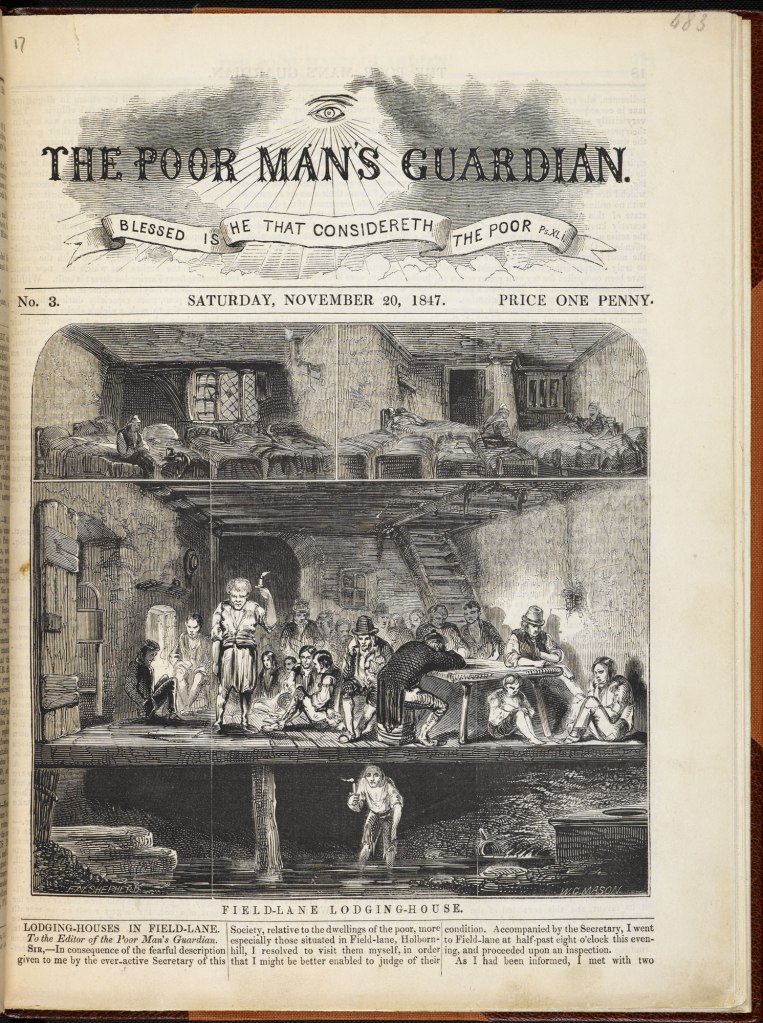
On the 20th of November 1847 The Poor Man’s Guardian published a somewhat scathing piece regarding the common lodging houses found in London. Whilst this article is focused on a lodging house located not in Derbyshire but in London it does offer insights into the issues surrounding payment for lodging. Cochrane describes a very bleak experience upon visiting one of the many lodging houses that were found in London. We learn in his article that one man was paying “4 pence”[3] a night which was typically reflective of the sort of prices that we see throughout those records which could be obtained. The real shock that came was in the form of an example of what can easily be assumed to be an illegitimate lodging house, where one man was renting the building for “11 shillings a week, but sub-letting its five makeshift bedrooms for 30 shillings a week.”[4] These prices can be seen as blatant exploitation when compared to the typical 4 pence that was typically seen with regards to the price per night as showcased in the picture of a signpost which noted the per nightly price.
In Kings Newton, a district located in, South Derbyshire The Old Alehouse [5]was believed to be a doss house, a term used interchangeably with the common lodging house citation. As Kings Newton was an agricultural town this may offer insight as to why there was a common lodging house, however outside of speculation within conservation records there is very limited information available as to whether or not this even was the case. When taking into consideration that those who sought out common lodging houses were often people who would have been down on their luck or simply just a sort to travel around and try their hand at new professions, it is not hard to say that one would have existed in a town such as this. As one can imagine though without being able to even fully obtain the information as to whether or not this even was a common lodging house, or a dosshouse as report states, it is clear this is merely speculation and as such no records of payment were available. While it may not always be possible in cases such as this to be able to learn exactly how much these establishments were charging in particular locations seeing that they may have existed in agricultural towns adds to the understanding of why places with such affordable rates existed for transient workers.
One of the primary issues that was presented with the common lodging house were the conditions. We only need to go back and look at the pictures from Cochrane’s article to see how cracked and somewhat deprived these houses were. Which posed an interesting question that is lodging houses exploiting individuals who sought out work but who were unable for whatever reason to settle or find a home of their own. In one Punch article from 1842 one of the tenants starts by referring to the places being “dirt cheap”[6]However she continues not much later where we learn that in fact it is actually not cheap at all as the woman in the article notes “you discover how exceedingly dear cheap lodging houses proved to be for you are charged five shillings a week for blacking and twelve and sixpence for coal”[7]. When considering hidden costs that existed within common lodging houses this opens up further questions, were the people that live there even able to progress onto anything else or were they simply trapped having to give over most of their money to the lodging house.
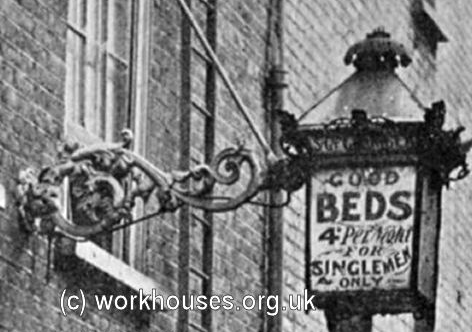
Signs like this one offered those seeking a bed the prices for a nightly stay.
As England grew through the industrial revolution migration into cities became more and more prevalent, the idea of travelling for work became more common and as such so did the issue of where to put these people. The common lodging houses were not an uncommon thing, but yet as a report on the importance of housing and lodging house inspection states “Good housing is more central to the building up of physically sound healthy bodies than drugs or medicines”[8]. This is indeed a valuable statement however the issue comes when you look at the conditions that some of these common lodging houses were in, as with the case of Cochrane’s article, or consider the girl who thought she was getting affordable housing but instead found herself paying for hidden extras. The question to pose at the end of all of this is, were common lodging houses truly good value if there may have been hidden extras or in some cases the person renting may have been being extorted; Is 4 pence a night always 4 pence a night? It is important to remember that the people who were in these lodging houses often had nowhere else to live, nowhere else to go and as such they had to pay the price whatever it was nightly or simply keep wandering.
[1] TOM CROOK, ‘Accommodating the Outcast: Common Lodging Houses and the Limits of Urban Governance in Victorian and Edwardian London’, Urban History, 35.3 (2008), 414–36.
[2] Barry Trinder, ‘BANBURY’S VICTORIAN LODGING HOUSES’, Cake and Cockhorse, 16.4 (2004), 138–57.
[3] Cochrane Charles, ‘“Field Lane Lodging-House”’, The Poor Man’s Guardian (London, 20 November 1847) <https://www.bl.uk/collection-items/field-lane-lodging-house-from-the-poor-mans-guardian-20-november-1847>.
[4] Cochrane Charles.
[5] Philip Heath, ‘CONSERVATION AREA HISTORIES: DISTRICT OF SOUTH DERBYSHIRE KING’S NEWTO’, 2005, p. 6 <https://www.google.com/url?sa=t&rct=j&q=&esrc=s&source=web&cd=&ved=2ahUKEwid3uGK-NX8AhVFhFwKHfbiC40QFnoECBEQAQ&url=https%3A%2F%2Fwww.southderbyshire.gov.uk%2Fassets%2Fattach%2F359%2FKingsNewtonA4complete_tcm21-85589.pdf&usg=AOvVaw3vWgWD01_JJXD_DkEJfdiv>.
[6] unknown, ‘Victorian London – Houses and Housing – Housing of the Middle Classes – Lodgings and Boarding-Houses’, 1842 <https://www.victorianlondon.org/houses/suburbanlodgings.htm> [accessed 10 January 2023].
[7] unknown.
[8] J. S. SCHOALES, ‘IMPORTANCE OF HOUSING AND LODGING-HOUSE INSPECTION’, The Public Health Journal, 7.11 (1916), 470–80 (p. 470).
 Derby's Dark Corners